Specialist Part (2): RADOS — The PG Log, Intervals, Missing Sets, and How Recovery and Backfill Work
TL;DR this chapter in a few lines
pg_info_tandpg_history_trecord a PG's last update and the epochs of its intervals.- Past intervals give the prior set: the OSDs that might hold writes and must be asked during peering.
- The primary picks the most authoritative log and merges it; missing sets list what each member must recover.
- Members whose log does not overlap get backfill instead of log-based recovery; log length (trimming) trades memory for faster recovery.
35-1 Before we begin#
Chapter 17 showed the peering state machine and how the authoritative info is chosen, and chapter 32 showed recovery reservation and scheduling. This chapter opens the middle layer: how a PG works out which OSDs it must ask (past intervals and the prior set), how the logs of two OSDs are merged, what it does with divergent entries, how the missing set is built, when and by how much the log is trimmed, and what recovery and backfill actually do object by object. Function names and defaults have been checked against the main branch of the ceph/ceph repository (November 2026).
35-1-1 What questions does this chapter answer?#
- What change in the OSDMap creates a new interval, and how is
maybe_went_rwdetermined? - Why does a PG sometimes become
down, and what doesblocked_byinceph pg query(thepeering_blocked_byfield) say? - What does
merge_logdo with a peer's log that is ahead or behind? - What is a divergent entry, and what are the five ways of handling it?
- How is the length of the pg log determined, and what prevents trimming?
- When is log-based recovery enough, and when is backfill needed?
- How does backfill compare and transfer objects?
35-1-2 Prerequisites#
Chapter 17 (peering), chapter 32 (scrub and recovery) and chapter 34 (the pg log on disk and versions).
35-2 The info and history of a PG#
Each member of a PG has a pg_info_t. The key fields:
| Field | Meaning |
|---|---|
last_update | the last version present in this member's log |
last_complete | up to this version all objects are complete on this member (there is no older missing object) |
log_tail | the oldest log entry |
last_backfill | objects greater than this (in hobject_t order) may not be on this member; MAX means no backfill is needed |
last_epoch_started | the last epoch in which the PG became active on this member |
purged_snaps | snaps whose purge has finished (chapter 36) |
history | a pg_history_t shared among the members |
pg_history_t keeps the PG's history at the epoch level: epoch_created, same_interval_since (since when up and acting have not changed), same_up_since, same_primary_since, last_epoch_started and last_interval_started (the last time the PG became active anywhere), last_epoch_clean and last_interval_clean, and the scrub times.
last_update and last_complete are two separate concepts. A replica may have the log up to 1462'93 (last_update) while object A, written at 1462'80, is not yet on its disk. In that case last_complete is 1462'79 and A is in that member's missing set.
35-3 Past intervals and the prior set#
35-3-1 When does a new interval start?#
An interval is a range of epochs during which the PG's mapping stayed constant. On every new map, PastIntervals::is_new_interval checks whether any of the following has changed: the primary or the acting set, the up primary or the up set, the pool's size or min_size, a split or merge (and their pending states), sort_bitwise, recovery_deletes, the CRUSH stretch parameters (crush_count, crush_target, crush_barrier, crush_member), EC optimizations being turned on, and in the main branch the PG entering or leaving a pool migration. So changing min_size alone also triggers peering.
Source in code: src/osd/osd_types.cc :: PastIntervals::is_new_interval, PastIntervals::check_new_interval
Complexity: O(n) for n acting members on each new map
pseudocode
check_new_interval(old, new, same_interval_since, last_epoch_clean):
    if not is_new_interval(old, new): return false
    i = interval(first = same_interval_since, last = new_epoch - 1,
                 acting = old_acting, up = old_up, primary = old_primary)
    if acting non-empty and primary != -1 and acting_set_writeable(old pool, old acting)
       and could_have_gone_active(acting shards):
        if up_thru[primary] >= i.first and up_from[primary] <= i.first:
            i.maybe_went_rw = true                    # the primary had reported up_thru to the mon
        elif i.first <= last_epoch_clean <= i.last:
            i.maybe_went_rw = true                    # the PG went clean in this range, so it had writes
        else: i.maybe_went_rw = false
    else: i.maybe_went_rw = false                     # acting smaller than min_size
    past_intervals.add_interval(i)
The role of up_thru is vital. Before going active, the primary asks the mon with MOSDAlive to raise its up_thru to at least the current epoch. If an interval did not last even long enough for up_thru to be recorded, the primary could not have gone active and no write happened in it. So the next peering does not need to wait for the members of that interval.
35-3-2 The prior set and the down state#
PastIntervals::PriorSet is the list of OSDs from which the primary must get info and logs. All current up and acting members, and all members of past intervals that are up now, go into probe. Then, for each interval with maybe_went_rw from last_epoch_started onward:
Source in code: src/osd/osd_types.h :: PastIntervals::PriorSet::PriorSet; src/osd/osd_types.cc :: PastIntervals::iterate_mayberw_back_to
Complexity: O(I × n) for I intervals and n members
pseudocode
for interval in past_intervals where maybe_went_rw, newest → last_epoch_started:
    up_now = {osd in interval.acting | osd is UP now or marked LOST}
    candidate_blocked_by = {osd in interval.acting | osd is DOWN now}
    if not recoverable(up_now) and candidate_blocked_by not empty:
        pg_down = true                               # some data may exist only on them
        blocked_by += candidate_blocked_by
# recoverable: replicated → at least one member ; EC → at least k distinct shards
Numerical example. PG 3.1f with size=3 and min_size=2 was on [12,4,27] in the interval [1400, 1449]. At epoch 1450 both OSD 4 and OSD 27 failed and acting dropped to [12]. Since one member is less than min_size, the interval [1450, 1460] had no writes (maybe_went_rw=false). Now at epoch 1461 osd.12 itself went down and 4 and 27 came back. The interval [1400, 1449] had writes and its up members are 4 and 27; for replicated, one member is enough, so the PG does not go down. But if only osd.12 had survived from that interval and it were now down, we would get pg_down=true and blocked_by: [12]. The way out is either to bring osd.12 back or to declare ceph osd lost 12, which means accepting the possible loss of data.
example (part of ceph pg 3.1f query):
"recovery_state": [ { "name": "Started/Primary/Peering/Down",
    "comment": "not enough up instances of this PG to go active" },
  { "name": "Started/Primary/Peering",
    "probing_osds": [ "4", "27" ],
    "blocked": "peering is blocked due to down osds",
    "down_osds_we_would_probe": [ 12 ],
    "peering_blocked_by": [ { "osd": 12, "current_lost_at": 0,
        "comment": "starting or marking this osd lost may let us proceed" } ] } ]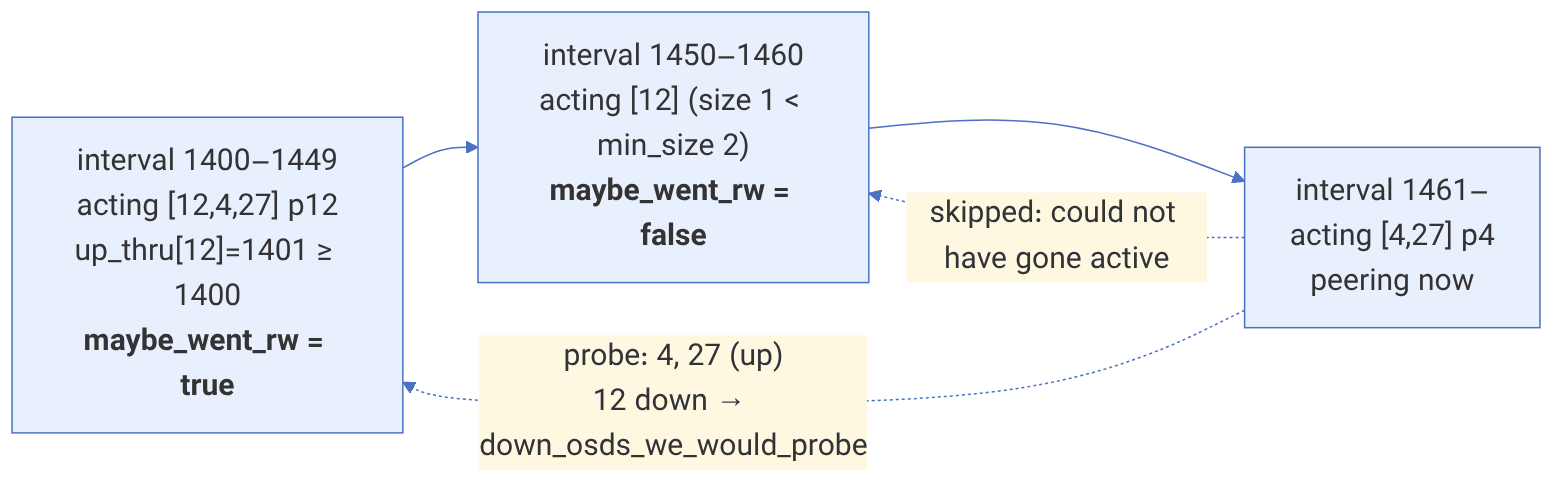
35-4 Merging logs#
After the primary has chosen, with find_best_info (chapter 17), the member with the most authoritative log, it gets that log and merges it into its own with PGLog::merge_log. For the replicas, proc_replica_log runs the same logic on a copy of their logs to compute each replica's missing set.
Source in code: src/osd/PGLog.cc :: PGLog::merge_log, PGLog::rewind_divergent_log
Complexity: O(E) for E new or divergent entries; a missing-set update per object
pseudocode
merge_log(olog from authoritative peer):
    assert overlap: log.head >= olog.tail and olog.head >= log.tail
    if olog.tail < log.tail:                      # extend the tail
        splice older entries of olog before log; log.tail = olog.tail
    if olog.head < log.head:                      # we were ahead: the extra entries are divergent
        rewind_divergent_log(olog.head)
    if olog.head > log.head:                      # extend the head
        lower_bound = newest olog entry <= log.head
        divergent = log.rewind_from_head(lower_bound)   # entries that olog does not have
        append olog entries after lower_bound; for each: missing.add_next_event(entry)
        _merge_divergent_entries(divergent)
        info.last_update = log.head = olog.head
        info.last_user_version = oinfo.last_user_version ; info.purged_snaps = oinfo.purged_snaps
Adding each new entry to the missing set is simple: if the object was not missing before, have becomes the entry's prior_version and need the entry's version. If it was, only need moves forward. For a DELETE entry, the FLAG_DELETE flag is set so that recovery deletes instead of copying.
35-4-1 Divergent entries#
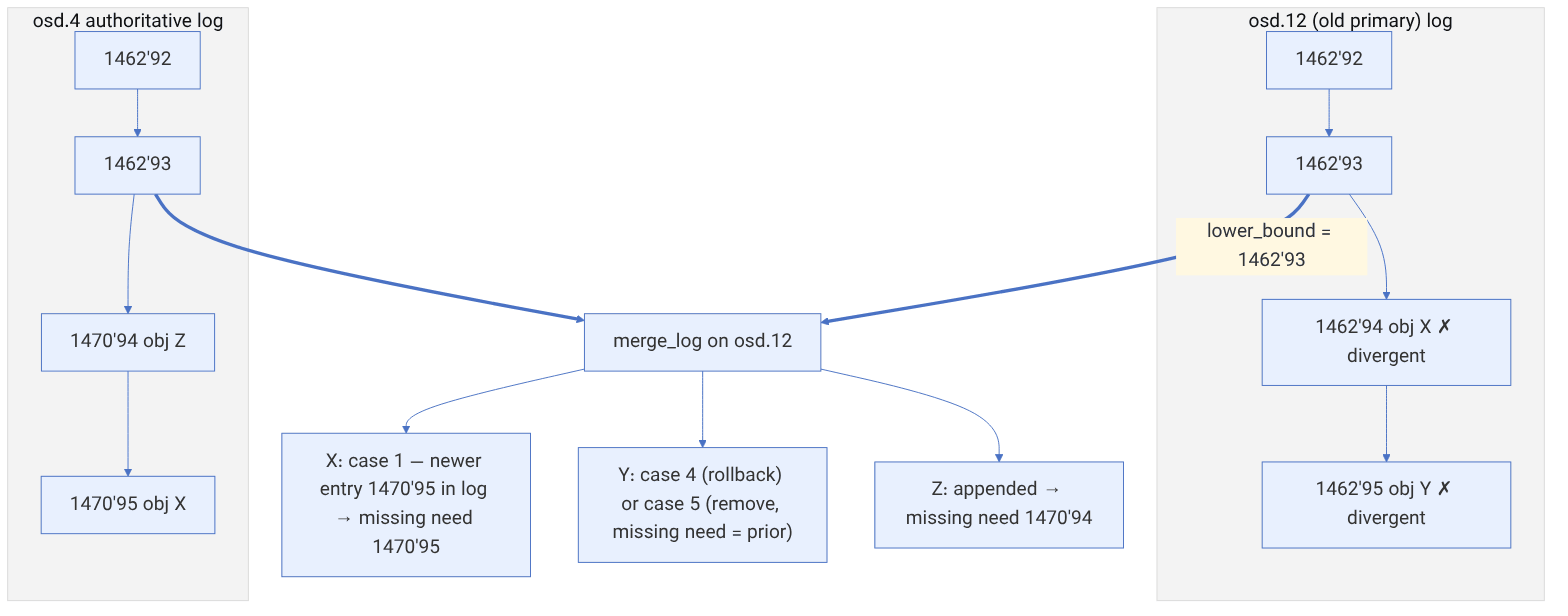
A divergent entry is one that is in a member's log but not in the authoritative log; for example, the previous primary recorded a write locally and failed before it reached the others. Since the client never received a reply for that write (the reply is sent only after all of acting has committed), it must be rolled back. _merge_object_divergent_entries groups the entries by object and applies one of five cases to each object:
Source in code: src/osd/PGLog.h :: PGLog::_merge_object_divergent_entries
Complexity: O(e) for e divergent entries of that object
pseudocode
for each object hoid with divergent entries (sorted by version):
    if hoid > info.last_backfill: ignore                 # not backfilled yet
    prior = prior_version of first divergent entry
    1) if log (authoritative) has a newer entry for hoid:
           nothing to do — merge_log already set missing to that newer version
    2) elif prior == eversion_t() or first entry is a clone:
           object should not exist: remove it from store, drop from missing
    3) elif hoid is already missing:
           if missing.have == prior: drop from missing ; else missing.need = prior
    4) elif every entry can_rollback() and version > olog.can_rollback_to:
           rollback each entry (EC: from the rollback stashes)   # the object does not become missing
    5) else:
           remove object from store ; missing.add(hoid, need=prior, have=none)
Case 4 happens mostly in EC, because the EC backend keeps rollback information for each write (for example the previous version of the xattrs or the previous length of the object). In replicated pools most writes have no rollback and case 5 applies: the object is removed and recovered from another member at version prior.
35-5 Log length and trimming#
The longer the log, the longer an OSD can be down and still come back with the log (without backfill), but more memory and omap space are used.
Source in code: src/osd/OSD.cc :: OSDService::get_target_pg_log_entries; src/osd/PeeringState.cc :: PeeringState::calc_trim_to
Complexity: O(t) for t entries being trimmed
pseudocode
target = clamp(osd_target_pg_log_entries_per_osd / num_pgs_on_osd,
               min = osd_min_pg_log_entries, max = osd_max_pg_log_entries)
limit = min(min_last_complete_ondisk, can_rollback_to)
if log.size > target:
    n = min(log.size - target, osd_pg_log_trim_max)
    if n < osd_pg_log_trim_min: return                 # trim in larger batches
trim_to = version of the n-th oldest entry, but never beyond limit| Option | Default in main |
|---|---|
osd_target_pg_log_entries_per_osd | 300000 |
osd_min_pg_log_entries | 250 |
osd_max_pg_log_entries | 10000 |
osd_pg_log_trim_min | 100 |
osd_pg_log_trim_max | 10000 |
osd_pg_log_dups_tracked | 3000 |
Numerical example. An OSD with 200 PGs: 300000/200 = 1500, which lies between 250 and 10000; so the target is 1500 entries per PG. With 1500 PGs on the same OSD (assumption: a large pool with a high pg_num) the target drops to 200 and is rounded up to the minimum of 250. The practical consequence: the more PGs an OSD has, the shorter each PG's log, and an OSD that was down for a few minutes falls back to backfill sooner.
What prevents trimming? min_last_complete_ondisk, that is, the lowest last_complete among all acting members. If a replica has an object missing, the log is not trimmed past that point, because that member's missing set depends on those entries. A PG that stays degraded for a long time has a longer log, and this shows up in the osd_pglog mempool.
35-6 Recovery and backfill in practice#
35-6-1 Is the log enough, or backfill?#
In PeeringState::activate a decision is made for each acting or backfill member. If pg_log.get_tail() > peer.last_update, meaning our log no longer has the entries after the peer's last version, or if peer.last_backfill is empty (a new member), that member is backfilled: its last_backfill is reset to the beginning (hobject_t()) and it is filled object by object from the start. Otherwise the entries after peer.last_update are sent to it and its missing set is built from those entries.
Peering and recovery stepper
Step through three stories of one PG with three replicas and watch the PeeringState machine, the up and acting sets and the PG logs.
6/8 · merge_log rewinds the divergent entry
merge_log sees that 40'4 is not in the authoritative history: rewind_divergent_log drops it and _merge_divergent_entries decides the object's fate. D did not exist before, so it is removed; E and B become missing on osd.0.
Follows: PGLog::merge_log, rewind_divergent_log, _merge_divergent_entries
- Reset
- Started
- Primary
- Peering
- GetInfo
- GetLog
- GetMissing
- WaitUpThru
- WaitActingChange
- Active
- Activating
- WaitLocalRecoveryReserved
- WaitRemoteRecoveryReserved
- Recovering
- WaitLocalBackfillReserved
- WaitRemoteBackfillReserved
- Backfilling
- Recovered
- Clean
- ReplicaActive
- Stray
- ToDelete
osd.0 primary
- 5'1 A
- 5'2 B
- 5'3 C
- 41'4 E to recover
- 41'5 B to recover
osd.1 replica
- 5'1 A
- 5'2 B
- 5'3 C
- 41'4 E
- 41'5 B
osd.2 replica
- 5'1 A
- 5'2 B
- 5'3 C
- 41'4 E
- 41'5 B
What happened so far
- e40 The primary logs a write
- e41 osd.0 is gone; osd.1 leads
- e41 New writes in the new interval
- e45 osd.0 returns as primary
- e45 The log of osd.1 wins
- e45 merge_log rewinds the divergent entry
Follows:
src/osd/PeeringState.h :: struct Started, Primary, Peering, GetInfo, GetLog, GetMissing, Active, …the state machine and its nestingsrc/osd/PeeringState.cc :: start_peering_interval, should_restart_peering, build_priorwhen peering restarts and which past OSDs to asksrc/osd/PeeringState.cc :: find_best_info, choose_acting, calc_replicated_actingthe authoritative log and the acting setsrc/osd/PeeringState.cc :: proc_master_log, proc_replica_log, activatemerging logs and activating the replicassrc/osd/PGLog.cc :: merge_log, rewind_divergent_log, _merge_divergent_entries, proc_replica_logmerging and rewinding divergent entriessrc/osd/PrimaryLogPG.cc :: start_recovery_ops, recover_primary, recover_replicas, recover_backfilllog-based recovery and backfill
35-6-2 The order of work in start_recovery_ops#
Source in code: src/osd/PrimaryLogPG.cc :: PrimaryLogPG::start_recovery_ops, recover_primary, recover_replicas, recover_backfill
Complexity: at most max operations per round (based on osd_recovery_max_active and mClock)
pseudocode
start_recovery_ops(max):
    if primary has no missing or all its missing are unfound:
        started = recover_replicas(max)                  # push to the replicas that have missing objects
    if started == 0:
        started += recover_primary(max)                  # pull for the primary's own missing objects
    if started == 0 and new unfound objects appeared:
        started = recover_replicas(max)
    if backfill targets exist and started < max and primary missing is empty
       and backfill reservation granted:
        started += recover_backfill(max - started)
    # main: then recover_pool_migration for pool migration
recover_primary picks, for each missing object, a source from missing_loc (a member that has that version) and pulls it. recover_replicas pushes the object from the primary to the replica. Each push carries at most osd_recovery_max_chunk (default 8 MiB) of data, and larger objects are transferred over several rounds. If no up member has the needed version, the object is unfound (chapter 17 and ceph pg <pgid> list_unfound).
35-6-3 Backfill: comparing two ordered scans#
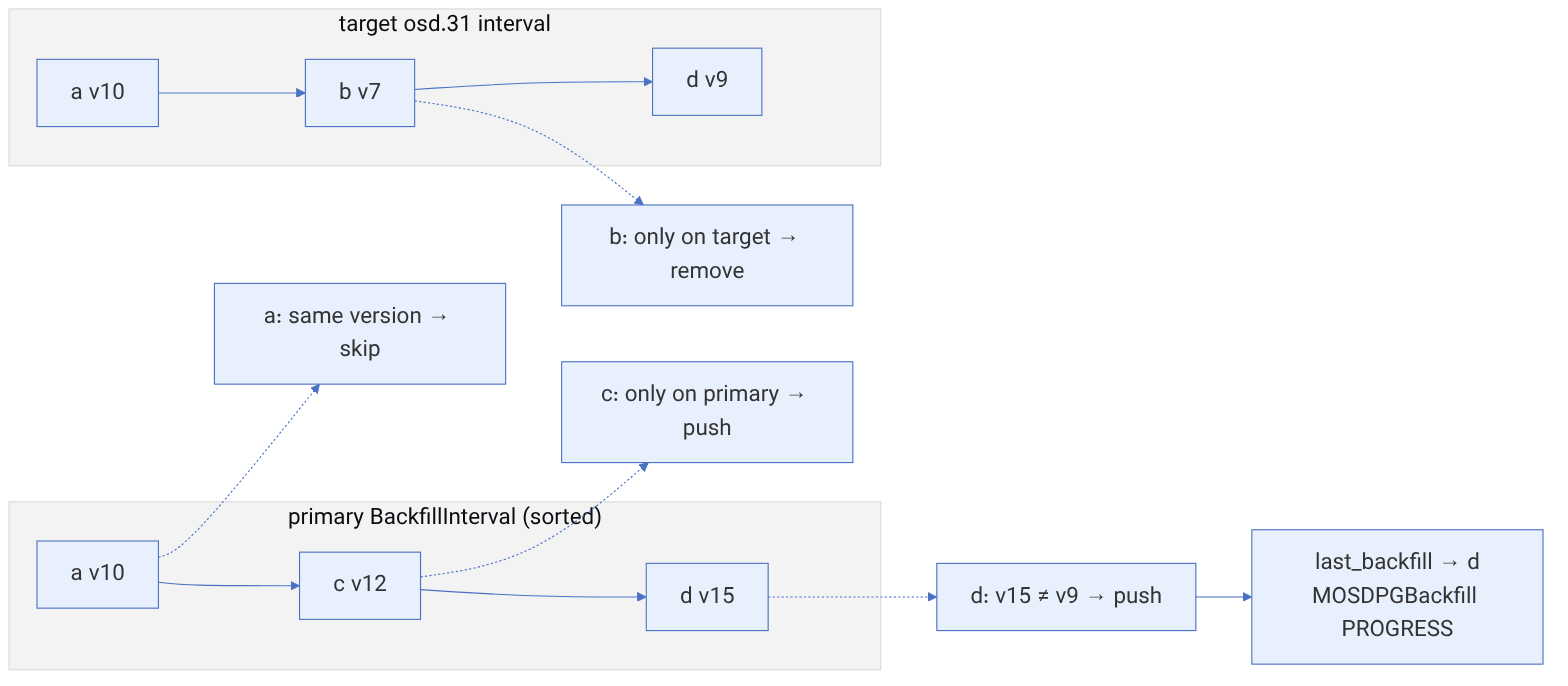
Backfill does not use the log. The primary and each backfill target scan the PG's contents in hobject_t order (chapter 34) in small intervals (BackfillInterval, with a minimum of osd_backfill_scan_min = 64 and a maximum of osd_backfill_scan_max = 512 objects per scan) and compare them like merging two sorted lists.
Source in code: src/osd/PrimaryLogPG.cc :: PrimaryLogPG::recover_backfill, scan_range_primary, scan_range_replica
Complexity: O(N) for N objects in the PG; each scan at most osd_backfill_scan_max objects
pseudocode
loop while ops < max:
    refill backfill_info (primary) and peer_backfill_info[t] when exhausted (MOSDPGScan)
    check = min(begin of all intervals)
    for each target t:
        if t's next object < check: t has extra object → send remove to t
    if primary has check:
        for targets whose version != primary version (and t.last_backfill < check):
            push check to them
    advance all intervals past check
    new_last_backfill = largest object fully handled on all targets
send MOSDPGBackfill PROGRESS(last_backfill) ; at end FINISH (last_backfill = MAX)
Client writes continue during backfill. If the object being written is before the target's last_backfill, it is replicated to that target as usual. If it is after it, it is only recorded in the log, and backfill itself later transfers the new version. An object that is being backfilled at that very moment is locked for writes, and the op waits in waiting_for_degraded_object (chapter 34).
35-7 Commands and troubleshooting#
| Command | Use |
|---|---|
ceph pg <pgid> query | the info of all members, past_intervals, probing_osds, peering_blocked_by and recovery_progress |
ceph pg ls recovering / backfilling / down / incomplete | listing PGs by state |
ceph pg <pgid> list_unfound | unfound objects and the OSDs that have been checked |
ceph pg <pgid> mark_unfound_lost revert or delete | the last resort for unfound objects; data is lost |
ceph osd lost <id> --yes-i-really-mean-it | declaring an OSD lost so peering does not wait for it |
ceph-objectstore-tool --op log --pgid <pgid> | a PG's log, dups and missing set on a stopped OSD |
ceph-objectstore-tool --op export / import | rescuing a PG from a faulty OSD |
ceph daemon osd.N dump_recovery_reservations | reservations (chapter 32) |
example (part of ceph pg 3.1f query during backfill):
"info": { "last_update": "1470'2210", "last_complete": "1470'2210",
          "log_tail": "1468'710", "last_backfill": "MAX" },
"peer_info": [ { "peer": "31", "last_update": "1470'2210",
                 "last_backfill": "3:fa21c9e8:::rbd_data.5f3a2b8c1d4e.0000000000000c1a:head" } ],
"recovery_state": [ { "name": "Started/Primary/Active",
    "recovery_progress": { "backfill_targets": [ "31" ],
        "waiting_on_backfill": [], "last_backfill_started": "3:fa21c9e8:::rbd_data...0c1a:head",
        "backfill_info": { "begin": "3:fa21c9e8:::rbd_data...0c1a:head", "end": "3:fa2a...", "objects": [ "..." ] } } } ]
The last_backfill of target 31 is an hobject_t with the bitwise key fa21c9e8. Since this PG's range at pg_num=32 runs from f8000000 to ffffffff, a simple division gives the approximate progress: (0xfa21c9e8 − 0xf8000000) / 0x08000000 ≈ 27%.
35-7-1 Symptoms and remedies#
- The PG stays in
peeringand haspeering_blocked_by: an OSD that was a member in an interval with writes is down. Bring it back first;ceph osd lostis the last option. - The PG is
incomplete: no live member has a complete log up tolast_epoch_started. Before usingosd_find_best_info_ignore_history_lesorexportandimportwith ceph-objectstore-tool, back up the OSDs. - An OSD fell back to backfill after a few minutes of downtime: the log was short. Check the number of PGs per OSD, or keep the downtime shorter during planned maintenance.
- A long log and high memory use: long-degraded PGs are preventing trimming. Finish the recovery.
35-8 Supplementary and up to date#
- In the main branch, support for EC partial writes (
written_shardsin pg_log_entry_t andpartial_writes_last_complete) has made the divergent and backfill logic more complex for EC; some entries were never applied on some shards and must not be considered missing. recover_pool_migrationandmigrating_pgshave been added in the main branch for migrating data between pools. Before using them, check whether they exist in your version.- Crimson shares the PeeringState logic directly, but implements backfill with a separate state machine (
crimson/osd/backfill_state.cc).
35-9 Hands-on exercise#
- 1. On a test pool, change
min_sizeand watchsame_interval_sincechange inceph pg <pgid> query. - 2. Set
nooutand stop one OSD, perform a few thousand writes and, with a smallosd_max_pg_log_entries, test whether the OSD comes back with the log or is backfilled after it returns. - 3. With
ceph-objectstore-tool --op logon a stopped OSD, find thepg_missingfields and matchneedandhaveagainst the log entries. - 4. During backfill, read the target's
last_backfilla few times and estimate the percentage of progress with the bitwise-key method.
35-10 Review questions#
- 1. What changes in the OSDMap create a new interval? Name three other than up and acting.
- 2. Under what conditions is
maybe_went_rwtrue? - 3. Why is up_thru necessary for the safety of peering?
- 4. When does a PG go down, and whom does
blocked_bypoint to? - 5. What does merge_log do when the authoritative log is ahead?
- 6. What is a divergent entry, and why is rolling it back safe?
- 7. How do cases 4 and 5 of divergent handling differ?
- 8. What is the target log length for an OSD with 600 PGs under the defaults?
- 9. What condition determines that a member is backfilled?
- 10. How does backfill determine that an object must be removed from the target?
Answers to these questions are in Appendix E: Answers to Review Questions. Answers to this chapter's questions →
35-11 Sources for this chapter#
- osd_types.cc and osd_types.h (PastIntervals, PriorSet, pg_info_t, pg_missing_item
https://github.com/ceph/ceph/blob/main/src/osd/osd_types.cc - PGLog.cc and PGLog.h (merge_log, divergent
https://github.com/ceph/ceph/blob/main/src/osd/PGLog.h - PeeringState.cc (activate, calc_trim_to
https://github.com/ceph/ceph/blob/main/src/osd/PeeringState.cc - PrimaryLogPG.cc (start_recovery_ops, recover_backfill
https://github.com/ceph/ceph/blob/main/src/osd/PrimaryLogPG.cc - Developer documentation on peering
https://docs.ceph.com/en/latest/dev/peering/ - Developer documentation on the log-based PG
https://docs.ceph.com/en/latest/dev/osd_internals/log_based_pg/ - PG troubleshooting
https://docs.ceph.com/en/latest/rados/troubleshooting/troubleshooting-pg/