Specialist Part (1): RADOS — Object Identity, Metadata and the Op Path Inside the OSD
TL;DR this chapter in a few lines
- The OSD identifies an object by
hobject_t: pool, hash, namespace, key, name and snap; its bitwise key sets the sort order. - An object has data, xattrs (inside the onode) and omap (separate RocksDB keys).
- An op is queued on an OSD shard and passes do_op's gates (map, peering, missing objects, blocks) before it runs.
execute_ctxturns ops into a transaction, assigns the version and writes the pg log entry, which lives in the pgmeta object's omap.
34-1 Before we start#
Chapter 8 showed how an object reaches an OSD through CRUSH, and chapter 22 followed the path of a write from librados to the ack at a glance. This chapter opens up that same path inside the OSD in detail: exactly what key a RADOS object is identified and sorted by, where its metadata (object_info_t and SnapSet) lives, which shard the op is queued in, which gates it passes through before it runs, how versions are numbered and what the pg log looks like on disk. All names have been checked against the main branch of the ceph/ceph repository (November 2026).
34-1-1 What questions does this chapter answer?#
- What fields identify a RADOS object, and why does its sort order reverse the bits of the hash?
- What fields do
object_info_tandSnapSethave, and in which xattr are they stored? - In which shard and thread does a client op run?
- What does
do_opcheck, in order, and in which wait queue does it put the op? - How is a duplicate request (for example after a reconnection) detected?
- How do
versionanduser_versiondiffer, and how are they incremented? - In which object, and with what keys, are the pg log and pg info stored?
34-1-2 Prerequisites#
Chapter 8 (CRUSH and PGs), chapter 14 (librados and MOSDOp), chapter 22 (code architecture) and chapter 24 (BlueStore keys). Familiarity with reading C++ helps but is not required.
34-2 The identity of a RADOS object#
34-2-1 From name to hobject_t#
The client knows an object by its name, but the OSD works with hobject_t (src/common/hobject.h). The main fields:
| Field | Meaning |
|---|---|
oid | the object name the client gave |
key | the locator key; if it is not empty, the hash is computed from this key instead of the name |
nspace | the namespace within the pool; objects with the same name in two namespaces are two separate objects |
pool | the pool id |
hash | the hash of the name (or key) with the pool's default hash function, that is rjenkins |
snap | the snapshot number; for the current version it is the special value CEPH_NOSNAP (head) |
max | the "largest possible object" flag, used as an end sentinel in traversals |
ghobject_t is a layer on top of it and adds shard_id (for EC) and generation. It is this ghobject_t that became the O key in RocksDB in chapter 24.
key (the locator) is rarely used but important: objects with the same key get the same hash and always stay in one PG. A program that wants several related objects always to be co-located (for example so that one class call can see both on the same OSD) can give them all the same key; the price is an uneven distribution of data.
34-2-2 Sort order: the reversed hash#
Object traversals (listing, scrub, backfill) all rely on hobject_t order. The function cmp(const hobject_t&, const hobject_t&) in hobject.cc compares in this order: max, then pool, then the bitwise key (get_bitwise_key, that is the hash with its bits reversed), then nspace, then the effective key, then oid and finally snap.
Source in code: src/common/hobject.cc :: cmp(const hobject_t&, const hobject_t&); src/common/hobject.h :: hobject_t::_reverse_bits, get_bitwise_key_u32
Complexity: O(1) for the numeric fields and O(L) for comparing strings
pseudocode
cmp(l, r):
    compare l.max, r.max
    compare l.pool, r.pool
    compare reverse_bits(l.hash), reverse_bits(r.hash)     # hash_reverse_bits is precomputed
    compare l.nspace, r.nspace
    if l.key or r.key: compare effective_key(l), effective_key(r)
    compare l.oid, r.oid
    compare l.snap, r.snap                                  # head (NOSNAP) is the largest snap
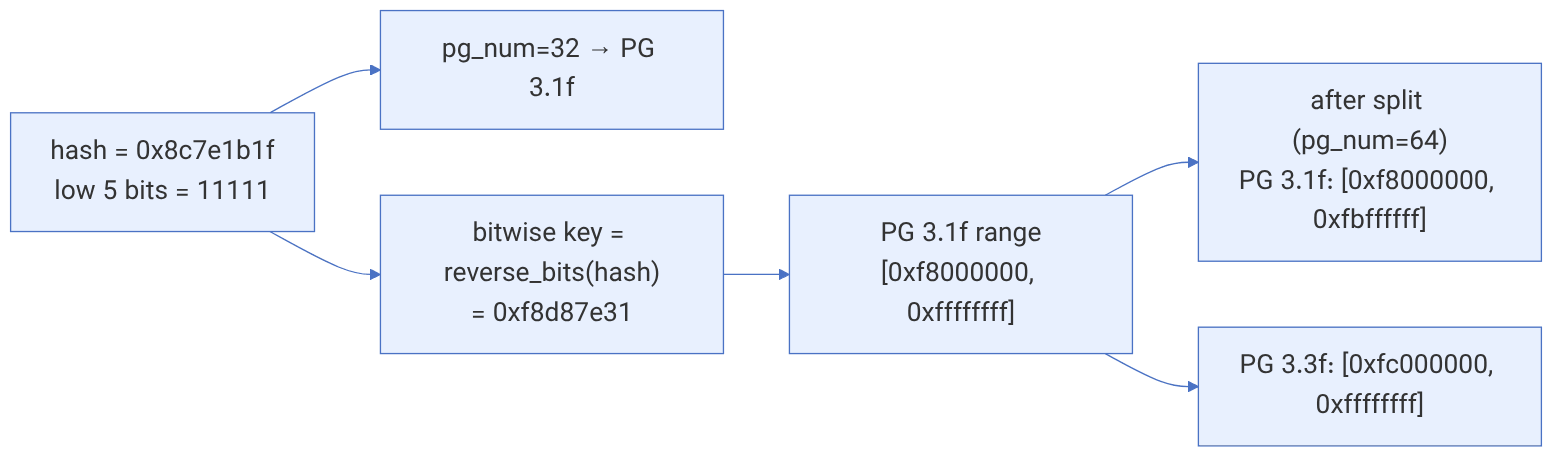
Why reversed? The PG number comes from the low bits of the hash (ceph_stable_mod). If the hash is reversed, those same low bits move to the top of the number, and all the objects of a PG fall in one contiguous range of the bitwise key. So each PG is a range, and traversing it is a range scan in RocksDB.
Numerical example. Consider an object with hash 0x8c7e1b1f in a pool with pg_num=32. The PG number is 0x8c7e1b1f & 31 = 0x1f. Its bitwise key is 0xf8d87e31. All the objects of PG 0x1f have the low five bits 11111, so their bitwise key starts with 11111 and lies in the range [0xf8000000, 0xffffffff]. If pg_num becomes 64, this PG splits into 0x1f and 0x3f. The sixth bit of the hash is the sixth bit from the top in the bitwise key, so the two new PGs are two contiguous halves of the same range: [0xf8000000, 0xfbffffff] and [0xfc000000, 0xffffffff]. That is why a split only moves the range boundary and does not need any keys to be rewritten.
34-3 Per-object metadata#
34-3-1 Three places to store: data, xattrs and omap#
Each RADOS object has three parts: data (contiguous bytes), xattrs (small key-value pairs) and omap (a sorted key-to-value map that can have millions of keys). In BlueStore the xattrs are stored inside the onode itself, and the omap in separate RocksDB keys with the prefixes M, m, p and P (chapter 24). The OSD keeps two special xattrs for itself:
| xattr | Constant in the code | Content |
|---|---|---|
_ | OI_ATTR | the encoded object_info_t |
snapset | SS_ATTR | the SnapSet, only on the head (chapter 36) |
_<name> | — | a user xattr; when storing, the OSD prepends _ to the name so that it does not clash with the internal xattrs |
34-3-2 object_info_t#
The important fields of object_info_t in src/osd/osd_types.h:
| Field | Meaning |
|---|---|
soid | the same hobject_t |
version, prior_version | the version of the last change and the one before it (of type eversion_t, that is epoch and number) |
user_version | the version the client sees (rados stat and ver in librados) |
last_reqid | the id of the last modifying request |
size, mtime, local_mtime | size, modification time as the client sees it, and the OSD's local time |
flags | flags, including whiteout, dirty, omap, data_digest, omap_digest, manifest |
data_digest, omap_digest | crc32c of the data and the omap, if valid (for scrub) |
watchers | the list of active watches (chapter 14) |
truncate_seq, truncate_size | for truncate ordering in CephFS |
manifest | for redirect or chunked (dedup) objects |
# example: reading an object's object_info_t and decoding it
rados -p rbd getxattr rbd_header.5f3a2b8c1d4e _ > /tmp/oi.bin
ceph-dencoder type object_info_t import /tmp/oi.bin decode dump_jsonexample (abbreviated output):
{
"oid": { "oid": "rbd_header.5f3a2b8c1d4e", "key": "", "snapid": -2,
"hash": 2356083487, "max": 0, "pool": 3, "namespace": "" },
"version": "1462'93",
"prior_version": "1462'92",
"last_reqid": "client.24183.0:118",
"user_version": 93,
"size": 0,
"flags": [ "dirty", "omap", "data_digest" ],
"data_digest": "0xffffffff",
"watchers": { "client.24183": { "cookie": 94823571521536 } }
}snapid: -2 is CEPH_NOSNAP, that is head. The version 1462'93 means epoch 1462 and number 93 in the pg log.
34-4 Op queueing: shard and thread#
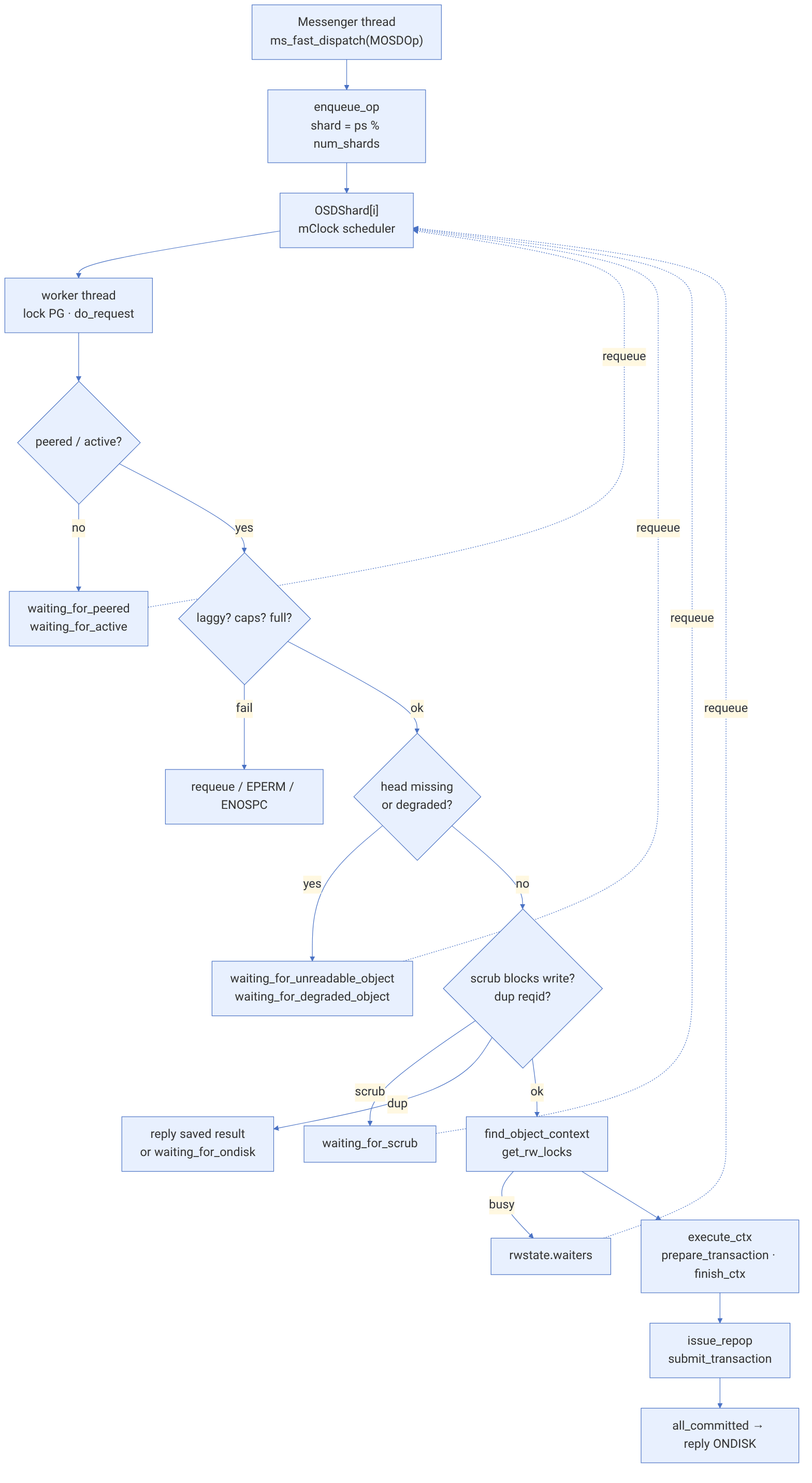
OSD::ms_fast_dispatch takes the MOSDOp message directly from the messenger thread, builds an OpRequest and with enqueue_op puts it into the sharded queue op_shardedwq. Each shard is an OSDShard with a lock, a scheduler (mClock by default, chapter 21) and several threads.
Source in code: src/osd/OSD.cc :: OSD::enqueue_op, OSD::ShardedOpWQ::_enqueue; src/osd/osd_types.h :: spg_t::hash_to_shard
Complexity: O(1); the real cost is in that shard's mClock scheduler
pseudocode
num_shards = osd_op_num_shards  or  (rotational ? osd_op_num_shards_hdd : osd_op_num_shards_ssd)
threads    = osd_op_num_threads_per_shard or (rotational ? _hdd : _ssd)
shard_index = pgid.ps() % num_shards                 # spg_t::hash_to_shard
shards[shard_index].scheduler.enqueue(OpSchedulerItem(pg, op, cost, priority, owner))
worker thread t of that shard: dequeue → lock PG → PG::do_request → PrimaryLogPG::do_op| Option | main default | Description |
|---|---|---|
osd_op_num_shards_ssd | 8 | number of shards on SSD/NVMe |
osd_op_num_threads_per_shard_ssd | 2 | threads per shard on SSD |
osd_op_num_shards_hdd | 1 | one shard on HDD |
osd_op_num_threads_per_shard_hdd | 5 | with five threads |
Numerical example. On an OSD with NVMe we have 8 shards and two threads in each shard, that is 16 op threads. PGs 3.0 to 3.1f with ps=0..31 go to shards 0 to 7 in turn, and each shard gets four PGs of this pool. Because each PG is always in one shard, the order of a PG's ops is preserved. But if one PG is very hot (for example a frequently used rbd_header object or an RGW index shard), it keeps only the two threads of that shard busy, and adding shards does not help.
34-5 The gates of do_op#
Before an op runs, PrimaryLogPG::do_op and do_op_impl pass it through several gates. If a condition does not hold, the op sits in one of the PG's wait queues and is requeued once the condition is cleared. op->mark_delayed("...") shows that text in dump_ops_in_flight.
Source in code: src/osd/PrimaryLogPG.cc :: PrimaryLogPG::do_request, do_op_impl
Complexity: O(1) per gate, except find_object_context, which may need to read the onode from disk
pseudocode (the order matters)
do_request: if not peered → waiting_for_peered ; if flushes pending → waiting_for_flush
            if not active (and the op needs it) → waiting_for_active
do_op_impl(op):
    check_laggy(op)                       # lease/readable_until; otherwise wait
    op_has_sufficient_caps(op)            # cephx caps; otherwise EPERM
    write_ordered = op.rwordered()
    if write_ordered and failsafe full → reply ENOSPC (or drop)
    if is_unreadable_object(head)       → wait_for_unreadable_object   # missing on the primary
    if write_ordered:
        if is_degraded_or_backfilling_object(head) → wait_for_degraded_object
        if scrub write_blocked(head)               → waiting_for_scrub
    if write_ordered and check_in_progress_op(reqid) → duplicate: the earlier reply or waiting_for_ondisk
    if maybe_await_blocked_head(oid)     → wait_for_blocked_object   # for example promote or flush
    find_object_context(oid)            → if the snap version is missing: wait_for_unreadable_object
    get_rw_locks(ctx)                    # RWState: read, write, excl
execute_ctx(ctx)| Text in dump_ops_in_flight | Queue | Practical meaning |
|---|---|---|
waiting for peered / waiting for active | waiting_for_peered / waiting_for_active | the PG has not finished peering yet (chapter 35) |
waiting for missing object | waiting_for_unreadable_object | the object is missing on the primary and must be recovered first |
waiting for degraded object | waiting_for_degraded_object | a write to an object that one of the replicas lacks; recovery first |
waiting for scrub | waiting_for_scrub | the chunk being scrubbed includes this object |
waiting for ondisk | waiting_for_ondisk | the request is a duplicate and the original has not committed yet |
waiting for rw locks | ObjectContext::rwstate.waiters | another op holds an incompatible lock on the same object |
When a client "hangs", take ceph daemon osd.N dump_ops_in_flight on the primary of that PG and read the flag_point field and the events. If most ops are waiting for degraded object, the problem is not I/O; recovery is slow or has stopped (chapter 32). If it is waiting for rw locks, usually a long op (for example a heavy class call) is sitting on the same object.
34-5-1 Object locks: RWState#
Each ObjectContext (the PG's in-memory cache of an object's metadata) has an RWState with the states none, read, write and excl and a counter. Several readers or several writers can hold the lock at once (writers because the pg log itself guarantees their order), but read and write are incompatible with each other and excl is incompatible with everything. Ops that both read and write depending on the result (such as a class call with CLASS_WRITE) take a write lock. A waiting op stays in waiters and is requeued when the lock is released.
34-5-2 Duplicate requests#
If the client does not receive the reply to a write (for example the connection drops or the primary changes), it resends the same op with the same reqid (consisting of entity, incarnation and tid). The OSD must not execute it twice, because operations such as append or incrementing a counter are not idempotent.
Source in code: src/osd/PrimaryLogPG.cc :: PrimaryLogPG::check_in_progress_op; src/osd/PGLog.h :: IndexedLog::get_request
Complexity: O(1) with hash tables on the reqids (caller_ops, extra_caller_ops and dup_index)
pseudocode
check_in_progress_op(reqid):
    if reqid in pg_log.caller_ops or extra_caller_ops:   # the current log entries
        found (version, user_version, return_code)
    elif reqid in pg_log.dup_index:                       # trimmed entries of which only a dup remains
        found (version, user_version, return_code)
    else: return not found
if found:
    if already_complete(version): reply with saved user_version and return_code
    else: waiting_for_ondisk[version] += op           # reply after the original version commits
dups are lightweight entries (pg_log_dup_t: reqid, version, user_version, return_code) kept after the main log entries are trimmed. Their number is limited by osd_pg_log_dups_tracked, and in chapter 33 we saw how these dups grow the pglog memory.
34-6 Executing the op and numbering versions#
execute_ctx builds an empty PGTransaction and calls prepare_transaction. This function first runs do_osd_ops, which turns each op inside the message (for example CEPH_OSD_OP_WRITE, SETXATTR, OMAPSETVALS or CALL) into operations on the transaction. Then come the pool-full check, make_writeable (for snapshots, chapter 36) and finally finish_ctx.
Source in code: src/osd/PrimaryLogPG.cc :: PrimaryLogPG::execute_ctx, prepare_transaction, finish_ctx
Complexity: O(1) per modified object; encoding object_info_t and SnapSet in proportion to their size
pseudocode
execute_ctx: ctx.at_version = get_next_version()   # (current epoch, info.last_update.version + 1)
finish_ctx(ctx, log_op_type):
    ctx.user_at_version = max(info.last_user_version, new_oi.user_version) + 1
    if ctx.at_version.version > ctx.user_at_version: ctx.user_at_version = at_version.version
    new_oi.version = at_version ; new_oi.prior_version = old_oi.version
    new_oi.user_version = user_at_version ; new_oi.last_reqid = reqid ; mtime ...
    attrs["_"] = encode(new_oi) ; if head: attrs["snapset"] = encode(new_snapset)
    op_t.setattrs(soid, attrs)
    log_entries.push(pg_log_entry_t(type, soid, at_version, prior_version,
                                    user_at_version, reqid, mtime, return_code))
Numerical example. PG 3.1f is at epoch 1462 with last_update = 1462'92 and last_user_version = 93. A write to object A (whose user_version is 40) arrives. at_version becomes 1462'93. user_at_version is max(93, 40) + 1 = 94, and since 93 is not greater than 94 it stays 94. So after the write, A has version = 1462'93 and user_version = 94. Note: user_version is monotonic at the PG level, not at the object level; so an object can jump from 40 to 94 between two of its own changes. A program that builds a compare-and-swap pattern with assert_version (chapter 14) relies only on it being unique and increasing, not on it being contiguous.
34-6-1 Replication and commit#
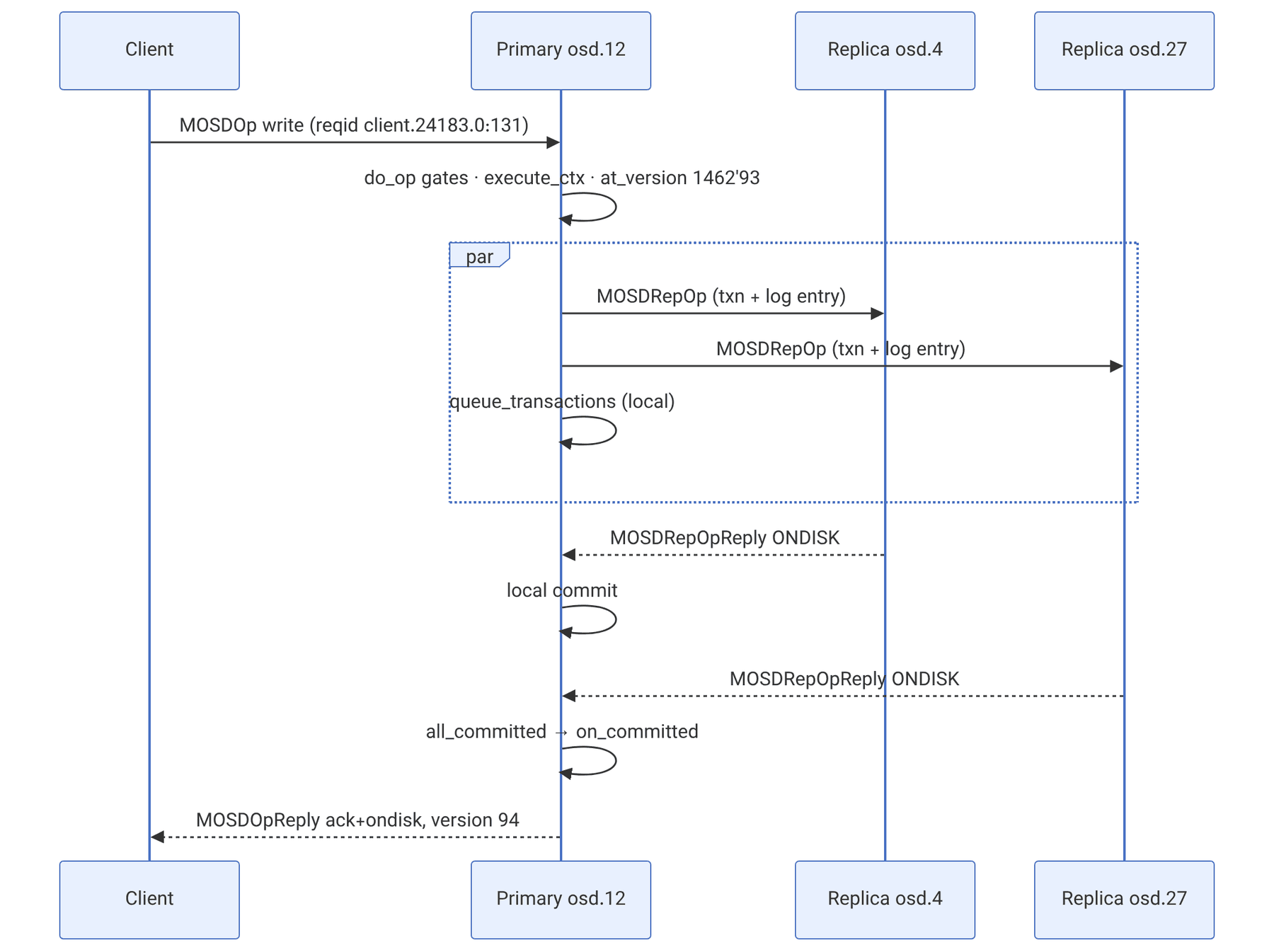
issue_repop builds a RepGather and calls pgbackend->submit_transaction. In ReplicatedBackend the transaction is sent to each replica in an MOSDRepOp and at the same time handed to the ObjectStore on the primary. Each replica returns an MOSDRepOpReply with the ONDISK flag after its local commit. When all members of acting (not just min_size) have committed, all_committed becomes true, the on_committed callbacks run and the reply is sent to the client. In EC, the EC backend plays the same role, with chunks and separate transactions for each shard (chapter 27).
34-7 The pg log and pg info on disk#
Each PG has a special object called pgmeta (spg_t::make_pgmeta_oid) that has no data; everything is in its omap. The log entries, dups and info are stored as omap keys of this object and, in BlueStore, go under the P prefix (the pgmeta-specific omap).
| omap key in pgmeta | Content |
|---|---|
_infover, _epoch | format version and epoch |
_info | the full pg_info_t (old form) |
_biginfo | past_intervals and purged_snaps, which change rarely |
_fastinfo | pg_fast_info_t: only last_update and a few statistics; for back-to-back writes |
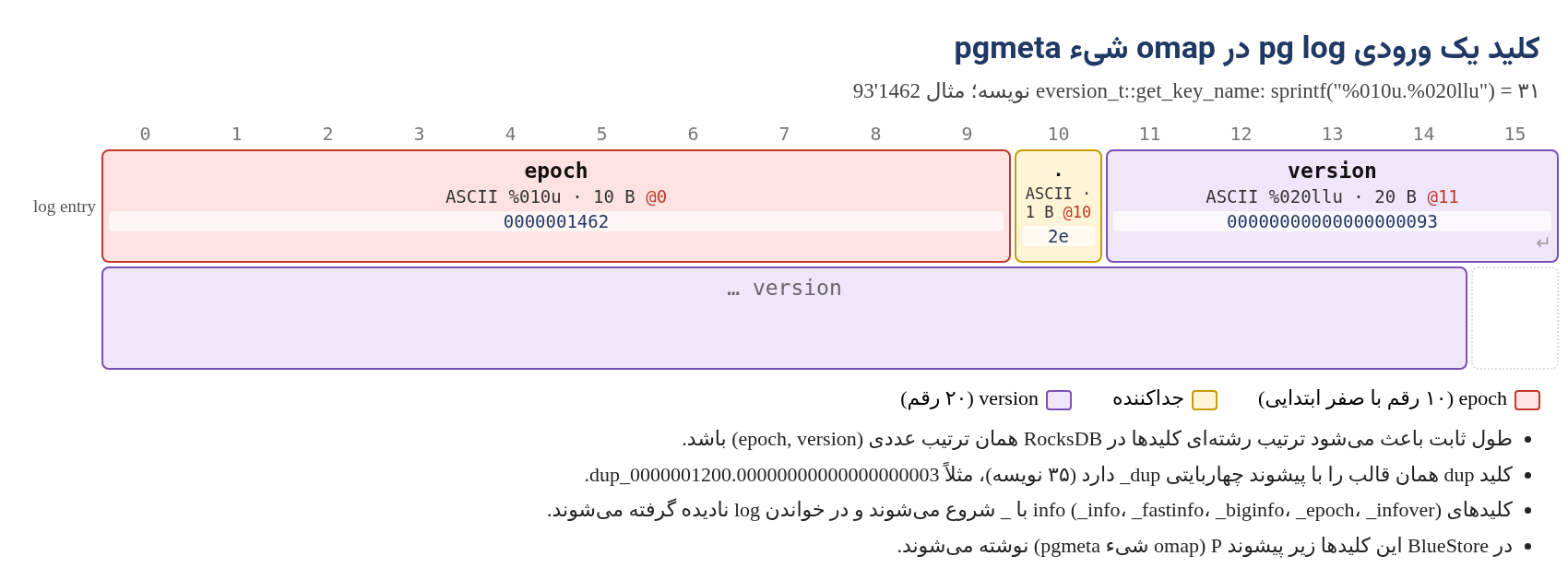
0000001462.00000000000000000093 | one pg_log_entry_t |
dup_0000001200.00000000000000000003 | one pg_log_dup_t |
Source in code: src/osd/osd_types.cc :: eversion_t::get_key_name, pg_log_dup_t::get_key_name; src/osd/osd_types.h :: infover_key, fastinfo_key
Complexity: O(1); a fixed 31-byte (or 35-byte) key
pseudocode
eversion_t::get_key_name():   sprintf("%010u.%020llu", epoch, version)       # 31 characters
pg_log_dup_t::get_key_name(): "dup_" + eversion.get_key_name()               # 35 characters
# info keys start with "_" so that read_log_and_missing can skip them
Because epoch and version are written with leading zeros and a fixed length, the string order of the keys is the numeric order of the versions, and reading the log is a simple ordered scan of the omap. Trimming the log is deleting a contiguous range from the start of these same keys.
_fastinfo is an optimization: in most writes only last_update, last_complete and a few statistics change. The function prepare_info_keymap (in osd_types.cc) writes only this small key, without touching the full _info, if it can fit the change into pg_fast_info_t (the osd_pg_fastinfo and osd_pg_biginfo counters in perf dump show how often each case happens).
34-8 Commands and tools#
34-8-1 Reference of this chapter's commands#
| Command | Use |
|---|---|
ceph osd map <pool> <obj> [<nspace>] | computing an object's PG and up/acting without accessing it |
rados -p <pool> stat <obj> | size and mtime (from object_info_t) |
rados -p <pool> listxattr <obj> / getxattr <obj> <name> | user xattrs (without the internal _ prefix) |
rados -p <pool> listomapkeys <obj> / listomapvals | omap keys and values |
ceph-dencoder type object_info_t import <file> decode dump_json | decoding the _ xattr |
ceph pg <pgid> query | info, peer_info and peering state |
ceph pg <pgid> list_unfound | unfound objects |
ceph daemon osd.N dump_ops_in_flight / dump_historic_ops / dump_blocked_ops | current, slow and blocked ops |
ceph daemon osd.N dump_op_pq_state | the state of the shard queues |
ceph-objectstore-tool --data-path <path> --pgid <pgid> --op log | a PG's pg log and missing set on a stopped OSD |
ceph-objectstore-tool --data-path <path> --op list <obj> | the list of ghobject_t values of an object (head and clones) |
# example: one object from start to finish
ceph osd map rbd rbd_header.5f3a2b8c1d4e
rados -p rbd stat rbd_header.5f3a2b8c1d4e
ceph daemon osd.12 dump_ops_in_flight | jq '.ops[] | {description, age, flag_point}'example (output):
osdmap e1462 pool 'rbd' (3) object 'rbd_header.5f3a2b8c1d4e' -> pg 3.8c7e1b1f (3.1f) -> up ([12,4,27], p12) acting ([12,4,27], p12)
rbd/rbd_header.5f3a2b8c1d4e mtime 2026-11-15T09:41:07.000000+0330, size 0
{ "description": "osd_op(client.24183.0:131 3.1f 3:f8d87e31:::rbd_header.5f3a2b8c1d4e:head [watch ping cookie 94823571521536] snapc 0=[] ondisk+write+known_if_redirected e1462)",
"age": 0.0021, "flag_point": "waiting for sub ops" }In the op description, the string 3:f8d87e31:::rbd_header...:head is the hobject_t: pool 3, the bitwise key f8d87e31 (not the raw hash), then the empty namespace and key, the name and the snap.
34-8-2 Tuning and troubleshooting#
- A hot PG: if
dump_historic_opsshows that most slow ops are on one PG, adding shards or threads does not help. Find the hot object (for example anrbd_headerwith many watches or an RGW index shard) and spread it out (more shards for the index, a larger pg_num for the pool). - Slow ops in
waiting for sub ops: one of the replicas is slow. Find the cause withceph osd perfanddump_historic_opson that replica. - Growth of
osd_pglogin the mempool: check the log length (osd_min_pg_log_entries,osd_max_pg_log_entries) and the dups (chapter 33). osd_op_num_shards: on NVMe with many cores, adding shards only helps when many PGs are active at the same time. Before changing it, look at the distribution of PGs over shards withdump_op_pq_state. Changing it requires restarting the OSD.
34-9 Supplementary and up to date#
- In Crimson (chapter 30) the op path runs on Seastar without a thread pool, but the same gates (peered, active, missing, degraded) are reimplemented in
crimson/osd/pg.ccandops_executer.cc. - In the main branch, the flags
CEPH_OSD_RMW_FLAG_EC_DIRECT_READandEC_SYNC_READexist for the optimized EC path (chapter 27); check your version before relying on them. - The default shard values for HDD in recent versions are one shard with five threads, so that mClock ordering is more precise. Older versions had a different value; check on your own version with
ceph config help osd_op_num_shards_hdd.
34-10 Hands-on exercise#
- 1. Run
ceph osd mapfor three objects of your choice and compute the bitwise key from the hash by hand. Then confirm it withdump_ops_in_flightor the log (debug_osd=20). - 2. Read an object's
_xattr withceph-objectstore-tool ... get-attr _(on a stopped test OSD) or withrados getxattr, and decode it withceph-dencoder. After a write, compare the change inversionanduser_version. - 3. Look at a few log entries of a PG with
ceph-objectstore-tool --op logand match their keys against the%010u.%020lluformat. - 4. On a test pool, set
nooutand stop one OSD, write to a few objects, bring the OSD back, and during recovery find an example ofwaiting for degraded objectindump_ops_in_flight.
34-11 Review questions#
- 1. In what order is hobject_t compared?
- 2. Why does the bitwise key reverse the hash?
- 3. After pg_num doubles, how is the bitwise-key range of PG
0x1fsplit? - 4. What do the
_andsnapsetxattrs hold? - 5. How is the shard of an op chosen, and what are the defaults on SSD?
- 6. If the object is missing on the primary, in which queue does the op wait?
- 7. How is a duplicate request detected, and what role do dups play?
- 8. How is user_version computed, and why may it not be contiguous for one object?
- 9. When is the reply to a replicated write sent to the client?
- 10. What format does the key of a pg log entry have, and why is its length fixed?
Answers to these questions are in Appendix E: Answers to Review Questions. Answers to this chapter's questions →
34-12 Sources for this chapter#
- hobject.h and hobject.cc
https://github.com/ceph/ceph/blob/main/src/common/hobject.h - osd_types.h (object_info_t, pg_log_entry_t, pgmeta keys
https://github.com/ceph/ceph/blob/main/src/osd/osd_types.h - PrimaryLogPG.cc (do_op, execute_ctx, finish_ctx
https://github.com/ceph/ceph/blob/main/src/osd/PrimaryLogPG.cc - OSD.cc (enqueue_op and the sharded queue
https://github.com/ceph/ceph/blob/main/src/osd/OSD.cc - Developer documentation on op execution
https://docs.ceph.com/en/latest/dev/osd_internals/ - OSD options
https://docs.ceph.com/en/latest/rados/configuration/osd-config-ref/