The Comprehensive Ceph Guide
Designing, Implementing and Operating Scalable Storage — from the Code to Operations
From the first cluster to source code and on-disk bytes, with tested commands, purpose-made figures and algorithms taken straight from the Ceph code.
Start reading Get started Read the Persian edition
Where should I start?
Pick a path for what you need from Ceph today. Every chapter stands on its own and links to the others.
Interactive lab
Seven small simulators that run the book's algorithms in your browser: no network, no installation. The arithmetic is a line-by-line port of Ceph's own code and is checked against it by the tests in tests/sims (make check-sims).
The four parts of the book
The book starts with day-to-day work and goes one layer deeper at a time.
Foundations and operations
Architecture and a first cluster, RBD, RGW and multisite, CephFS, operations, BlueStore, erasure coding, troubleshooting, monitoring and tuning.
10 h 47 min
Code architecture
The layout of the Ceph repository and the full path of a request, function by function, from client to disk.
19 min
Lower Layers
Chapters 23–33 revisit Ceph from the lowest layer up.
4 h 21 min
Contents
The list of all chapters and appendices, with their main sections and reading times, is on a separate contents page.
About this work
About this work. This book is an original work. The text, explanations, examples, commands, exercises and all figures were written and designed for it. The English edition is the author's English version of the Persian text.
Source code. Short excerpts of Ceph code are quoted with their paths from github.com/ceph/ceph (LGPL-2.1/3.0). Chapters 25 and 29 cite function names, constants and string formats from RocksDB (Apache-2.0/GPL-2.0) and the Linux kernel (GPL-2.0) with their paths. All other code is pseudocode or an example written for this book.
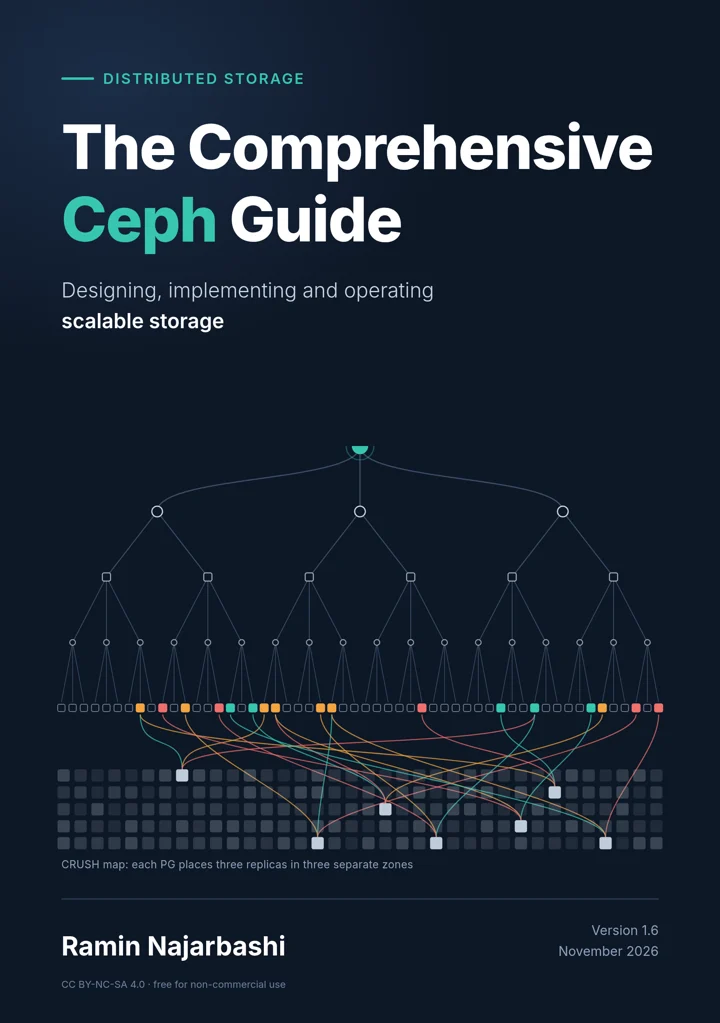
Trademarks. Ceph and the names of other projects and products mentioned are trademarks of their respective owners. The cover design is original and uses no publisher's logo or design.
Licence. © 2026 Ramin Najarbashi. The text, figures and tools of this work are licensed under Creative Commons Attribution-NonCommercial-ShareAlike 4.0 International (CC BY-NC-SA 4.0): you may share and adapt it with attribution and under the same licence, but commercial use is not permitted without written permission. Full licence: creativecommons.org/licenses/by-nc-sa/4.0. Quoted code excerpts keep their original licences.
Use. This work is provided for personal, educational and non-commercial use. The technical information was prepared with care but comes without any warranty. Test commands in a lab before running them in production.