Lower Layers (4): msgr2 at the Byte Level, AsyncConnection and EventCenter
TL;DR this chapter in a few lines
- msgr2 is Ceph's wire protocol: a banner, then frames with a preamble, segments and an epilogue, in crc or secure (AES-GCM) mode.
- A message has four segments: header, front, middle and data.
- AsyncConnection runs a connection's state machine and EventCenter dispatches socket events on a few worker threads.
- The chapter decodes real frames byte by byte, such as a KEEPALIVE2 in crc mode.
26-1 Introduction: the wire between two daemons#
Every message exchanged in Ceph, whether a client's write request to an OSD, a heartbeat between OSDs or a map that the mon publishes, passes through the messenger layer. Since Nautilus the default protocol is msgr2 (port 3300 for the mon). This chapter opens it up at the byte level: the opening banner, the frame format with its preamble and segments, the two modes crc and secure (AES-GCM), the authentication handshake, the session and reconnection, and finally the ProtocolV2 state machine and the EventCenter event loop that runs all of this with a small number of threads. The source of the structures is src/msg/async/frames_v2.h, ProtocolV2.cc, crypto_onwire.cc and src/include/msgr.h on the main branch.
- The banner is
ceph v2\n, followed by a length of 16 and two 64-bit feature sets (supported and required). The current features are REVISION_1 (msgr2.1) and COMPRESSION. - Every frame starts with a 32-byte preamble: the tag, the number of segments (at most 4), the length and alignment of each segment, flags and a crc32c.
- crc mode has one crc32c per segment. secure mode both encrypts and authenticates with AES-128-GCM (16-byte key, 12-byte IV and 16-byte tag).
- Defaults:
ms_cluster_modeandms_client_modearecrc secure, andms_mon_*_modearesecure crc. - AsyncMessenger works with
ms_async_op_threads=3workers. Each worker has an EventCenter based on epoll (edge-triggered).
26-2 The banner and feature negotiation#
The first bytes sent after the TCP connection is established are not encrypted. ProtocolV2::_banner_exchange builds this structure: the eight-byte string CEPH_BANNER_V2_PREFIX = "ceph v2\n", a u16 for the payload length, and then the payload of two u64s, namely CEPH_MSGR2_SUPPORTED_FEATURES and CEPH_MSGR2_REQUIRED_FEATURES.
| Bytes (example) | Meaning |
|---|---|
63 65 70 68 20 76 32 0a | "ceph v2\n" |
10 00 | payload length = 16 (u16 LE) |
03 00 00 00 00 00 00 00 | supported = REVISION_1 (bit 0) + COMPRESSION (bit 1) = 3 |
00 00 00 00 00 00 00 00 | required = 0 |
An old client with a version 1 banner (ceph v027) cannot connect to an msgr2 port, because the banner bytes differ. This is why mons publish two addresses, v2:...:3300 and v1:...:6789, in the addrvec. If ms_bind_msgr1=false, old clients (and old krbd versions from before msgr2 support in kernel 5.11) cannot connect.
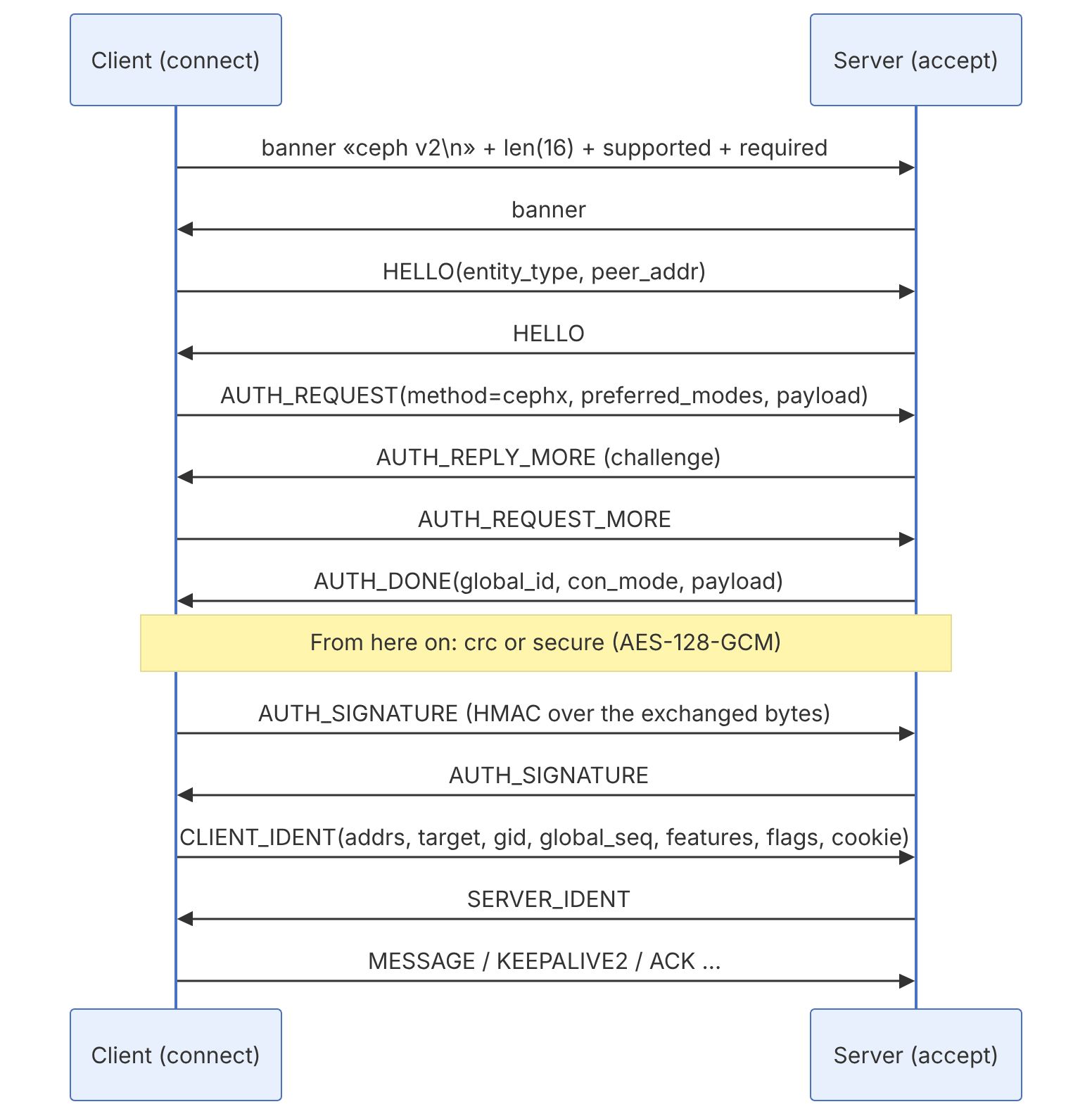
Why AUTH_SIGNATURE? The banner, HELLO and part of the auth negotiation are sent before a session key exists. A man in the middle could, for example, change the preferred_modes list so that the two sides agree on crc instead of secure (a downgrade attack). After AUTH_DONE, each side sends the hmac_sha256, with the session key, of all the bytes it has received (pre_auth.rxbuf), and the other side compares it with the bytes it has itself sent. Any change along the way drops the connection.
26-3 The frame at the byte level#
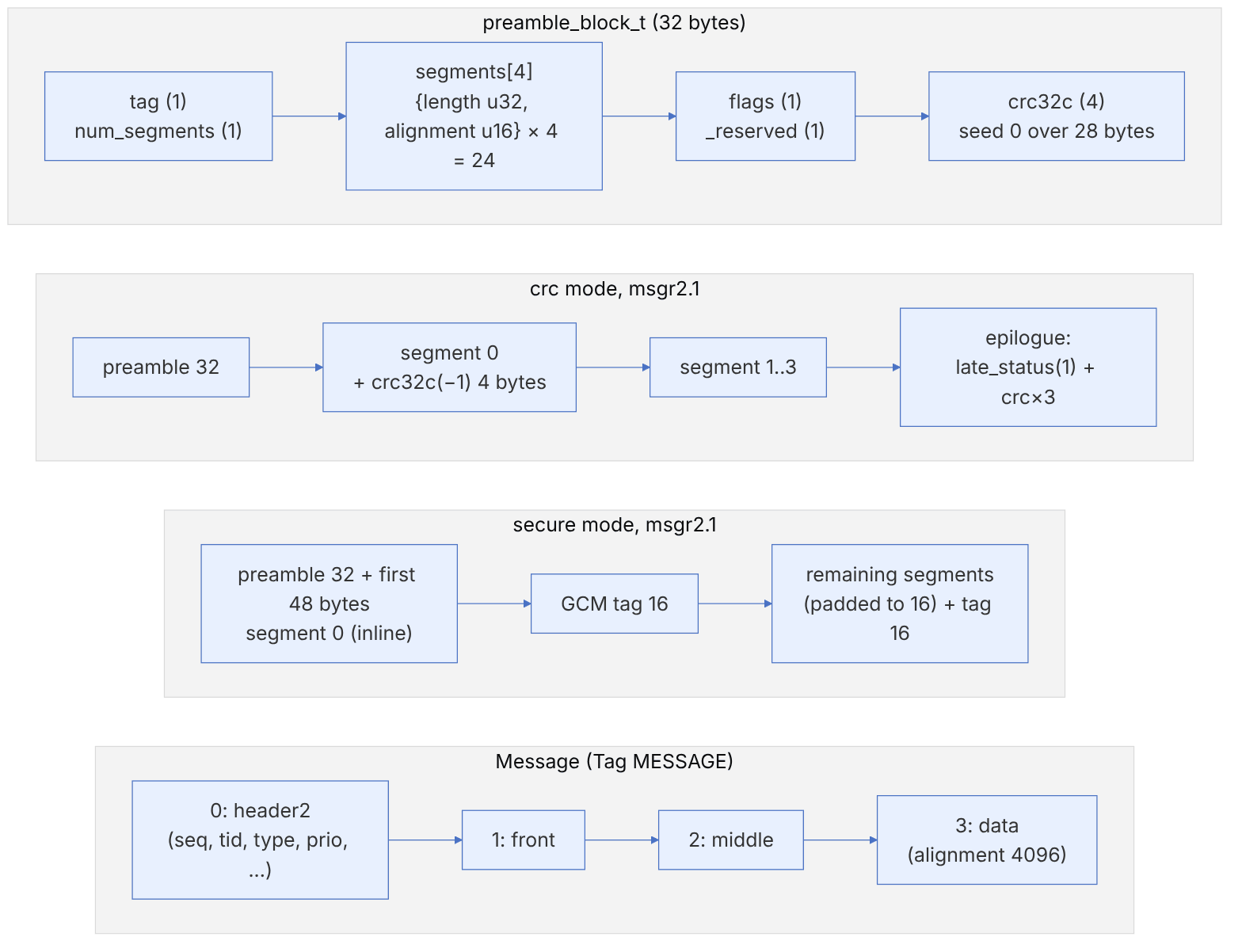
| offset | size | field | description |
|---|---|---|---|
| 0 | 1 | tag | frame type (next table) |
| 1 | 1 | num_segments | 1 to 4 |
| 2 | 24 | segments[4] | each one length (le32) and alignment (le16) |
| 26 | 1 | flags | for example FRAME_EARLY_DATA_COMPRESSED=0x1 |
| 27 | 1 | _reserved | zero |
| 28 | 4 | crc | ceph_crc32c(0, preamble, 28) |
| Tag | Value | Tag | Value |
|---|---|---|---|
| HELLO | 1 | SESSION_RETRY | 13 |
| AUTH_REQUEST | 2 | SESSION_RETRY_GLOBAL | 14 |
| AUTH_BAD_METHOD | 3 | SESSION_RECONNECT_OK | 15 |
| AUTH_REPLY_MORE | 4 | WAIT | 16 |
| AUTH_REQUEST_MORE | 5 | MESSAGE | 17 |
| AUTH_DONE | 6 | KEEPALIVE2 | 18 |
| AUTH_SIGNATURE | 7 | KEEPALIVE2_ACK | 19 |
| CLIENT_IDENT | 8 | ACK | 20 |
| SERVER_IDENT | 9 | COMPRESSION_REQUEST | 21 |
| IDENT_MISSING_FEATURES | 10 | COMPRESSION_DONE | 22 |
| SESSION_RECONNECT | 11 | SESSION_RESET | 12 |
26-3-1 A complete example: one KEEPALIVE2 in crc mode#
KEEPALIVE2 has one segment that is just a utime_t (sec and nsec, each a u32). For the time 1700000000.5 seconds, the complete frame is 44 bytes. We computed these values with an independent encoder:
| Bytes | Part |
|---|---|
12 01 | tag=18 (KEEPALIVE2), num_segments=1 |
08 00 00 00 08 00 | segment 0: length=8, alignment=8 (DEFAULT_ALIGNMENT = sizeof(void*)) |
00 × 18 | three empty segments |
00 00 | flags, reserved |
d8 d5 f5 99 | preamble crc = 0x99F5D5D8 (seed 0) |
00 f1 53 65 00 65 cd 1d | sec=1700000000, nsec=500000000 |
39 7f 34 4d | segment crc = 0x4D347F39 (seed 0xFFFFFFFF) |
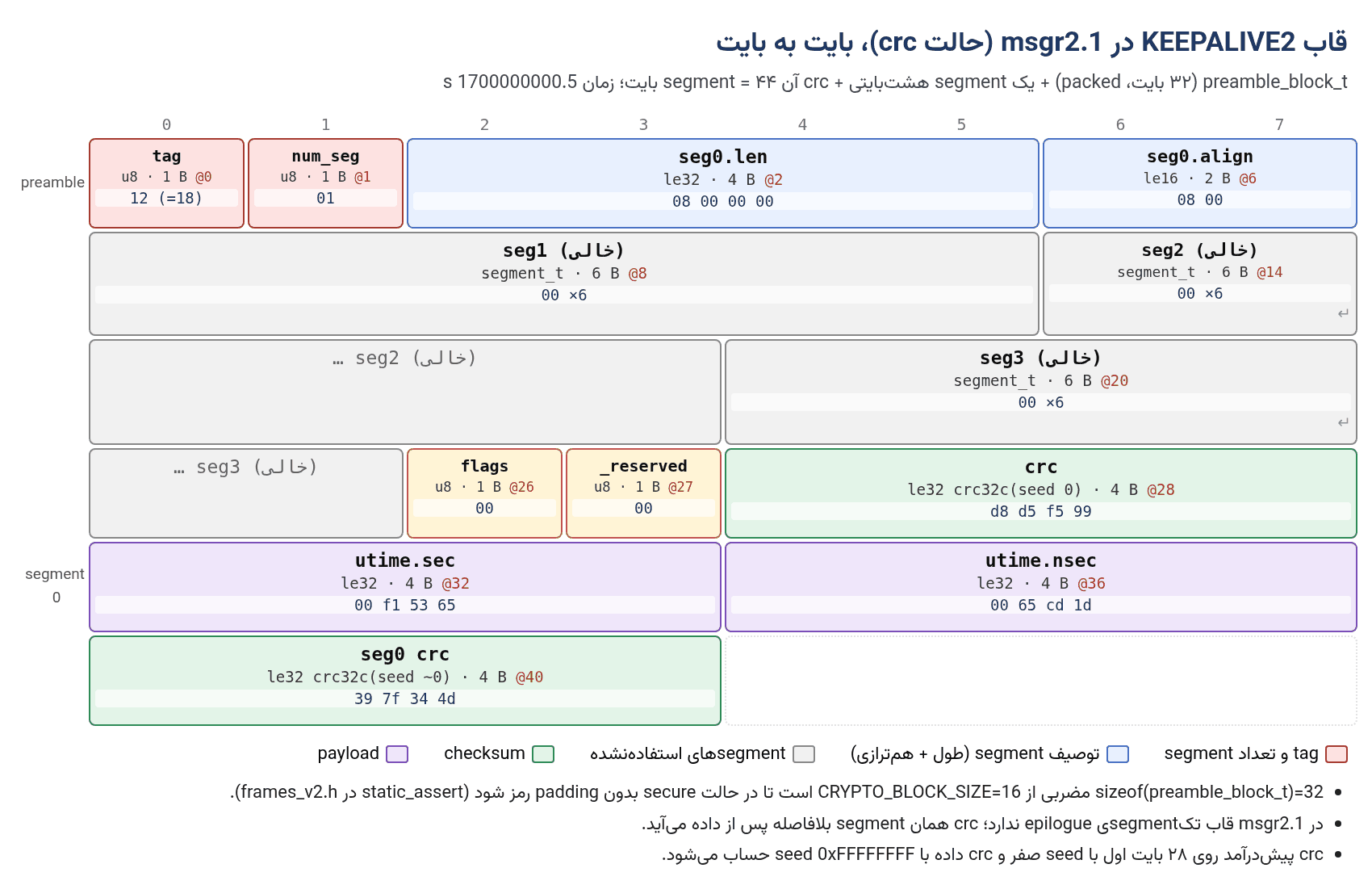
Because there is only one segment, no epilogue is sent (in msgr2.1). The server replies with KEEPALIVE2_ACK and the same timestamp. The client uses this reply to measure the connection's "last alive time" (mon_client_ping_interval and heartbeats).
26-3-2 A message: four segments#
MESSAGE always has four segments (SegmentIndex::Msg): HEADER (0), which is ceph_msg_header2 (seq, tid, type, priority, version, data_pre_padding_len, data_off, ack_seq, flags, compat_version); FRONT (1), which is the main encoded body of the message (for example the fields of MOSDOp); MIDDLE (2), which is rarely used; and DATA (3), which is the raw data of a write or read. The data segment's alignment is PAGE_SIZE_ALIGNMENT = 4096, so that the receiver can allocate a page-aligned buffer and take the data without copying all the way to O_DIRECT in BlueStore (chapter 23). sizeof(ceph_msg_header2) is less than 48, so in secure mode the whole header fits in the inline part and the receiver can learn the length of the rest with one decryption.
26-4 secure mode: AES-128-GCM on the wire#
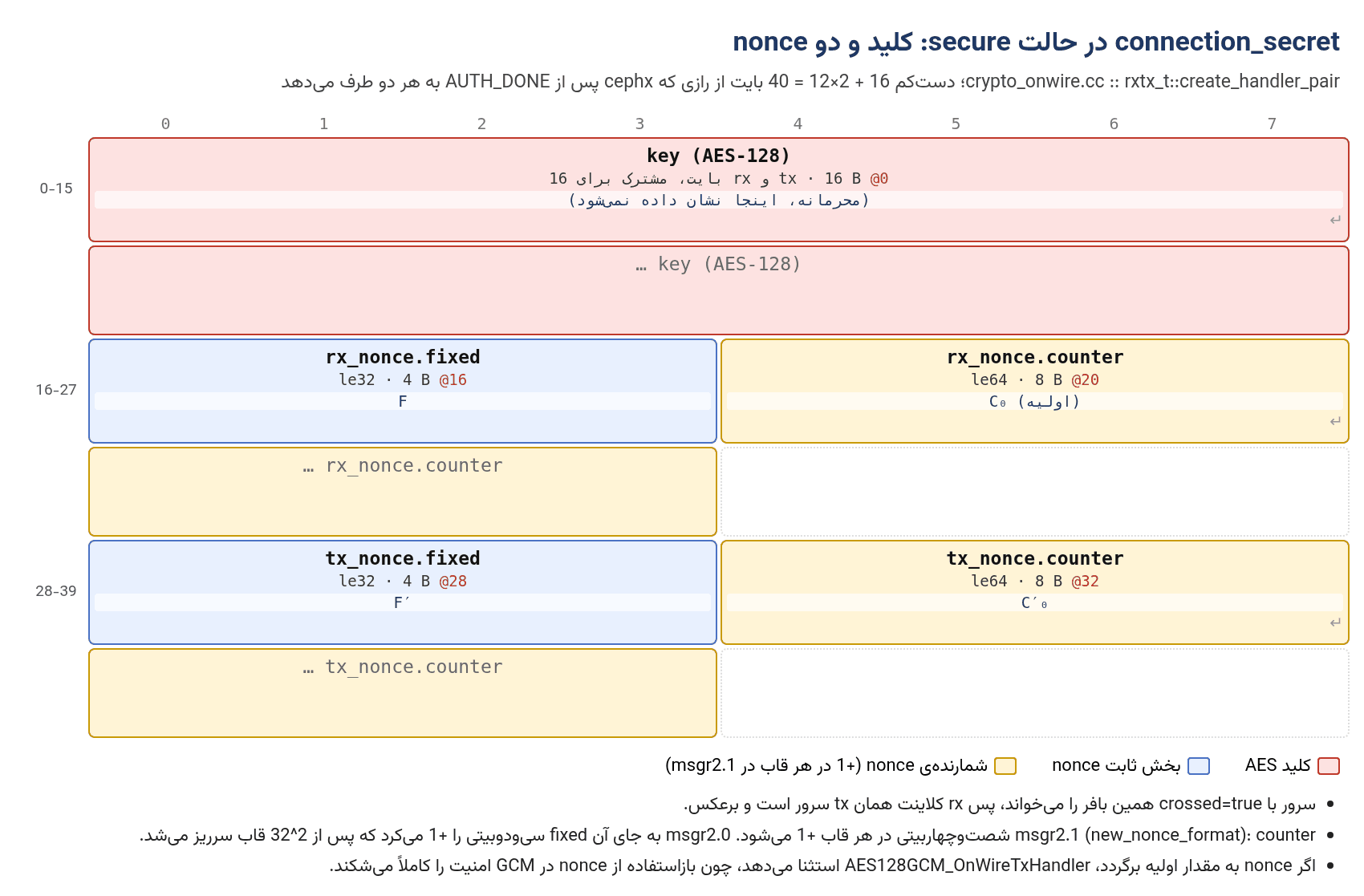
When con_mode is CEPH_CON_MODE_SECURE (0x2), crypto_onwire.cc works with OpenSSL (EVP_aes_128_gcm): AESGCM_KEY_LEN=16, AESGCM_IV_LEN=12 and AESGCM_TAG_LEN=16. The nonce is a twelve-byte structure: a fixed 32-bit part and a 64-bit counter that is incremented for each frame. The key and the initial nonce are derived, separately for each direction, from the cephx session key and the connection_secret exchanged in AUTH_DONE.
pseudocode: sending one frame in secure mode (msgr2.1, this book's summary)
  plain_head = preamble(32) || segment0[0:48] (padded with zeros if shorter)
  out  = AES_GCM_encrypt(key_tx, nonce_tx, plain_head) || tag(16); nonce_tx.counter++
  if len(segment0) > 48 or num_segments > 1:
      rest = segment0[48:] || segment1 || segment2 || segment3   # each padded to 16
      out += AES_GCM_encrypt(key_tx, nonce_tx, rest || epilogue) || tag(16); nonce_tx.counter++
  send(out)
Overhead: for a small control message, secure mode uses about 96 bytes (32 + 48 + 16) versus 44 bytes in crc mode. For a 4M write the overhead is negligible, but the CPU cost of AES-GCM (with AES-NI, around a few gigabytes per second per core) is measurable on busy NVMe OSDs. This is why the default for data traffic is crc secure (crc preferred) and for the mon secure crc.
| Option | Default | Use |
|---|---|---|
ms_cluster_mode | crc secure | OSD↔OSD |
ms_service_mode | crc secure | modes the server (OSD, MDS) accepts |
ms_client_mode | crc secure | client preference |
ms_mon_cluster_mode / ms_mon_service_mode / ms_mon_client_mode | secure crc | connections to the mon |
ms_osd_compress_mode | none | on-wire compression for the OSD |
ms_crc_data / ms_crc_header | true / true | turning off the crc in crc mode (not recommended) |
crc mode has no protection against an attacker. A crc only detects random errors. If the public network is shared or untrusted, consider ms_client_mode=secure and ms_service_mode=secure, and measure the effect on CPU. In crc mode cephx only proves identity, not the confidentiality or integrity of messages.
26-5 Session, reconnection and reset#
Lossless connections (for example OSD↔OSD, or client↔mon under some policies) must continue after a TCP drop without losing or repeating messages. For this msgr2 keeps the following state:
| Variable | Meaning |
|---|---|
client_cookie / server_cookie | random session identifier set in CLIENT_IDENT and SERVER_IDENT |
global_seq | the messenger's global counter for ordering connection attempts (resolving a race between two simultaneous connections) |
connect_seq | the number of successful reconnections of this session |
message seq / ack_seq | the number of the last message received; unacknowledged messages stay in the resend queue |
Reconnection scenario (this book's summary)
  client: SESSION_RECONNECT(addrs, client_cookie, server_cookie, global_seq, connect_seq, msg_seq)
  server:
    unknown cookie (the server restarted)     → SESSION_RESET(full=true)  → new session, queues empty
    global_seq older than what I have seen    → SESSION_RETRY_GLOBAL(gs)  → again with a larger gs
    inconsistent connect_seq                  → SESSION_RETRY(cs)
    race with a connection I am establishing  → WAIT
    everything correct                        → SESSION_RECONNECT_OK(msg_seq)
resend the messages above msg_seqConnection race: two OSDs may connect to each other at the same time. Each side has one outgoing and one incoming connection. ProtocolV2 decides which connection stays by comparing addresses (and global_seq). The "losing" side receives WAIT and drops its own connection, and the winning connection (replacing) takes its place. Queued messages are moved to the winning connection. Old bugs in this very logic were the cause of many reports of "duplicate messages" or "stuck connections".
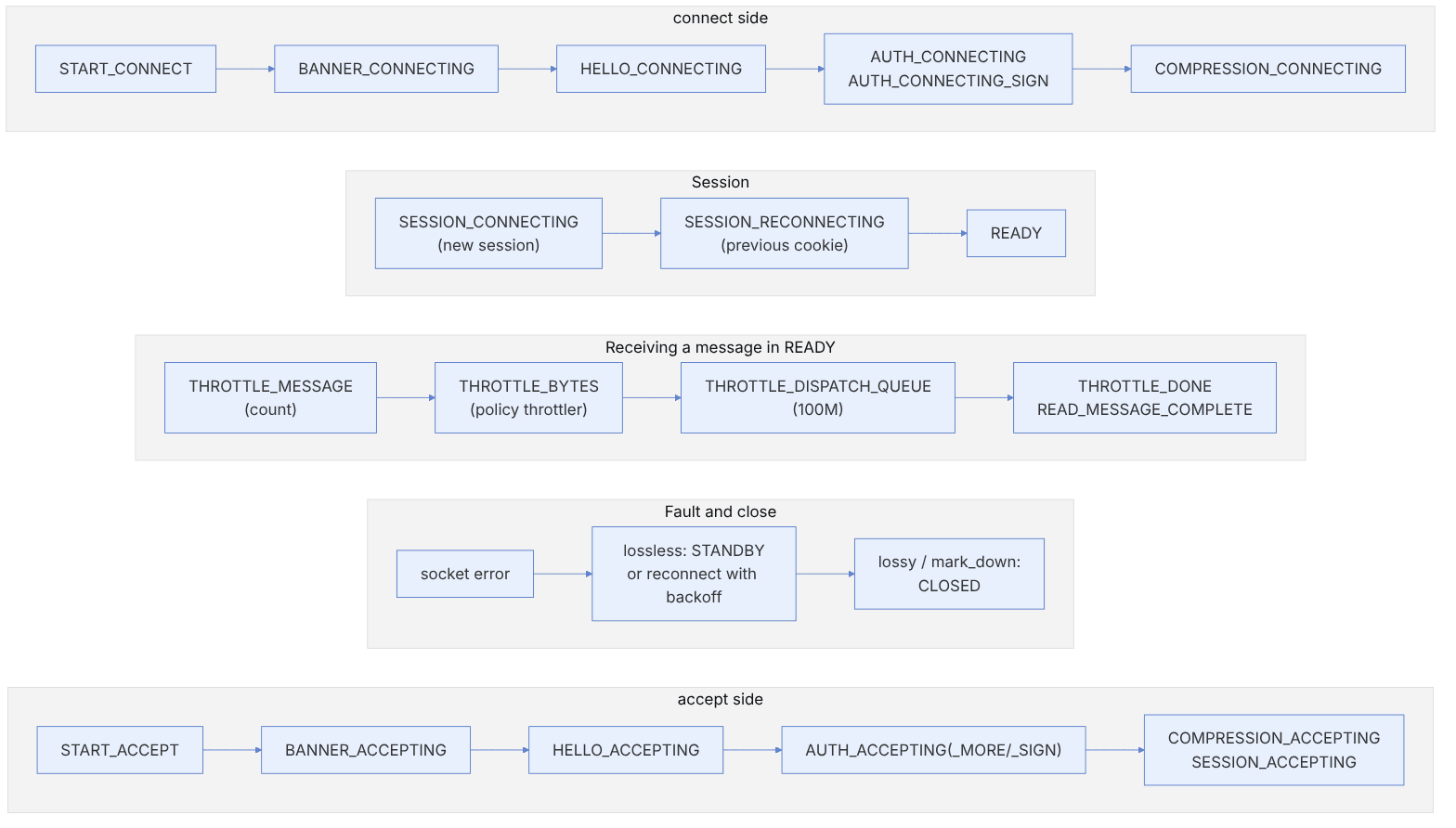
| Throttle | Option or policy | Effect when full |
|---|---|---|
| THROTTLE_MESSAGE | policy.throttler_messages (for example osd_client_message_cap=256) | reading from the socket stops, so TCP backpressure reaches the client |
| THROTTLE_BYTES | policy.throttler_bytes (for example osd_client_message_size_cap=500M) | the same |
| THROTTLE_DISPATCH_QUEUE | ms_dispatch_throttle_bytes=100M | the same; protects the dispatch queue's memory |
26-6 AsyncMessenger, Worker and EventCenter#
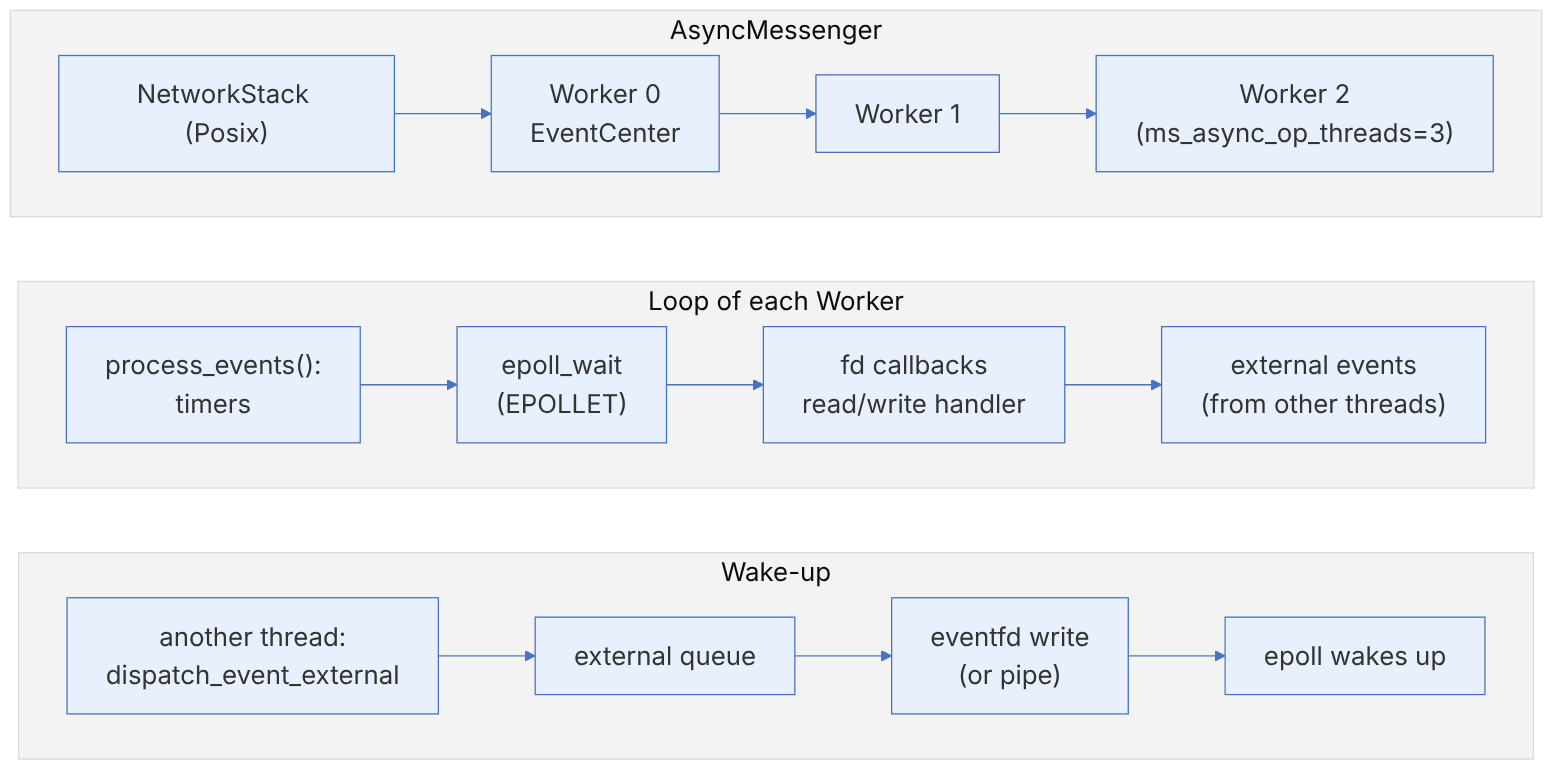
EventCenter::process_events does the following in each round:
- 1. It computes when the nearest time event is due, to set the wait duration (at least
ms_time_events_min_wait_interval). - 2. If no poller is active and no external event is queued, it blocks in
event_wait(that isepoll_waitinEventEpoll.cc) until that time. - 3. For each ready fd, it calls the registered
read_cborwrite_cb. For connections these areAsyncConnection::processandhandle_write. - 4. It runs the expired timers (for example keepalive, connection timeout and reconnection backoff).
- 5. It empties and runs the
external_eventsqueue.AsyncConnection::send_message, from another thread (for example a PG thread in the OSD), puts the message inout_qand schedules the write on the right worker withdispatch_event_external.
Because epoll is registered in EPOLLET (edge-triggered) mode, the handler must read or write until EAGAIN. Otherwise the remaining data does not generate any new event. This is why ProtocolV2 keeps its reading state in continuations (CONTINUATION(...)) and waits for more data by returning nullptr.
Why only three threads? Protocol processing (encryption or crc, frame parsing and throttling) is light, and the main work happens in the OSD's thread pools (osd_op_num_threads_per_shard). Three workers are usually enough for tens of thousands of connections, but with secure mode on busy NVMe OSDs these workers may become a CPU bottleneck. In that case top -H -p <pid> shows threads named msgr-worker-N near 100%.
top -H -p $(pidof -s ceph-osd)            # msgr-worker-0..2
ceph daemon osd.4 perf dump AsyncMessenger::Worker-0 | jq '.[] | {msgr_recv_messages, msgr_send_messages, msgr_running_total_time}'
ceph daemon osd.4 messenger dump        # without arguments, the list of messengers; with one's name, its connections
ss -tinp | grep ceph-osd | head            # cwnd, rtt and retrans for each connection
tcpdump -i any -s 128 -w /tmp/msgr.pcap port 3300 # the banner and preamble are visible in crc modeWireshark has a Ceph dissector, but its msgr2 support is limited. In crc mode you can read the preamble by hand with this chapter's tag table: byte 0 is the tag and bytes 2 to 5 are the length of the first segment (LE). In secure mode everything after the banner and HELLO is encrypted.
26-7 Exact on-wire frame size#
FrameAssembler in frames_v2.h has a separate function for each part of the frame: get_preamble_onwire_len, get_segment_onwire_len and get_epilogue_onwire_len. With these three functions the exact overhead of each message can be computed before it is sent.
Source in code: src/msg/async/frames_v2.h :: FrameAssembler::get_preamble_onwire_len, get_segment_onwire_len, get_epilogue_onwire_len, get_frame_onwire_len
Complexity: O(number of segments) = O(1) (at most 4)
pseudocode
preamble = secure ? 32 + 48 (inline) + 16 (tag) : 32
seg(i):
    if secure:
        p = round_up(len_i, 16)
        if i == 0: return p > 48 ? p + 16 − 48 : 0       # up to 48 bytes fit inside the preamble
        return p
    return (i == 0 and len_0 > 0) ? len_0 + 4 : len_i        # separate crc for segment 0
epilogue = (only one segment) ? 0 : secure ? 16 + 16 : 1 + 3×4
total = preamble + Σ seg(i) + epilogue
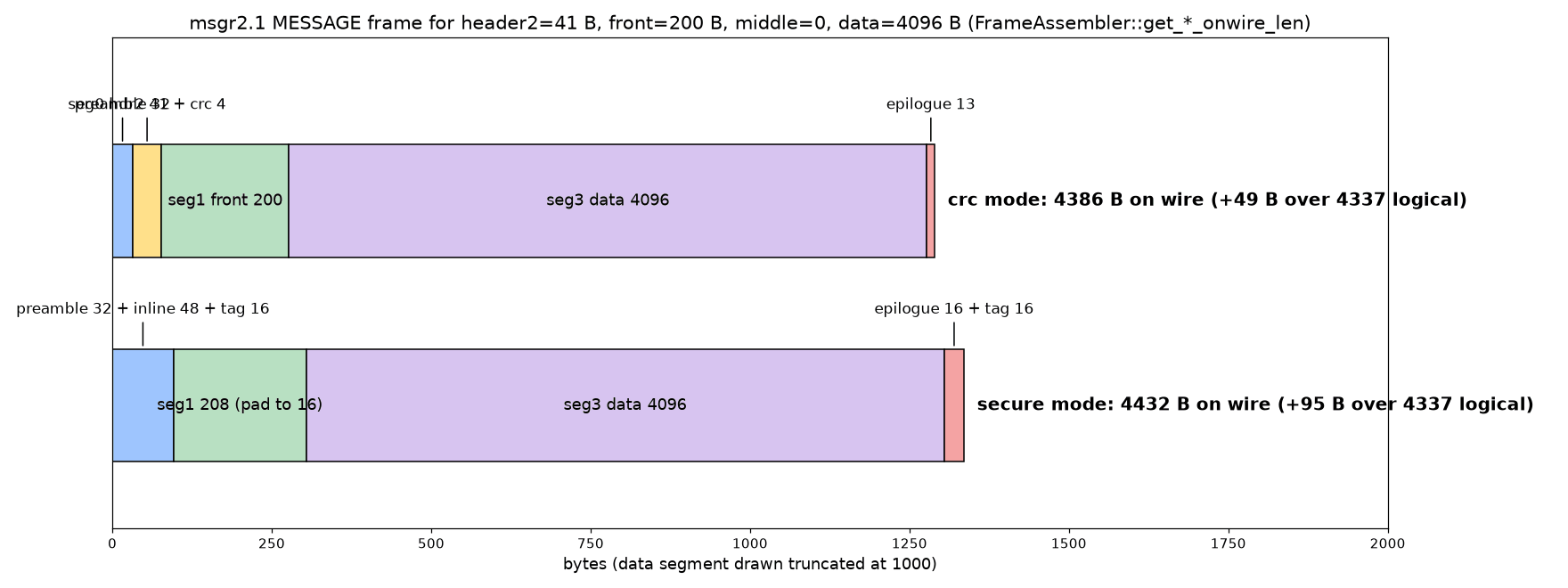
Numerical example. Take a MESSAGE with segment 0 = ceph_msg_header2 (packed, 41 bytes), front = 200 bytes, middle = 0 and data = 4096 bytes. The logical data is 4337 bytes.
- crc mode: 32 + (41 + 4) + 200 + 0 + 4096 + 13 = 4386 bytes, that is 49 bytes of overhead (1.1%).
- secure mode: 96 + 0 (the 41-byte header is rounded up to 48 and fits entirely inside the preamble) + 208 + 0 + 4096 + 32 = 4432 bytes, that is 95 bytes of overhead (2.2%).
For KEEPALIVE2 in crc mode the figure is the same 44 bytes as in the table above, because it has only one segment and no epilogue. In secure mode the eight-byte segment is rounded up to 16 and fits inside the preamble, so the whole frame is 96 bytes.
26-8 Nonces in AES-GCM and preventing reuse#
Source in code: src/msg/async/crypto_onwire.cc :: rxtx_t::create_handler_pair, AES128GCM_OnWireTxHandler::reset_tx_handler, AES128GCM_OnWireRxHandler::reset_rx_handler
Complexity: O(1) per frame; encryption O(L) with AES-NI
pseudocode
create_handler_pair(secret, crossed):
    key = secret[0:16] ; rx = secret[16:28] ; tx = secret[28:40]
    Tx = AESGCM(key, crossed ? rx : tx) ; Rx = AESGCM(key, crossed ? tx : rx)
reset_tx_handler(segments):
    if nonce == initial_nonce:
        if used_initial_nonce: throw "nonce reuse"     # the counter has wrapped around
        used_initial_nonce = true
    EVP_EncryptInit_ex(..., iv = nonce)
    if msgr2.1: nonce.counter += 1  else: nonce.fixed += 1   # msgr2.0: wraps after 2^32
Numerical example. An OSD sending 10000 frames per second on one connection would, in msgr2.0, return to the initial nonce after seconds (about 5 days), and the connection had to be reset. In msgr2.1 the 64-bit counter lasts years. GCM also allows at most about 64 GiB of data per nonce ( blocks of 16 bytes), and msgr frames, with their segment limit, are far smaller than that.
26-9 The EventCenter loop and waking up across threads#
Source in code: src/msg/async/Event.cc :: EventCenter::process_events, dispatch_event_external, wakeup; src/msg/async/Stack.cc :: NetworkStack::add_thread
Complexity: O(k) for k ready fds + O(t) due time events + O(e) external events per round
pseudocode
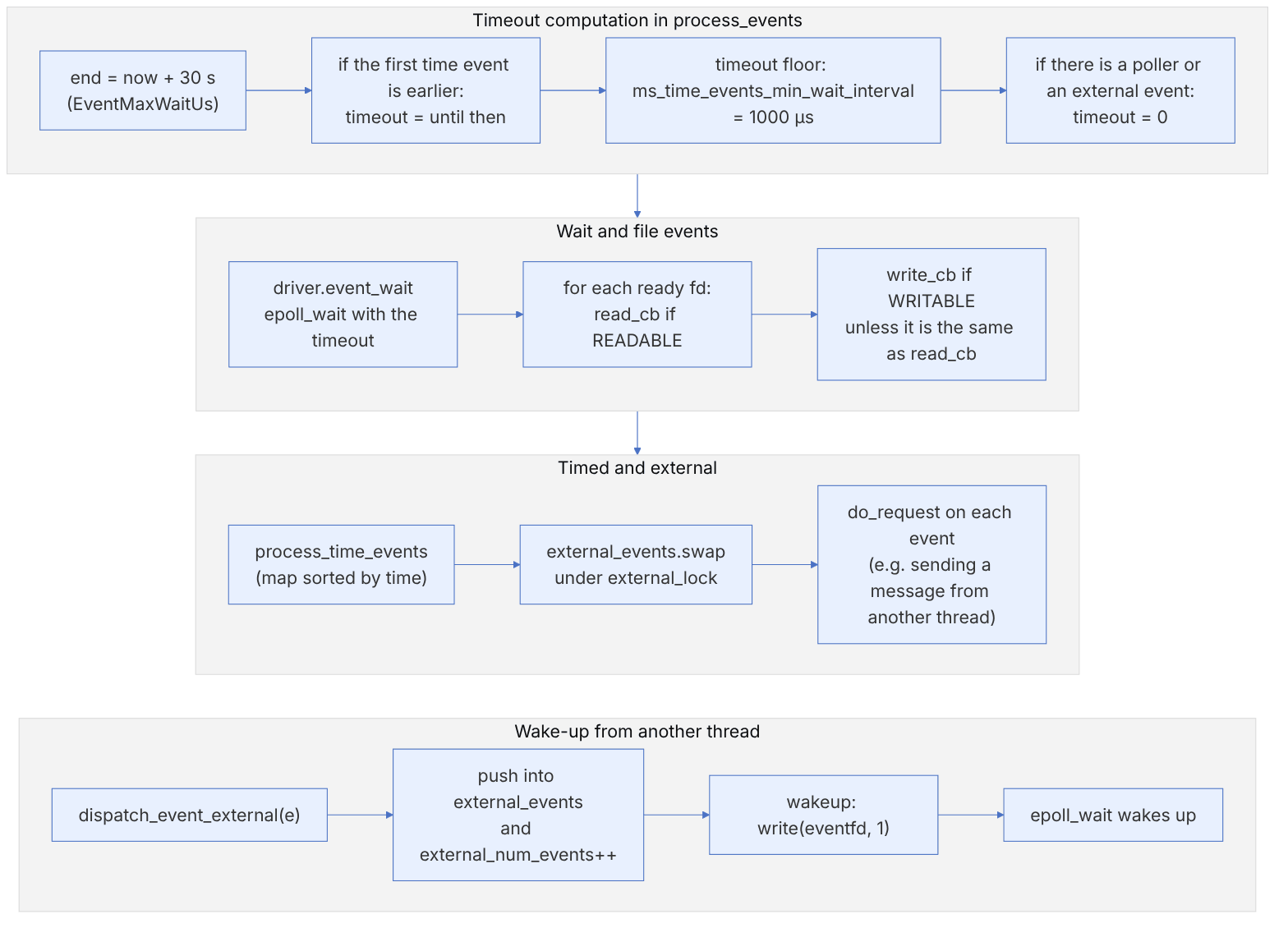
loop (each Worker, msgr-worker-N): process_events(30 s)
process_events(timeout):
    if first time event < now + timeout: timeout = max(that gap, 1000 µs) ; trigger_time = true
    if pollers or external_num_events > 0: timeout = 0
    n = epoll_wait(timeout)
    for each ready fd: read_cb and/or write_cb
    if trigger_time: process_time_events()
    if external_num_events: lock ; swap(external_events) ; unlock ; do_request on all of them
dispatch_event_external(e) (from another thread):
    lock ; external_events.push(e) ; external_num_events++ ; unlock
    if the current thread is not that Worker: wakeup() ⇒ write(eventfd, 1)
Numerical example and latency. A thread of an OSD op shard prepares the reply to an op and calls send_message. The connection belongs to msgr-worker-1, so the send is queued as an external event and the eventfd is woken. The cost of this path is one write on the eventfd, one epoll_wait wake-up (usually a few microseconds to a few tens of microseconds, depending on load and the C-state settings) and then a writev on the socket. If the Worker is busy processing other fds at that moment, the event waits until the end of that round. This is why a Worker that has hundreds of busy connections at once raises tail latency. The 1000-microsecond floor of ms_time_events_min_wait_interval keeps very close timers from turning the loop into a busy loop.
26-10 Choosing a Worker for each connection#
Source in code: src/msg/async/Stack.cc :: NetworkStack::get_worker; Stack.h :: Worker::release_worker; AsyncConnection.cc :: AsyncConnection::_stop
Complexity: O(W) with W = ms_async_op_threads (default 3) under a spinlock
pseudocode
get_worker():
    lock(pool_spin)
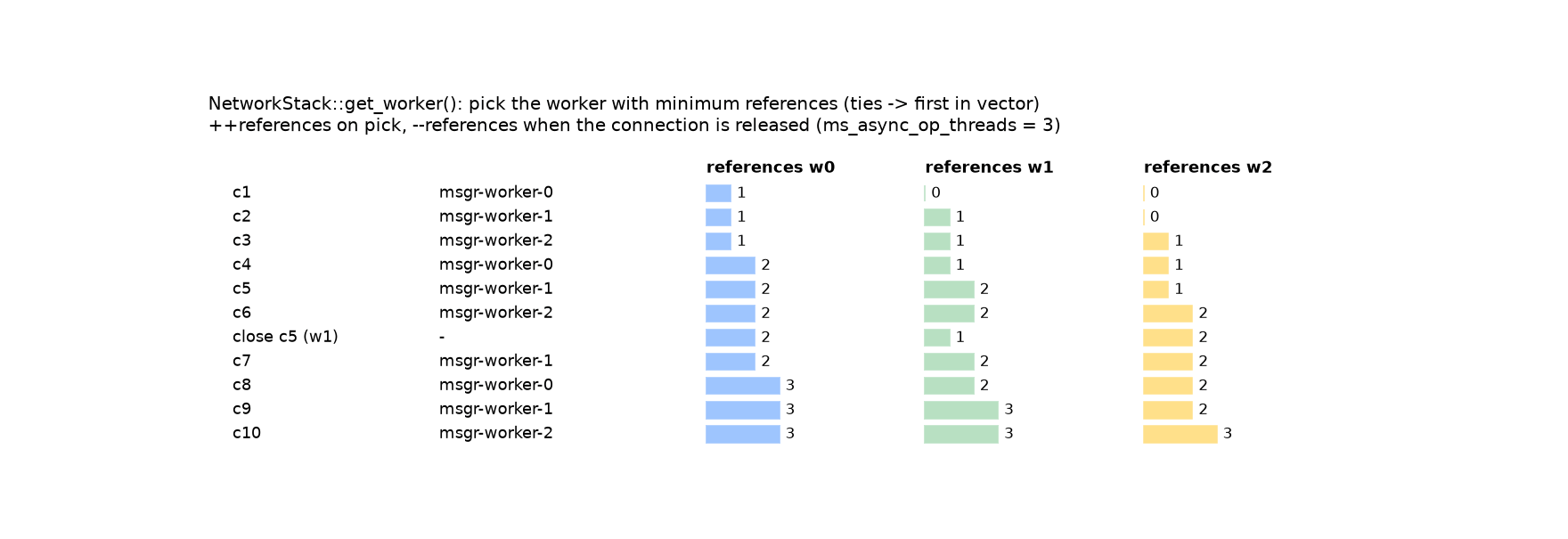
    best = argmin_w w.references       # tie ⇒ the first in the vector
    unlock ; best.references++ ; return best
release_worker(): references.fetch_sub(1)    # in AsyncConnection::_stop when the connection closes
Numerical example. With three Workers and ten connections in a row, the distribution is round-robin: 0, 1, 2, 0, 1, 2. If the fifth connection (on Worker 1) is closed, the counters become [2, 1, 2] and the seventh connection goes to Worker 1. At the end the counters are [3, 3, 3]. This balance is based only on the number of connections, not on their traffic. An OSD with 2 busy connections to two neighbouring OSDs and 200 idle connections to clients may end up with both busy connections on one Worker. Raising ms_async_op_threads (which needs a restart) makes this coincidence less likely. Each Worker's msgr_recv_bytes and msgr_send_bytes counters in ceph daemon osd.N perf dump AsyncMessenger::Worker-N show whether the real balance holds.
26-11 Reconnection: which messages are sent again?#
Source in code: src/msg/async/ProtocolV2.cc :: ProtocolV2::requeue_sent, discard_requeued_up_to, handle_reconnect_ok
Complexity: O(s) for s sent messages without an ack
pseudocode
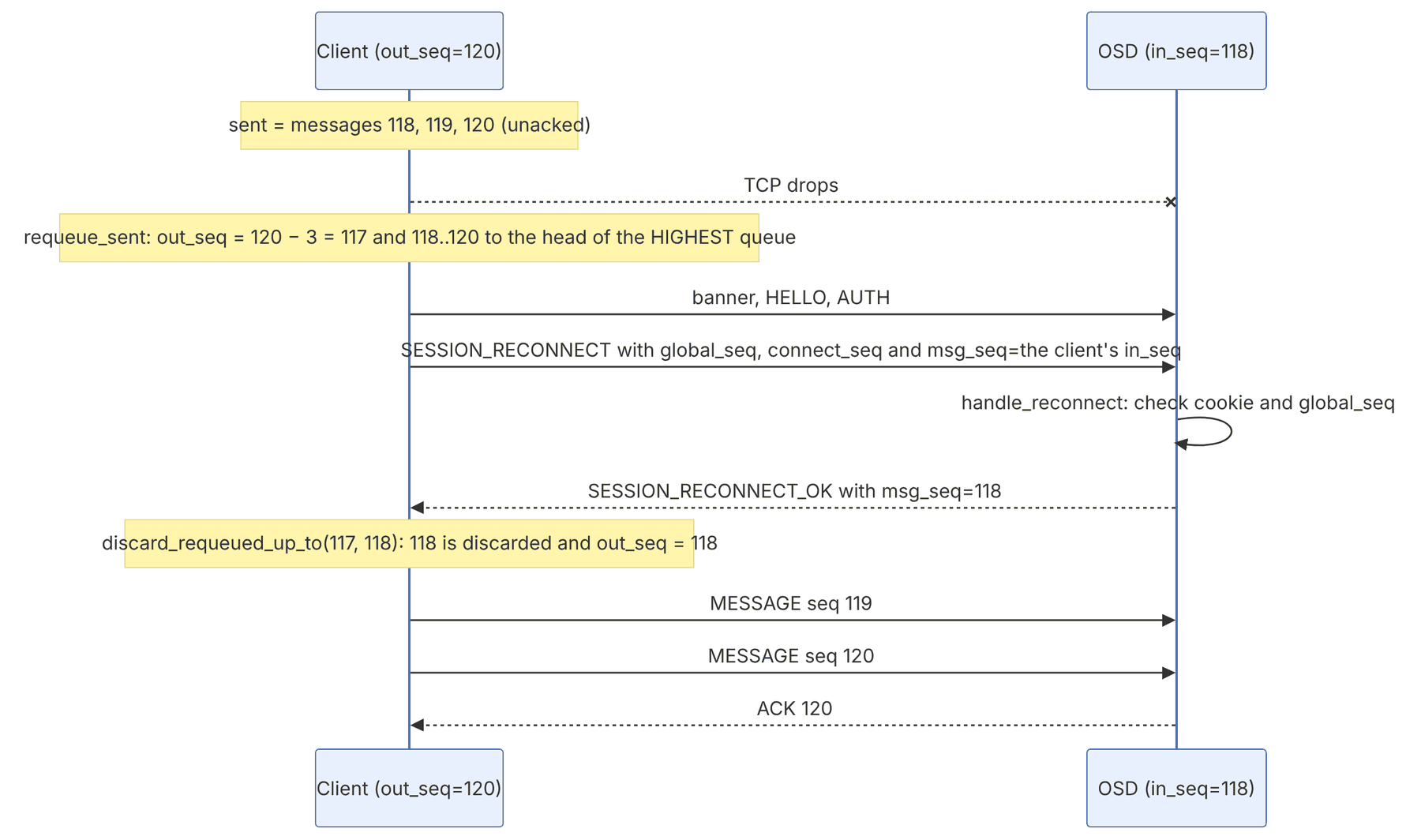
on fault (lossless connection): requeue_sent():
    out_seq −= |sent|
    for the sent messages from last to first: clear_payload ; push_front into out_queue[HIGHEST]
handle_reconnect_ok(msg_seq from the peer):
    out_seq = discard_requeued_up_to(out_seq, msg_seq)
discard_requeued_up_to(out_seq, seq):
    count = out_seq
    while the HIGHEST queue is not empty and front.seq ≠ 0 and front.seq ≤ seq: pop_front ; count++
    return count
Numerical example. A client has sent up to seq 120, but acks have arrived only up to 117. So sent = {118, 119, 120}. When TCP drops, requeue_sent sets out_seq back to 117 and moves the three messages to the head of the queue. The OSD had received 118 before the drop (in_seq = 118), so it returns msg_seq = 118 in SESSION_RECONNECT_OK. discard_requeued_up_to(117, 118) discards message 118 and out_seq becomes 118. Only 119 and 120 are sent again, and no message reaches dispatch twice. The payload of each message is cleared (clear_payload), because the features of the new connection may differ and a fresh encode may be needed.
26-12 Supplementary and up to date#
- msgr2.1 (the REVISION_1 bit) exists in Nautilus and later releases. It changed the epilogue format and the inlining of the first segment in secure mode, and it removed the epilogue from single-segment frames. msgr2.0 is kept only for compatibility with early Nautilus releases.
- On-wire compression (
COMPRESSION_REQUESTandCOMPRESSION_DONE, thems_osd_compress_modeoption) is negotiated after auth. Its default isnone. - The Linux kernel has supported msgr2.1 since 5.11, with the
ms_modeoption (legacy,crc,secure,prefer-crc,prefer-secure) (chapter 29). - crimson-osd uses a Seastar-based messenger instead of AsyncMessenger, but it has the same msgr2 format on the wire.
26-13 Hands-on exercise#
- 1. Capture the first 26 bytes of a connection to port 3300 with
tcpdumpand compare the banner and features with this chapter's table. - 2. Write a Python encoder for KEEPALIVE2 and check the preamble crc against this chapter's calculation (0x99F5D5D8).
- 3. On a test cluster set
ms_client_mode=secureandms_cluster_mode=secure, and compare the CPU used by the msgr-workers withrados benchandtop -H. - 4. During a
rados bench, take one OSD's network card down for 5 seconds and find the SESSION_RECONNECT and RECONNECT_OK messages in the log (debug_ms=1).
26-14 Review questions#
- 1. What is the structure of the msgr2 banner, and which features exist today?
- 2. Why is the preamble exactly 32 bytes?
- 3. With what seeds are the preamble crc and the segment crc computed?
- 4. Why does the data segment have an alignment of 4096?
- 5. What is the benefit of inlining 48 bytes in secure mode?
- 6. What attack does AUTH_SIGNATURE prevent?
- 7. When are SESSION_RESET and SESSION_RETRY_GLOBAL sent?
- 8. What are the three throttlers on message receive, and how do they create backpressure?
- 9. Why must handlers in EventCenter read until EAGAIN?
- 10. How does another thread wake a worker to send a message?
Answers to these questions are in Appendix E: Answers to Review Questions. Answers to this chapter's questions →
26-15 Sources for this chapter#
- msgr2 design document
https://docs.ceph.com/en/latest/dev/msgr2/ - frames_v2.h
https://github.com/ceph/ceph/blob/main/src/msg/async/frames_v2.h - ProtocolV2.cc
https://github.com/ceph/ceph/blob/main/src/msg/async/ProtocolV2.cc - crypto_onwire.cc
https://github.com/ceph/ceph/blob/main/src/msg/async/crypto_onwire.cc - Messenger configuration
https://docs.ceph.com/en/latest/rados/configuration/msgr2/ - The ms_mode option in the kernel
https://docs.kernel.org/filesystems/ceph.html - NIST SP 800-38D (GCM
https://csrc.nist.gov/pubs/sp/800/38/d/final - epoll(7
https://man7.org/linux/man-pages/man7/epoll.7.html