Lower Layers (2): BlueStore and BlueFS On-Disk Format
TL;DR this chapter in a few lines
- BlueFS is a tiny file system that holds RocksDB; its superblock and log describe the files and are compacted when the log grows.
- Object keys in RocksDB are built so a range scan returns a PG's objects in order; the onode holds size, xattrs and the extent map.
- The extent map maps logical ranges to blobs; shared blobs with reference counts make clones and snapshots cheap.
- Allocators (AVL, bitmap, hybrid) and the freelist track free space; the fragmentation score shows how scattered it is.
24-1 Introduction: what does BlueStore write on disk?#
In chapter 23 we saw how bytes get from a bufferlist to io_submit. This chapter shows where and in what format those bytes land on disk: from the device's first 4 kilobytes (the label) to the superblock and the BlueFS log, and from the RocksDB keys that hold the onode and extent map to the freelist bits and the in-memory cache structure. All structures were extracted from the main branch of the Ceph code (src/os/bluestore/). Wherever behaviour depends on the version, it is marked.
- The first 4K of every BlueStore device is a label, and the second 4K is the BlueFS superblock. New versions also copy the label at 1G, 10G, 100G and 1000G.
- BlueFS is a small append-only file system for RocksDB. Its metadata lives in a log file (ino 1) as transactions of type
bluefs_transaction_t. - Compact encoding with
denc_varint_lowzanddenc_lbameans a 4K-aligned extent usually fits in 5 bytes. - The onode is under key
O, and large extent maps are broken into shards with anxsuffix. - The default allocator is hybrid (AVL with overflow to Bitmap). The freelist in RocksDB is only used when "allocation from file" mode is off.
24-2 The device label: bluestore_bdev_label_t#
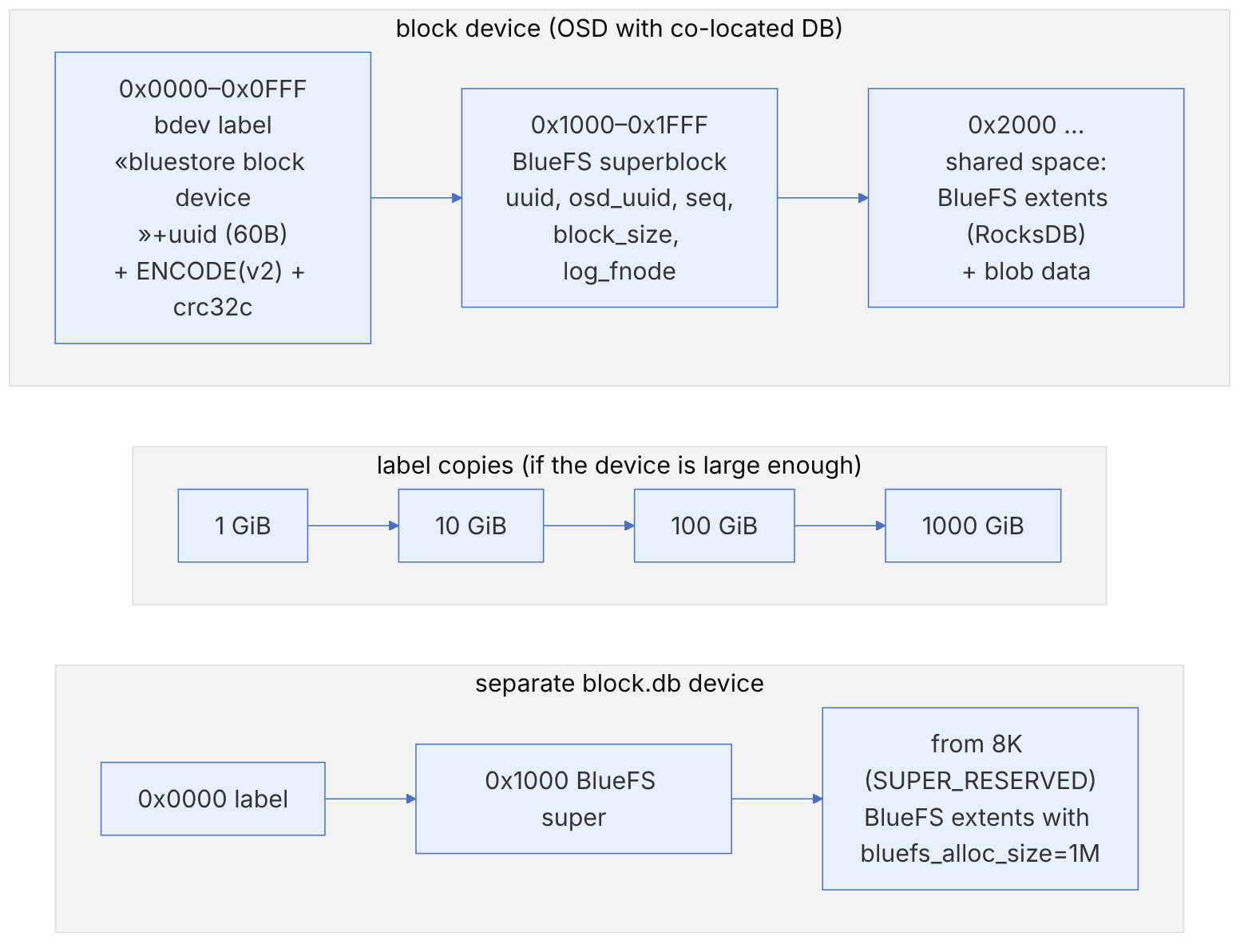
The constants are defined in bluestore_common.h: BDEV_FIRST_LABEL_POSITION = 0, BDEV_LABEL_BLOCK_SIZE = 4096, BLUEFS_SUPER_POSITION = 4096 and SUPER_RESERVED = 8192. The label's content, in order:
| Bytes | Content | Description |
|---|---|---|
| 0–22 | bluestore block device\n | 23 ASCII bytes, for anyone looking at the device with hexdump |
| 23–58 | the OSD's uuid as text | 36 characters |
| 59 | \n | 60 bytes in total; the decoder skips this part with p += 60 |
| 60… | ENCODE_START(2,1) | struct_v=2, compat=1, length (u32) |
| … | osd_uuid (16 bytes), size (u64), btime (utime_t), description (string) | description is for example main or bluefs db |
| … | meta: map<string,string> | keys such as ceph_fsid, whoami, osd_key, ready, kv_backend, type=bluestore |
| end | crc32c (u32) over everything above with seed −1 | then zeros up to 4096 bytes |
# reading the label (read-only; the OSD can be running)
ceph-bluestore-tool show-label --dev /dev/ceph-xxx/osd-block-yyy
dd if=/dev/ceph-xxx/osd-block-yyy bs=4096 count=1 2>/dev/null | hexdump -C | head -5The osd_key value in meta is a cephx key. Never put the output of show-label in a ticket or chat without removing this field.
Why multiple copies? In old versions, corruption of the first 4K (for example by wipefs or a partitioning tool writing by mistake) made the OSD unrecoverable. The main branch has the array bdev_label_positions = {0, 1G, 10G, 100G, 1000G}. At mount, BlueStore reads a valid label from any healthy position (_read_multi_bdev_label) and keeps the valid positions in bdev_label_valid_locations. Because old versions may have used those regions for data, a copy is only written where the allocator has reserved it. Check the reservation mechanism and the exact range of versions in your version's release notes before relying on it.
24-3 Compact encodings: varint, lowz and lba#
Before going to the structures, you need to know three encodings defined in include/denc.h and used everywhere in BlueStore metadata:
| Function | Format | Use |
|---|---|---|
denc_varint | 7 data bits per byte; the high bit means "another byte follows" (little-endian) | counters, blobid |
denc_varint_lowz | the low 2 bits = number of trailing zero nibbles removed (0 to 3), then a varint | lengths (usually multiples of 4K) |
denc_lba | a 32-bit word: the first 1 to 3 bits are the kind of trailing-zero removal (0=12 bits, 01=16, 011=20, 111=none), then 28 to 30 data bits, bit 31 = continuation | physical offsets on disk |
| Value | denc_varint | denc_varint_lowz | denc_lba |
|---|---|---|---|
| 0x1000 (4K) | 80 20 | 07 | 02 00 00 00 |
| 0x3000 (12K) | 80 60 | 0f | — |
| 0x10000 (64K) | 80 80 04 | 43 | — |
| 0x12340000 | — | — | d1 48 00 00 |
| 0x3a8f05000 | — | — | 0a 1e 75 00 |
Step-by-step lowz example for 0x10000: this number has 16 trailing zero bits, that is 4 nibbles, but the cap is 3. So 0x10000 >> 12 = 0x10 and (0x10 << 2) | 3 = 0x43, which fits in one byte.
lba example for 0x12340000: this number has 18 trailing zero bits, that is 4 full nibbles. So t = 4 − 3 = 1, and the "remove 16 bits" mode with prefix 01 is chosen: 0x12340000 >> 16 = 0x1234 and word = 0b01 | (0x1234 << 2) = 0x48D1. The output is four little-endian bytes: d1 48 00 00. We computed these values with an independent Python implementation based on the logic of denc.h.
The practical result: a bluestore_pextent_t (offset with denc_lba and length with denc_varint_lowz) for a typical 4K-aligned 64K extent is only 5 bytes, while its raw form would be 12 bytes (u64 + u32). When you have billions of extents in RocksDB, this difference has a big effect on DB size and cache hit rate.
24-4 BlueFS: a file system for RocksDB#
RocksDB needs a file system (SST, WAL, MANIFEST and CURRENT files). Instead of ext4 or XFS, BlueStore has its own small file system, BlueFS, connected to RocksDB through BlueRocksEnv. BlueFS implements only what RocksDB needs: a few flat directories, append-only files, rename, unlink and fsync.
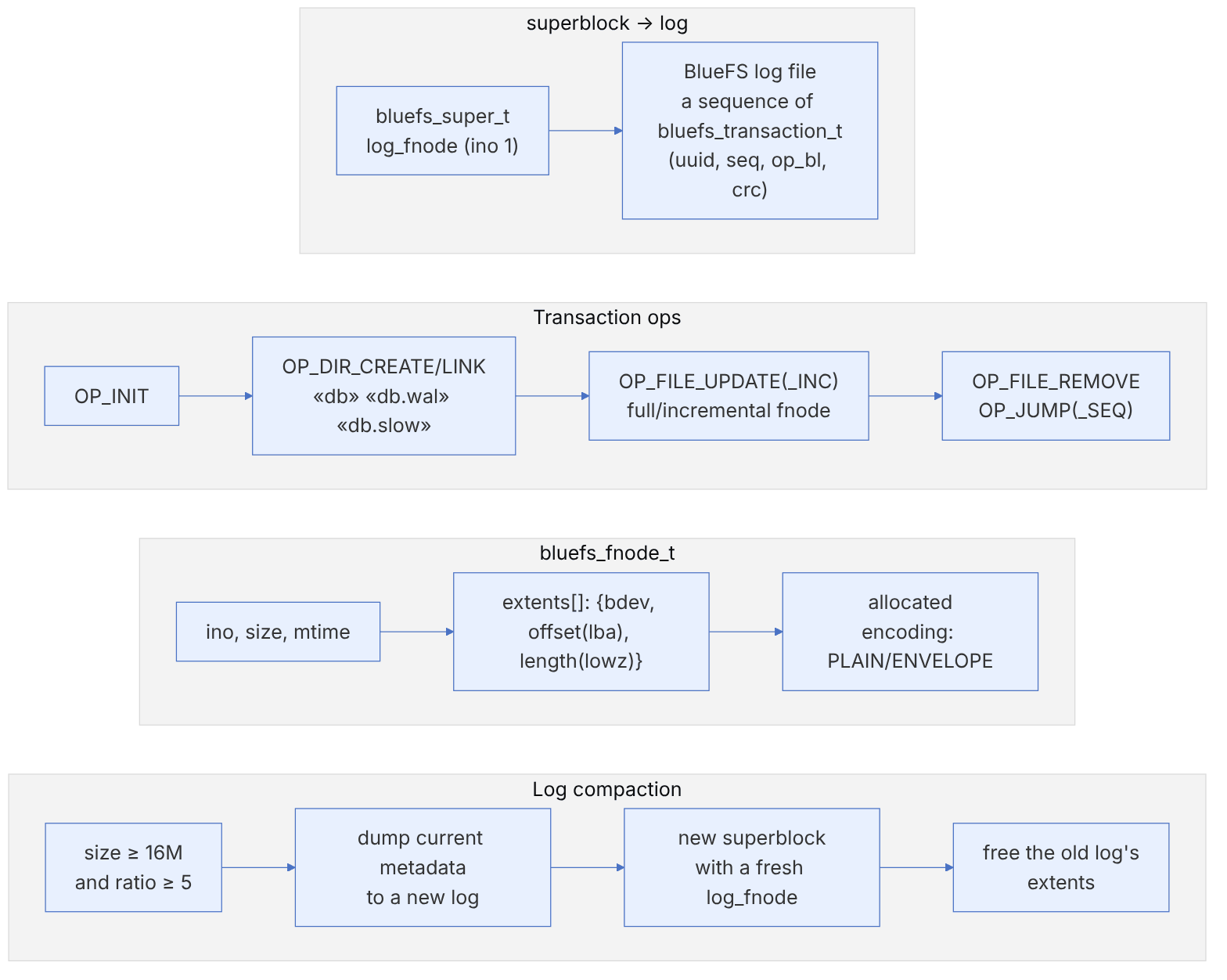
24-4-1 Structures#
| struct | Fields | Note |
|---|---|---|
bluefs_super_t | _version, uuid, osd_uuid, seq, block_size, log_fnode, memorized_layout | _version is BASELINE=2 or ENVELOPE_MODE_ENABLED=3 |
bluefs_fnode_t | ino, size, mtime, extents, allocated, encoding, content_size | extents_index is in memory only, for finding an extent with upper_bound |
bluefs_extent_t | offset (lba), length (lowz), bdev (u8) | bdev: WAL=0, DB=1, SLOW=2, NEWWAL=3, NEWDB=4 (MAX_BDEV=5) |
bluefs_transaction_t | uuid, seq, op_bl | op_t from OP_NONE to OP_FILE_UPDATE_INC; the ALLOC_ADD/RM ops are obsolete |
pseudocode: BlueFS mount (this book's summary)
  super = decode(read(bdev[DB or SLOW], 0x1000, 4096)); verify crc
  log_reader = open(super.log_fnode)
  pos = 0
  repeat:
      read header at pos; if uuid != super.uuid or seq != expected → end of log
      t = decode(bluefs_transaction_t); verify crc
      for op in t.op_bl:
          INIT        → nothing
          DIR_CREATE  → dir_map[name] = {}
          DIR_LINK    → dir_map[d][f] = ino
          FILE_UPDATE → file_map[ino].fnode = fnode
          FILE_UPDATE_INC → merge extents into file_map[ino].fnode
          FILE_REMOVE → release extents (unless shared)
          JUMP/JUMP_SEQ → pos/seq = ...
      pos = next block-aligned boundary
# at the end, each bdev's allocator is built from the extents of all fnodes| Option | Default (main) | Effect |
|---|---|---|
bluefs_alloc_size | 1_M | allocation unit on dedicated DB and WAL devices |
bluefs_shared_alloc_size | 64_K | allocation unit on a device shared with data |
bluefs_min_log_runway / bluefs_max_log_runway | 1_M / 4_M | pre-allocated space for the log to continue |
bluefs_log_compact_min_size | 16_M | a log smaller than this is never compacted |
bluefs_log_compact_min_ratio | 5 | ratio of actual to estimated size to start compaction |
bluefs_buffered_io | true | BlueFS reads use the kernel page cache |
24-4-2 Log compaction and envelope mode#
_should_start_compact_log_L_N() compares the current log size with _estimate_log_size_N(). If both conditions in the table above hold, _compact_log_async_LD_LNF_D() runs: a complete image of the metadata (all directories and fnodes) is written into a new log, the superblock is updated with the new log_fnode and a higher seq, and the old log's extents are freed. The order of these steps is such that a crash at any moment leaves either the old log intact or the new log complete.
Version-dependent: bluefs_node_encoding (PLAIN, ENVELOPE, ENVELOPE_FIN) exists in Tentacle and main but not in Squid. In envelope mode, data appended to a file (for example RocksDB's WAL) is placed in a self-describing envelope. So for each fsync the file size does not need to be updated in the BlueFS log, and an extra synchronous write is eliminated. After a crash, the region between size and allocated is scanned to find the envelopes.
ceph-bluestore-tool bluefs-bdev-sizes --path /var/lib/ceph/osd/ceph-4      # OSD stopped
ceph-bluestore-tool bluefs-log-dump --path /var/lib/ceph/osd/ceph-4
ceph daemon osd.4 bluefs stats                         # admin socket on the OSD host
ceph-bluestore-tool bluefs-export --path ... --out-dir /tmp/bluefs # RocksDB files for ldb24-5 The full map of KV prefixes#
All of BlueStore's metadata lives in RocksDB. The first character of each key is its "prefix", defined in BlueStore.cc:
| Prefix | Constant name | Key → value |
|---|---|---|
S | PREFIX_SUPER | field name → value (nid_max, blobid_max, min_alloc_size, per_pool_omap, ...) |
T | PREFIX_STAT | pool or whole-store statistics (an int64 array with an int64_array merge operator) |
C | PREFIX_COLL | collection (PG) name → bluestore_cnode_t (only the bits field) |
O | PREFIX_OBJ | object key → bluestore_onode_t; extent map shards with an x suffix |
M | PREFIX_OMAP | u64 (nid) + key name → value (old, global omap) |
P | PREFIX_PGMETA_OMAP | omap of the pgmeta object (pg log and pg info) |
m | PREFIX_PERPOOL_OMAP | s64 (pool) + u64 (nid) + key name → value |
p | PREFIX_PERPG_OMAP | u64 (pool) + u32 (hash) + u64 (nid) + key name → value (the default in new versions) |
L | PREFIX_DEFERRED | seq → bluestore_deferred_transaction_t |
B | PREFIX_ALLOC | freelist metadata (size, blocks_per_key, ...) |
b | PREFIX_ALLOC_BITMAP | offset → bitmap (through BitmapFreelistManager) |
X | PREFIX_SHARED_BLOB | sbid → bluestore_shared_blob_t |
To see the volume of each prefix on a stopped OSD, use ceph-kvstore-tool bluestore-kv /var/lib/ceph/osd/ceph-4 stats, or count the onode keys with list O | wc -l. On a healthy RBD OSD, O and p usually have the most volume. If L is large, deferred writes are piling up.
24-6 The onode: from key to extent#
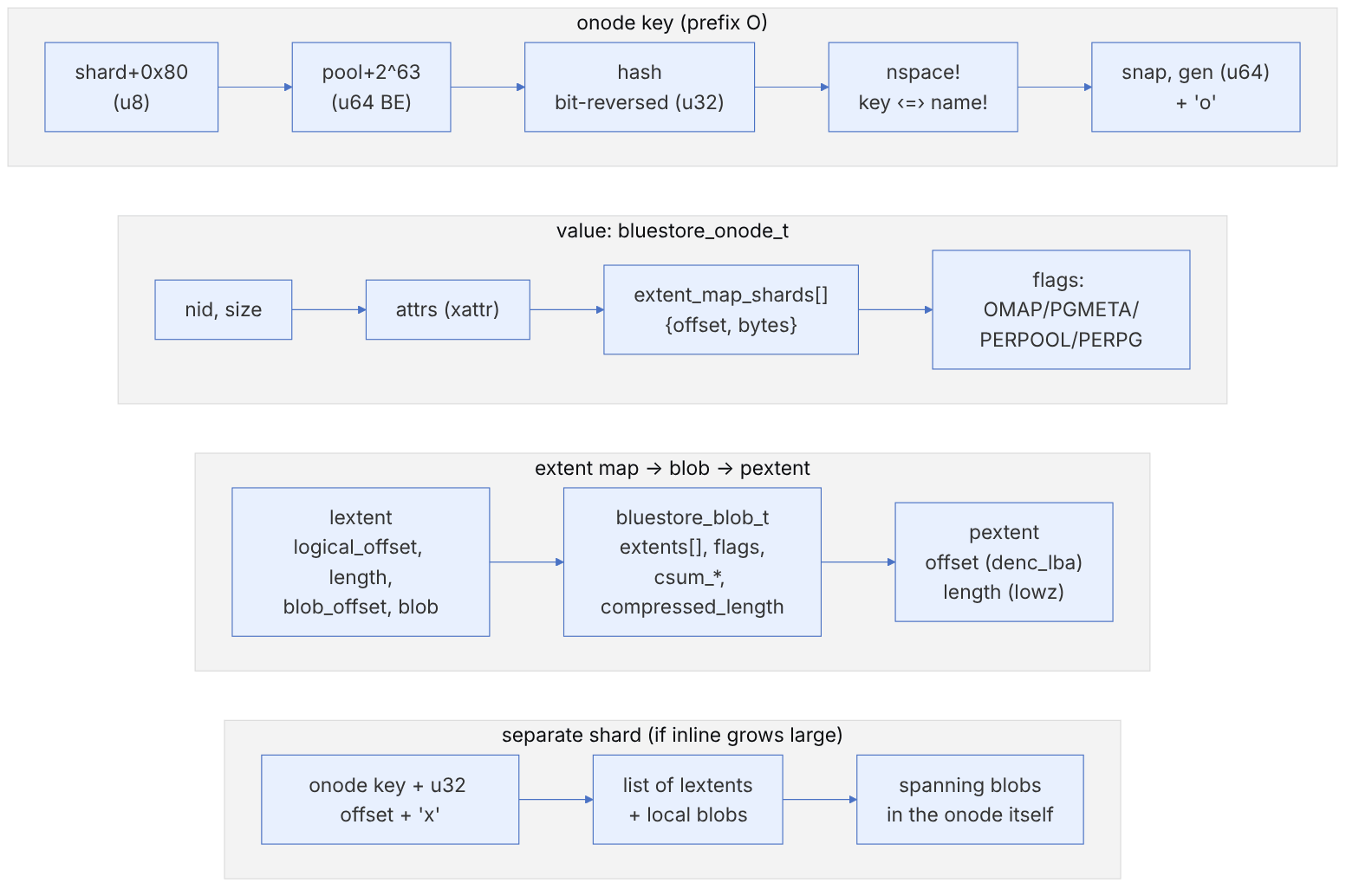
24-6-1 The object key#
The key is built so that a sequential RocksDB scan gives exactly the order of a PG's objects. So collection_list (used in scrub and backfill) becomes a simple range scan:
| Component | Encoding | Reason |
|---|---|---|
| shard | u8(shard.id + 0x80) | shard = −1 (NO_SHARD) becomes 0x7F and sorts before the EC shards (0x80 and up) |
| pool | u64(pool + 2^63) big-endian | negative (temp) pools sort before positive ones |
| hash | bit-reversed u32, big-endian | PGs are contiguous ranges of the bit-reversed hash, so a PG's objects fall next to each other |
| namespace and key | escaped string + ! | characters ≤ # become #xx and ≥ ~ become ~xx |
< or = or > | one character | = means the key equals the name and the name is not written again |
| snap, generation | u64 big-endian | snaps and EC generations one after another |
o | suffix | distinguishes the onode from extent shards (x) |
24-6-2 bluestore_onode_t#
The main fields: nid (a local numeric ID for omap keys), size, attrs (xattrs such as _ for object_info_t and snapset), extent_map_shards (a list of {offset, bytes}), expected_object_size, expected_write_size, alloc_hint_flags, segment_size and flags (FLAG_OMAP=1, FLAG_PGMETA_OMAP=2, FLAG_PERPOOL_OMAP=4, FLAG_PERPG_OMAP=8). If extent_map_shards is empty, the whole extent map is stored inline after the onode in the same value.
24-6-3 The extent map and its compact encoding#
Each lextent has four numbers: logical_offset, length, blob_offset and a reference to a blob. ExtentMap::encode_some avoids repeating information with four flags in the low bits of the blobid:
| Flag | Value | Meaning |
|---|---|---|
BLOBID_FLAG_CONTIGUOUS | 0x1 | this extent starts exactly after the previous one, so logical_offset is not written |
BLOBID_FLAG_ZEROOFFSET | 0x2 | blob_offset is zero |
BLOBID_FLAG_SAMELENGTH | 0x4 | the length equals the previous extent's |
BLOBID_FLAG_SPANNING | 0x8 | the blob is a spanning blob (shared across several shards) and its ID is written |
The remaining bits (after BLOBID_SHIFT_BITS = 4) are the blob ID. If the blob is local and appears for the first time in this shard, zero is written as the ID and the decoder infers it from its own counter.
Numerical example: an RBD image with a 4M object that has received two consecutive 64K writes at offsets 0 and 0x10000, each in a new blob:
| extent | blobid before varint | lextent bytes |
|---|---|---|
| 1: lo=0, len=0x10000, boff=0 | CONTIGUOUS + ZEROOFFSET = 0x3 | 03 + lowz(0x10000)=43 → 2 bytes |
| 2: lo=0x10000, len=0x10000, boff=0 | CONTIGUOUS + ZEROOFFSET + SAMELENGTH = 0x7 | 07 → 1 byte |
After each lextent, if the blob is new, the blob itself is also encoded: flags, pextents (about 5 bytes each) and the checksum array. For a 64K blob with crc32c and a 4K chunk, the checksum array is 16 × 4 = 64 bytes. So checksums are the dominant part of an onode's size, not the addresses. With bluestore_csum_type=crc32c_16 this volume is halved.
| Option | Default | Role |
|---|---|---|
bluestore_extent_map_shard_max_size | 1200 | if a shard grows beyond this size (encoded bytes), it is resharded |
bluestore_extent_map_shard_target_size | 500 | target size when resharding |
bluestore_extent_map_shard_min_size | 150 | shards smaller than this are merged with a neighbour |
bluestore_extent_map_inline_shard_prealloc_size | 256 | buffer pre-allocation for the shard inside the onode |
Why sharding? RocksDB rewrites each update in full (an LSM has no read-modify-write at the value level). If an RBD image has many random 4K writes on one 4M object, its extent map gets hundreds of lextents. Without shards, every 4K write would have to rewrite several kilobytes of onode into the WAL and memtable, and metadata write amplification would rise sharply. With shards, only the shard containing the written range (about 500 bytes) becomes dirty.
24-6-4 Shared blobs and clones#
When rbd snap or clone_range shares a blob between two onodes, the FLAG_SHARED flag is set on the blob and it gets an sbid. The reference counts of its physical extents (bluestore_extent_ref_map_t: offset → {length, refs}) are stored under key X + sbid. Deleting one of the clones only decrements refs. The physical space is freed when refs reaches zero.
24-7 Deferred writes on disk#
For writes smaller than bluestore_prefer_deferred_size (64K on HDD), BlueStore first writes the data into RocksDB together with the metadata transaction. Its structure:
| struct | Fields |
|---|---|
bluestore_deferred_op_t | op (only OP_WRITE=1), extents (the destination PExtentVector), data (bufferlist) |
bluestore_deferred_transaction_t | seq, ops (a list), released (an interval_set of space freed after applying) |
pseudocode: the deferred cycle (this book's summary)
  txc: kv.set("L" + seq, encode(deferred_txn)); kv.submit_sync()     # RocksDB's WAL = durability
  ack → client
  deferred_queue: gather until bluestore_deferred_batch_ops or throttle pressure (128M)
  _deferred_submit: aio_write(extents, data) on the main device (no separate fsync)
  _deferred_aio_finish → in the next txc: kv.rmkey("L" + seq)     # after the device flush
mount after a crash: _deferred_replay() rewrites all L* to disk (idempotent)24-8 The allocator: who knows the free space?#
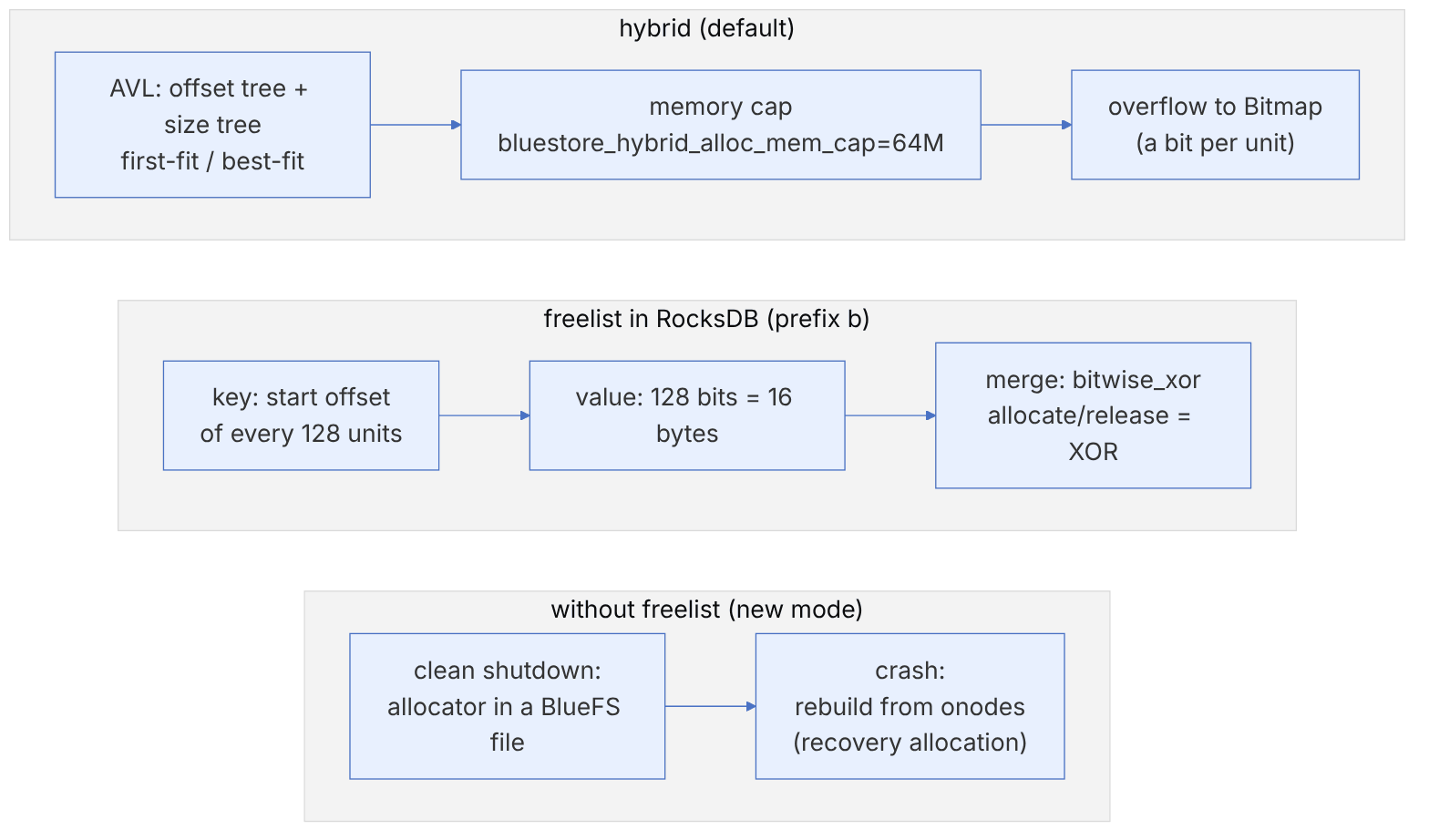
| Allocator | Structure | Property |
|---|---|---|
bitmap | a three-level bit tree (fastbmap_allocator_impl) | fixed, predictable memory (1 bit per unit), but searching for large pieces is slower |
avl | two AVL trees: by offset and by size | first-fit up to bluestore_avl_alloc_bf_threshold=128K or while free space is above bf_free_pct=4%, then best-fit |
btree / hybrid_btree2 | a B-tree instead of AVL | lower memory use per range |
hybrid (default) | AVL + Bitmap for overflow | memory cap with bluestore_hybrid_alloc_mem_cap=64M |
stupid | bin trees | testing only |
bluestore_allocator_lookup_policy (present in Squid, Tentacle and main) determines whether the search continues from the last found position (hdd_optimized, for sequential writes on HDD and QLC) or starts from the beginning of the device (ssd_optimized), or is chosen automatically by device type (auto).
24-8-1 The fragmentation score#
Allocator::get_fragmentation_score() returns a number between 0 (one contiguous piece) and 1 (all free space in single-block pieces). The idea is that a 2X-byte piece is more valuable than two X-byte pieces. For pieces smaller than 1M, each doubling of length gets 1.2 times the weight; this factor falls linearly to 1 by 128M and stays constant above that. The score is computed like this:
score(len) ≈ an increasing convex function (linear interpolation between 2^k and 2^(k+1) with the factors above)
ideal    = score(sum)                          # all free space in one piece
terrible = (sum / block_size) × score(block_size)
actual   = Σ score(len_i)
fragmentation = (ideal − actual) / (ideal − terrible)| Free space state (conceptual example) | Score |
|---|---|
| one contiguous 100G piece | 0 |
| thousands of 4M pieces | middling |
| millions of scattered 4K pieces | close to 1 |
ceph daemon osd.4 bluestore allocator score block       # {"fragmentation_rating": 0.27...}
ceph daemon osd.4 bluestore allocator fragmentation histogram block
ceph-bluestore-tool free-score --path /var/lib/ceph/osd/ceph-4 # OSD stoppedA score above 0.8 on HDD usually means new blobs are broken into several pieces and sequential writes turn into random ones. The usual solution is adding capacity or reducing fullness. There is no magic defrag tool for BlueStore. Rebuilding the OSD (removal and backfill) is the last resort.
24-8-2 The freelist and freelist-less mode#
In BitmapFreelistManager, bytes_per_block equals the allocation unit (min_alloc_size) and blocks_per_key = bluestore_freelist_blocks_per_key = 128. So each b key, with a 16-byte value, covers 128 units (with a 4K unit, 512K of disk). Allocation and release are both an XOR with a mask (XorMergeOperator named bitwise_xor). So without reading the previous value, only one merge is sent to RocksDB.
The bluestore_allocation_from_file option has existed since Quincy (it is not in Pacific), and on main its default is true. In this mode the freelist update is removed from the write path, and on a clean umount BlueStore writes the allocator map into the file ALLOCATOR_NCB_DIR/ALLOCATOR_NCB_FILE inside BlueFS. If the shutdown is not clean, the next mount scans all onodes with read_allocation_from_onodes to rebuild the used space. This makes transactions lighter, but after a crash it adds several minutes to the mount time of OSDs full of objects.
24-9 The BlueStore cache#
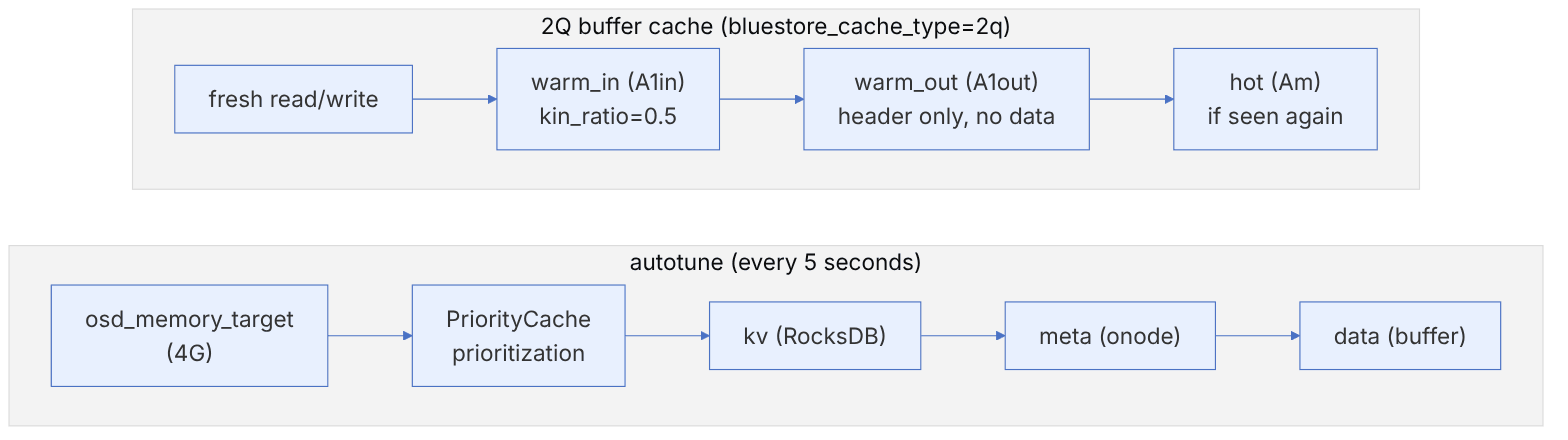
| Option | Default | Role |
|---|---|---|
bluestore_cache_type | 2q | buffer cache type (2q or lru); the onode cache is always LRU |
bluestore_2q_cache_kin_ratio / kout_ratio | 0.5 / 0.5 | warm_in share and warm_out size |
bluestore_cache_autotune | true | dynamic split with PriorityCache |
bluestore_cache_autotune_interval | 5 | seconds |
bluestore_cache_size_hdd / ssd | 1_G / 3_G | only when autotune is off |
bluestore_cache_meta_ratio / kv_ratio / kv_onode_ratio | 0.45 / 0.45 / 0.04 | initial shares in manual mode |
osd_memory_cache_min | 128_M | floor for the whole cache |
The caches are sharded (each OSD op shard has its own cache) to reduce lock contention. Onodes are pinned with a reference counter. An onode in use by an in-flight transaction is not evicted until the transaction ends, even if the cache is full.
ceph daemon osd.4 perf dump bluestore | jq '.bluestore | {onodes, onode_hits, onode_misses}'
ceph daemon osd.4 dump_mempools | jq '.mempool.by_pool | {o: .bluestore_cache_onode, d: .bluestore_cache_data}'24-10 Space allocation in numbers#
The free space of BlueStore's main device is kept by the allocator. The default is bluestore_allocator = hybrid: an AVL allocator that hands part of its ranges to a bitmap allocator when needed. This section follows three of its algorithms with numbers.
24-10-1 near-fit and best-fit in AVL#
Source in code: src/os/bluestore/AvlAllocator.cc :: AvlAllocator::_allocate, _pick_block_after, _pick_block_fits
Complexity: near-fit O(log R + c) with a cap of c = 100 steps or 16 MiB scanned; best-fit O(log R) on the size tree
pseudocode
max_size = the largest range (the end of the size tree)
if max_size < want: want = p2align(max_size, unit) ; force best-fit   # piecewise allocation
free_pct = num_free × 100 / device_size
if force or max_size < bf_threshold (128K) or free_pct < bf_free_pct (4): best-fit
else near-fit:
    align = want & −want ; cursor = lbas[cbits(align) − 1]   # one cursor per power of two
    walk forward from lower_bound(cursor) in the offset tree until offset + want ≤ end
    (at most ff_max_search_count = 100 ranges or ff_max_search_bytes = 16M; then from the start up to cursor)
best-fit: lower_bound({0, want}) in the size tree ⇒ the smallest sufficient range; on a tie, the lower offset
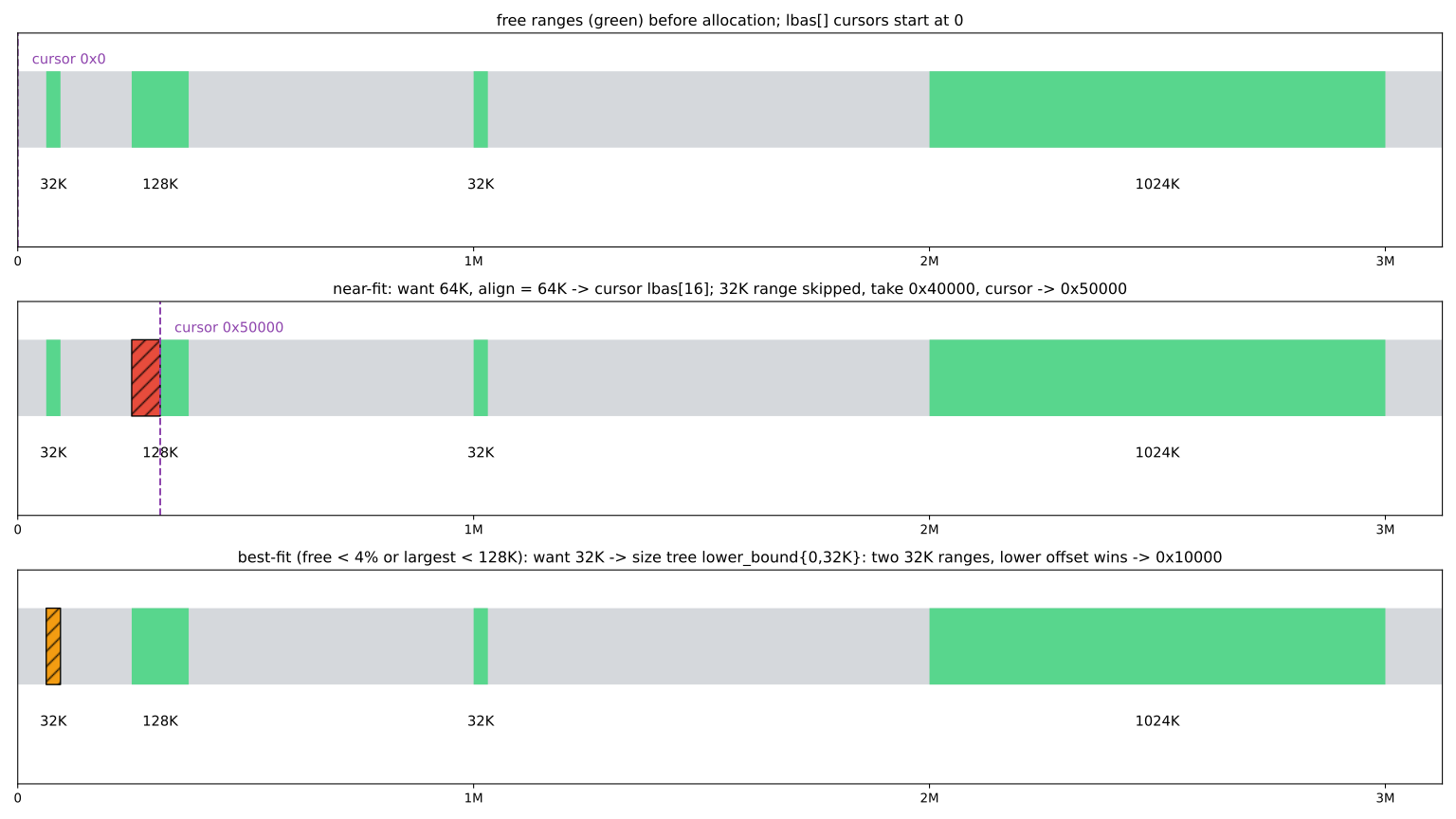
Numerical example. Part of the device has four free ranges: 32K at 0x10000, 128K at 0x40000, 32K at 0x100000 and 1M at 0x200000.
- A 64K request (near-fit): align = 0x10000, so cbits = 17 and cursor = lbas[16] = 0. The first range is too small and the cursor moves to 0x20000. The second range fits: offset = 0x40000 and cursor = 0x50000. The next 64K request continues from 0x50000 with the same cursor, so same-sized allocations land next to each other.
- A 32K request (best-fit): suppose the device is large and free space has dropped below 4%. The size tree has two 32K ranges, and lower_bound with key {0, 32K} returns the one with the lower offset, that is 0x10000. The 1M range stays untouched.
The penalty of near-fit is that it fragments large ranges. best-fit is not slower, but it spreads consecutive allocations apart. That is why it is only enabled when space is low.
24-10-2 The fragmentation score in numbers#
Source in code: src/os/bluestore/Allocator.cc :: Allocator::get_fragmentation_score
Complexity: O(R) for R free ranges (one pass with foreach_interruptible)
pseudocode
scale[0] = 1 ; scale[k+1] = scale[k] × w(k)    # w = 1.2 up to 2^20, linear to 1.0 at 2^27, then 1.0
score(v): sc = floor(log2 v) ; b = 2^sc ; x = (v − b)/b
          return b·scale[sc]·(1 − x) + 2b·scale[sc+1]·x       # linear interpolation
actual = Σ score(len_i) ; ideal = score(Σ len) ; terrible = (Σ len / block_size) × score(block_size)
rating = (ideal − actual) / (ideal − terrible)
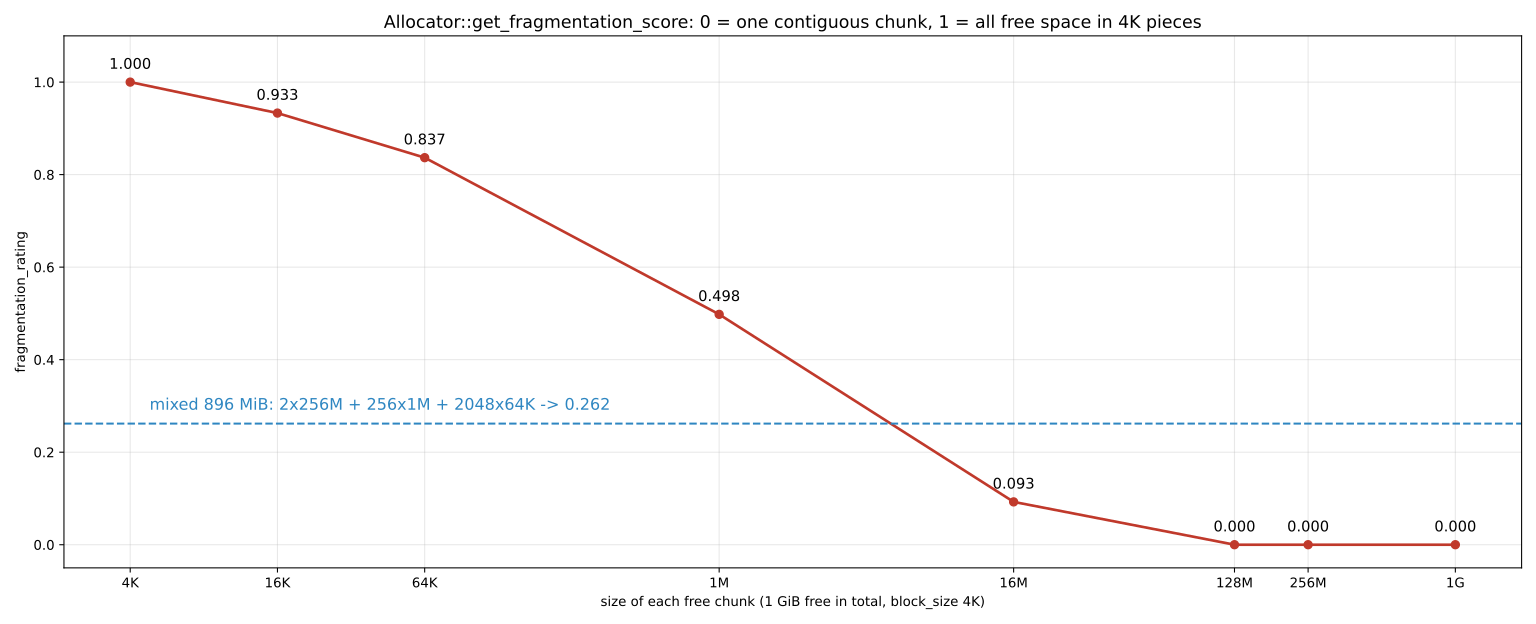
Numerical example (block_size = 4K, 1 GiB free). These numbers were computed with an independent implementation of the same formula:
- One 1G piece, and any piece larger than 128M: score 0.
- 16M pieces: 0.093.
- 1M pieces: 0.498.
- 64K pieces: 0.837.
- 16K pieces: 0.933.
- 4K pieces: 1.
- An 896-megabyte mix (two 256M pieces, 256 1M pieces and 2048 64K pieces): 0.262. Most of the space is in large pieces, so the score stays low even though there are many small pieces.
Because the factor above 128M is 1, pieces larger than 128M carry no penalty. A score above 0.8 on HDD usually means a small min_alloc_size and scattered allocations. In that state, large writes are broken into several extents.
24-10-3 Hybrid overflow to bitmap#
Source in code: src/os/bluestore/AvlAllocator.h :: AvlAllocator::_try_insert_range; src/os/bluestore/HybridAllocator_impl.h :: HybridAllocatorBase::allocate, _spillover_range
Complexity: insert O(log R); with the cap R ≤ range_count_cap
pseudocode
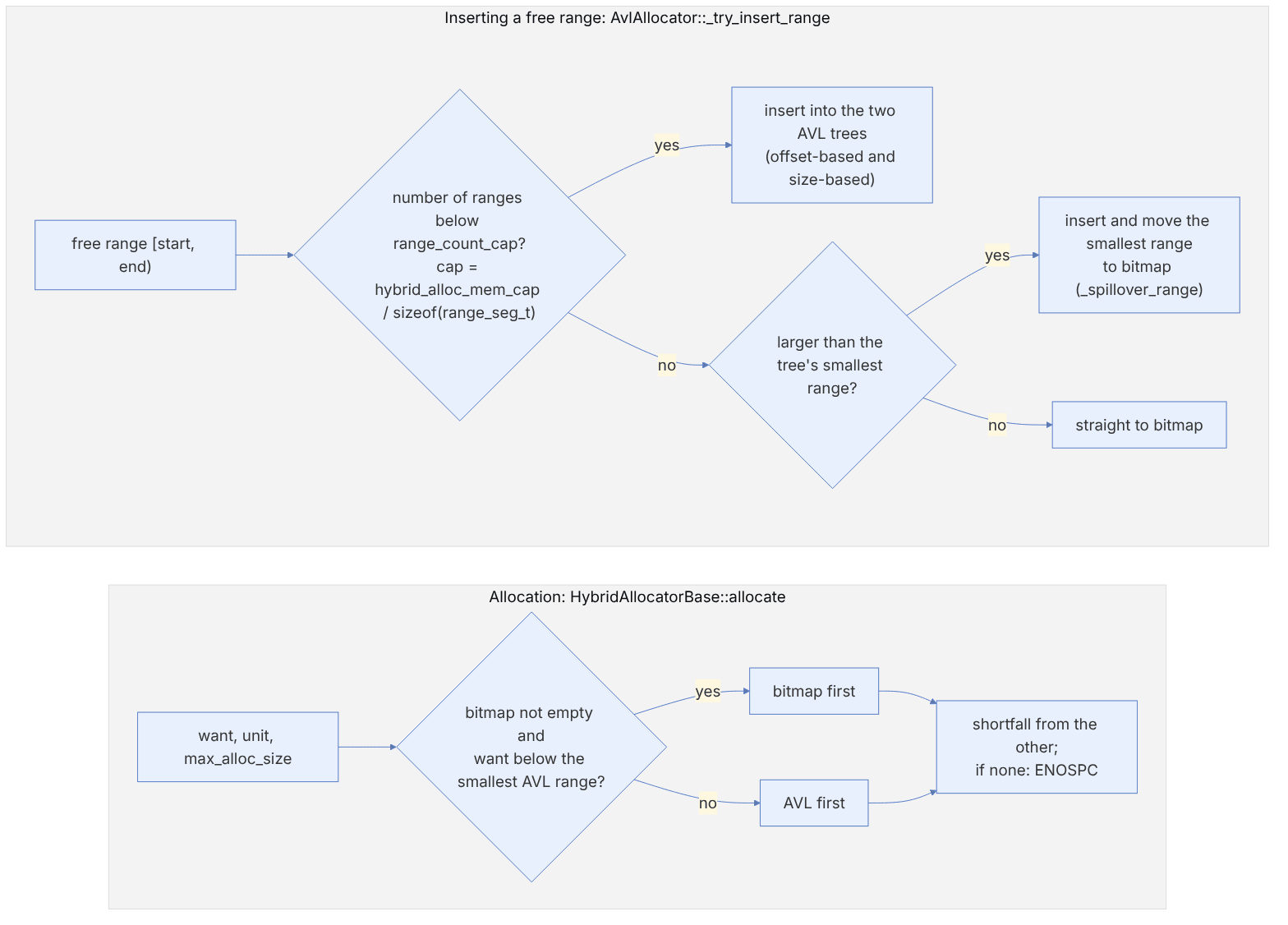
range_count_cap = bluestore_hybrid_alloc_mem_cap (64M) / sizeof(range_seg_t)
insert(start, end):
    if size_tree.size < cap: insert into the AVL
    elif end − start > the smallest AVL range: insert and move the smallest to bitmap
    else: straight to bitmap
allocate(want):
    primary = AVL, unless bitmap has free space and want < the smallest AVL range ⇒ primary = bitmap
    take from primary ; take the shortfall from the other ; nothing ⇒ ENOSPC
Numerical example. Each range_seg_t has two 64-bit numbers (start and end, 16 bytes together) and two boost::intrusive AVL tree hooks (offset_hook and size_hook). MEMPOOL_CLASS_HELPERS() only defines operator new/delete and adds no data member. Each avl_set_member_hook<> with default parameters (no optimize_size) has three pointers, parent, left and right, and a balance field, which with 8-byte alignment comes to 32 bytes. So sizeof(range_seg_t) = 16 + 32 + 32 = 80 bytes. We checked this number by compiling a small program with the same layout on x86-64 (boost.intrusive headers from the main branch, Clang 22.1 via zig c++ 0.17.1, the C++17 standard): the output was hook = 32, seg = 80, offsetof(size_hook) = 48 and alignof = 8. The 64-megabyte cap (bluestore_hybrid_alloc_mem_cap = 64 MiB = 67108864 bytes) therefore keeps ⌊67108864 / 80⌋ = 838860 ranges in the AVL. The real memory is a bit higher, because the heap allocator's overhead is not in this calculation. On 32-bit architectures or with other boost headers the number may differ.
- A sixteen-terabyte HDD with 30% free space and an average piece of 64K: there are about 4.8T / 64K, that is nearly 73 million ranges. So more than 98% of the ranges, the smallest ones, stay in the bitmap, and the AVL keeps only the largest.
- A 4K allocation: it is smaller than the smallest AVL range, so it is taken directly from the bitmap and the large ranges stay untouched.
To see the real state, run ceph daemon osd.N bluestore allocator score block and bluestore allocator fragmentation histogram block. If most ranges are small and the score is high, ceph-bluestore-tool --command free-dump gives the full distribution. This command only runs on a stopped OSD.
24-11 On a real disk: the label and the free space map#
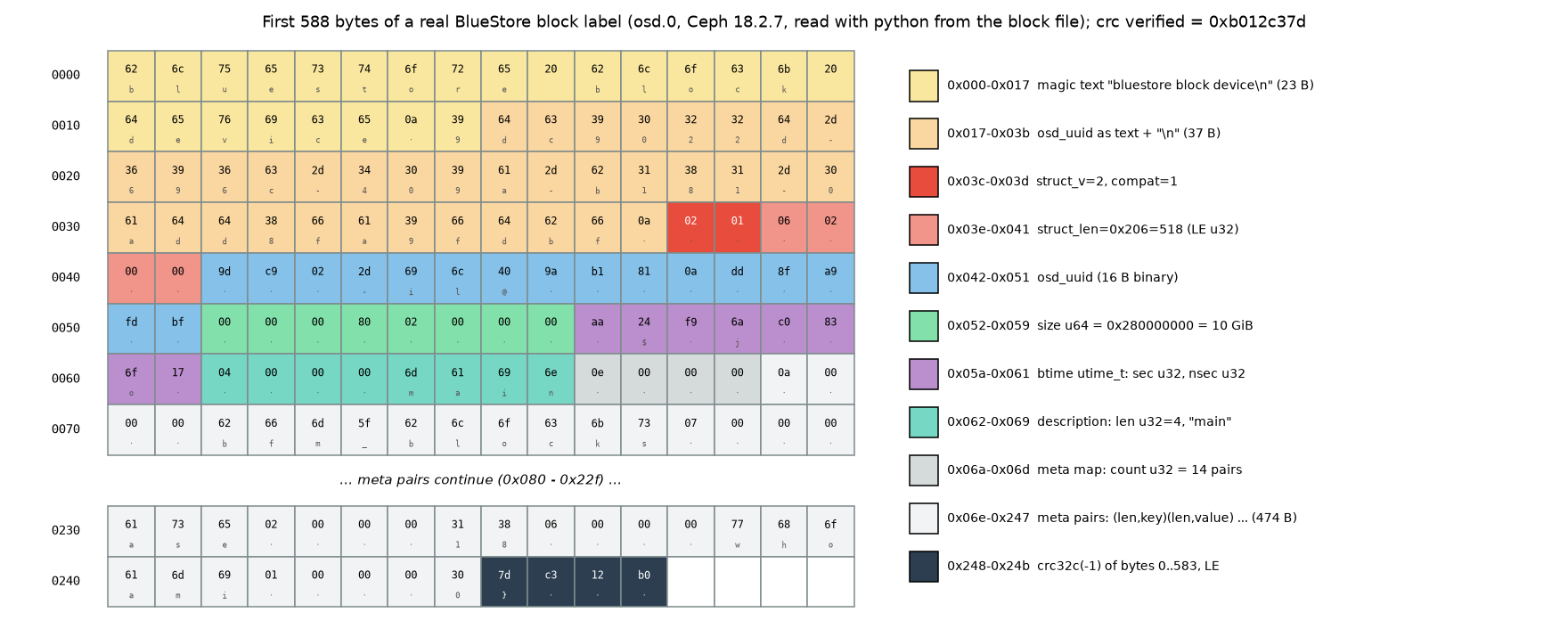
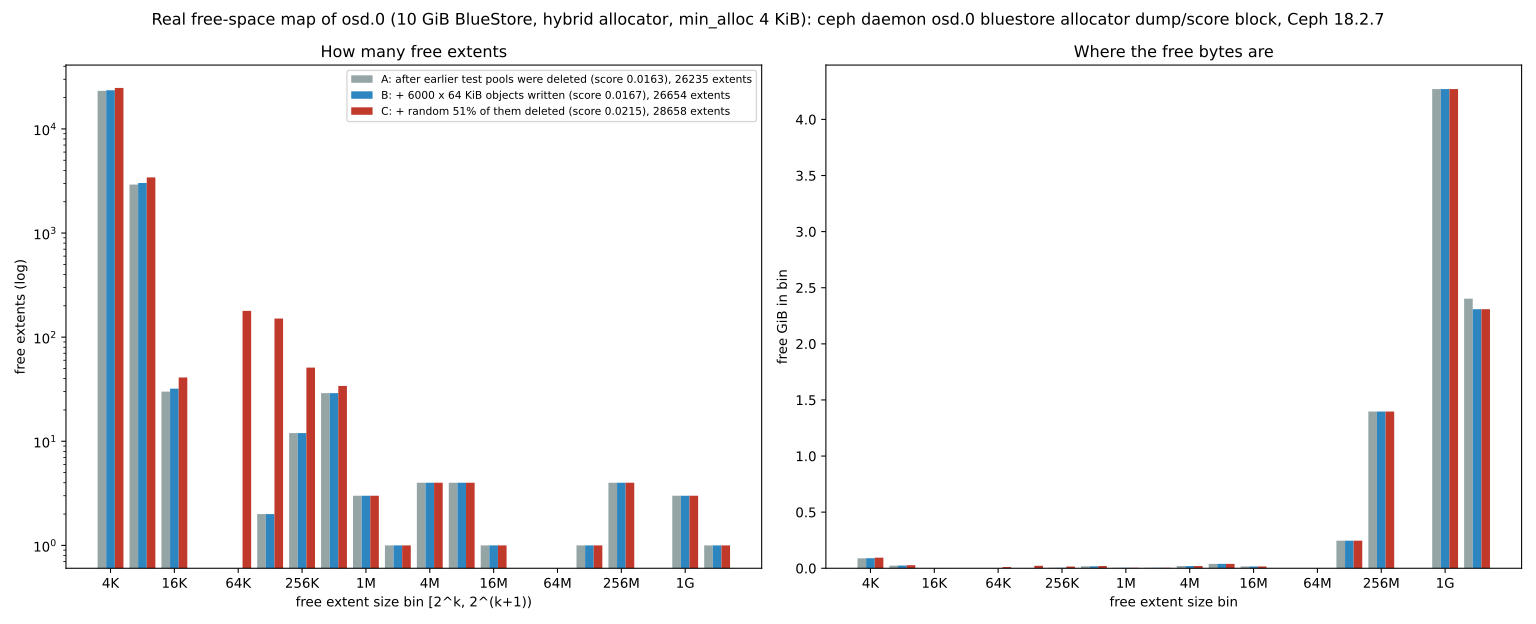
The two figures in this section were taken from the BlueStore OSDs of a test cluster with Ceph 18.2.7. Each OSD's block device was a ten-gigabyte sparse file.
24-11-1 The first 588 bytes of the label#
The bytes were read directly from the block file and compared with the output of ceph-bluestore-tool show-label. This cluster had no cephx, so meta had no osd_key. On a real cluster, remove this field before showing it to anyone.
Source in code: bluestore_bdev_label_t::encode/decode in src/os/bluestore/bluestore_types.cc; _write_bdev_label with bl.crc32c(-1) in BlueStore.cc
Complexity: O(label length)
pseudocode
b = the first 4 KiB of the device
skip the 60 text bytes: "bluestore block device\n" (23) + text uuid + "\n" (37)
struct_v = b[60] ; compat = b[61] ; len = u32le(b[62:66])        # ENCODE_START(2, 1)
osd_uuid = b[66:82] ; size = u64le(b[82:90]) ; btime = (u32 sec, u32 nsec)
description = (u32 len, bytes) ; meta = u32 count then count pairs (u32 len, key)(u32 len, value)
end = 60 + 6 + len ; crc = u32le(b[end:end+4])
valid if crc32c(seed = 0xffffffff, no final xor)(b[0:end]) == crc
Real values.
- Structure header: at offset 0x3c the value
02 01, that is struct_v = 2 and compat = 1, and06 02 00 00, that is a length of 518. So the body continues up to offset 584. - size:
00 00 00 80 02 00 00 00equals 0x280000000, that is 10737418240 bytes. - btime: sec = 1794712746 and nsec = 393184192, that is 2026-11-15 06:49:06.393 Tehran time.
- description and meta: the description value is "main", and meta has fourteen pairs, including
bfm_blocks = 2621440,bfm_bytes_per_block = 4096,kv_backend = rocksdbandmagic = ceph osd volume v026. - crc: the four bytes at offset 0x248 are 0xb012c37d. We recomputed this value with an independent crc32c implementation (the Castagnoli polynomial, seed −1, no final xor). The decoder skips the same 60 bytes with
p += 60u.
24-11-2 The allocator's free space map#
The tool used is ceph daemon osd.0 bluestore allocator dump block. This command gives the complete list of free extents. … allocator score block returns the fragmentation_rating. Both were taken for this version's default allocator (hybrid) with a min_alloc_size of 4 KiB. Three moments were recorded:
- A: after deleting the earlier test pools (the 4 KiB and 4 MiB benchmarks). The score was 0.0163.
- B: after writing 6000 64 KiB objects into a single-replica pool. The score was 0.0167.
- C: after randomly deleting 51% of those objects. The score was 0.0215.
What the data shows.
- 1. 4 KiB holes: even in A, the free space was fragmented into 26235 extents, 23218 of which were only 4 KiB. We did not isolate the exact cause of these holes in this experiment. It probably comes from interleaved placement with live data and metadata.
- 2. Amount of free space: about 8.5 GiB of free space is almost all in a few large extents of 256 MiB to 2.4 GiB.
- 3. 64 KiB writes: these writes did not fill the 4 KiB holes, because the allocator wants a contiguous extent for a 64 KiB request. The later random deletion created about 330 new holes of 64 to 512 KiB.
- 4. Overall score: fragmentation_rating stayed below 0.03 in all three states. This score is byte-weighted (the fragmentation score algorithm in the previous section), and when most free bytes are in large extents, tens of thousands of small holes do not raise it.
So a low score does not mean "we have no small holes". The number of extents affects the allocator's memory and search time. To see it, count the extent list itself.
24-12 Supplementary and up to date#
- Label copies (
bdev_label_positions) exist in the code of Squid, Tentacle and main. Envelope mode in BlueFS is only in Tentacle and main, not in Squid. If you have a mixed cluster, do not count on these features on the older OSDs. hybrid_btree2andbluestore_allocator_lookup_policyexist in Squid and later.- The main branch also has structures for BlueStore's new write path (such as
segment_sizein the onode and FragMetric inbluestore_common.h), which are part of ongoing work on reducing fragmentation and the new EC. Follow the details in the release notes before the final release.
24-13 Hands-on exercise#
- 1. On a test OSD, read the device's first 4K with
dd. Look at the 60 text bytes, compare the rest with the output ofceph-bluestore-tool show-label, and recompute the crc with the Python function from chapter 23. - 2. Write a
lowzand anlbafunction, reproduce the values in this chapter's table, and measure the encoded size for real offsets from the output ofceph-bluestore-tool fsck --deepordump onode. - 3. Write an RBD image with random 4K fio, and count the
Okeys with anxsuffix (shards) before and after withceph-kvstore-tool. - 4. Record
bluestore allocator score blockdaily on several OSDs and compare it with how full they are. - 5. Stop an OSD with
kill -9, start it again, and measure the time ofread_allocation_from_onodesin the log.
24-14 Review questions#
- 1. What do the label's first 60 bytes contain, and why does the decoder skip them?
- 2. Why is the BlueFS superblock always at offset 4096?
- 3. How many bytes does
denc_lbause for a 4K-aligned offset, and why? - 4. What condition starts BlueFS log compaction?
- 5. Why is the hash in the onode key bit-reversed?
- 6. What savings do the BLOBID flags in the extent map create?
- 7. Why is the checksum the largest part of an encoded blob?
- 8. How does the hybrid allocator limit memory use?
- 9. Why does the freelist use merge with XOR?
- 10. What problem of LRU does the 2Q algorithm solve?
Answers to these questions are in Appendix E: Answers to Review Questions. Answers to this chapter's questions →
24-15 Sources for this chapter#
- BlueStore types
https://github.com/ceph/ceph/blob/main/src/os/bluestore/bluestore_types.h - BlueFS types
https://github.com/ceph/ceph/blob/main/src/os/bluestore/bluefs_types.h - denc encoding
https://github.com/ceph/ceph/blob/main/src/include/denc.h - Fragmentation score
https://github.com/ceph/ceph/blob/main/src/os/bluestore/Allocator.cc - BitmapFreelistManager
https://github.com/ceph/ceph/blob/main/src/os/bluestore/BitmapFreelistManager.cc - BlueStore configuration
https://docs.ceph.com/en/latest/rados/configuration/bluestore-config-ref/ - ceph-bluestore-tool
https://docs.ceph.com/en/latest/man/8/ceph-bluestore-tool/ - The BlueStore paper (SOSP 2019
https://www.pdl.cmu.edu/PDL-FTP/Storage/ceph-exp-sosp19.pdf - 2Q (Johnson and Shasha, VLDB 1994
https://www.vldb.org/conf/1994/P439.PDF