Day-to-Day Operations: Upgrades, Disk Replacement, Autoscaler and Balancer
TL;DR this chapter in a few lines
- cephadm upgrades are rolling: mgrs, then MONs one by one, then OSDs while PGs stay active, then the other daemons.
- Replace a disk with
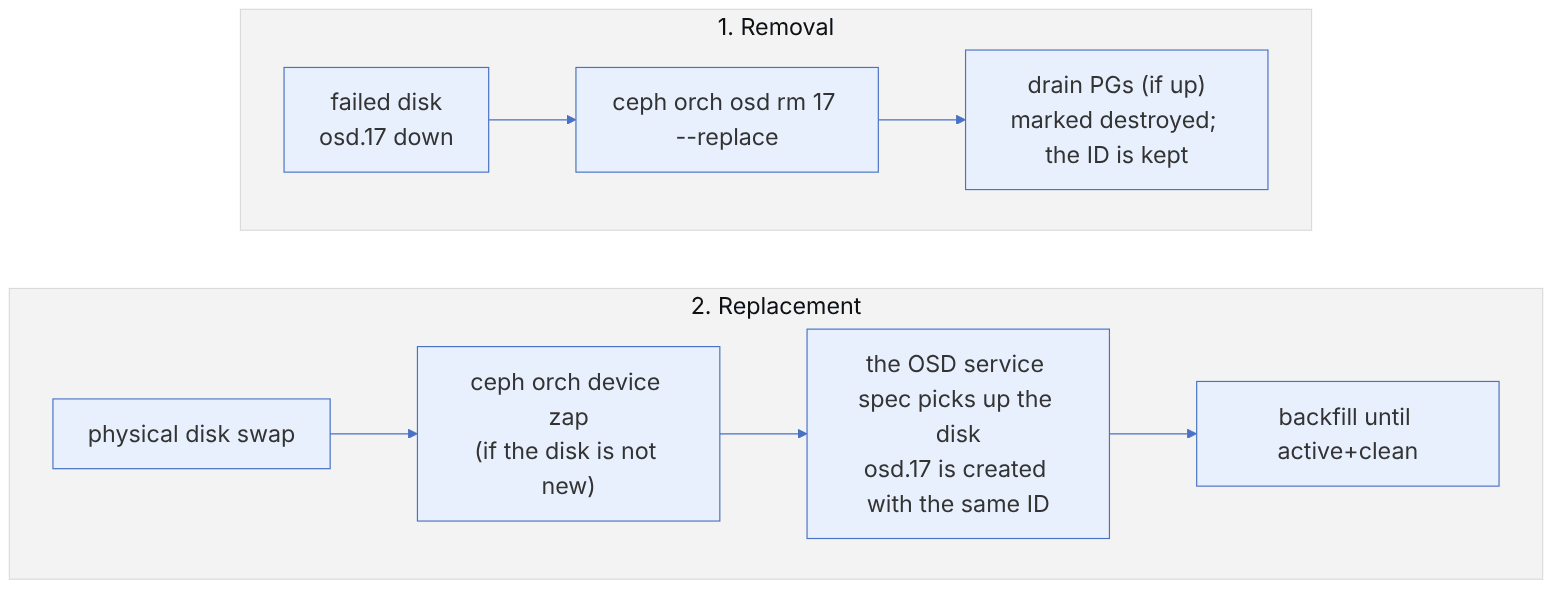
--replaceso the OSD id and CRUSH position are kept and only its PGs are backfilled. - Host maintenance mode checks that stopping a host is safe and sets
nooutfor that host only. - pg_autoscaler sets PG counts per pool and the upmap balancer evens out the PG distribution; device health and periodic checks belong in the routine.
19-1 Before you start#
19-1-1 What questions does this chapter answer?#
Most of a Ceph cluster's life consists of routine work: upgrading versions, replacing disks, adding and removing hosts, adjusting the number of PGs and balancing data. Each of these tasks is uneventful if done right, and turns into an incident if not. This chapter reviews today's procedures with cephadm and then goes inside two important mgr modules: pg_autoscaler and balancer.
- In what order does a cephadm upgrade proceed, and what is a staggered upgrade?
- How do we replace a failed disk while keeping the OSD id?
- How do we take a host out for maintenance, or remove it permanently?
- With what formula does pg_autoscaler compute the number of PGs, and what changed in Umbrella?
- In upmap mode, how does the balancer decide which PG to move?
- Which flags and settings are needed for maintenance work?
19-2 Upgrading#
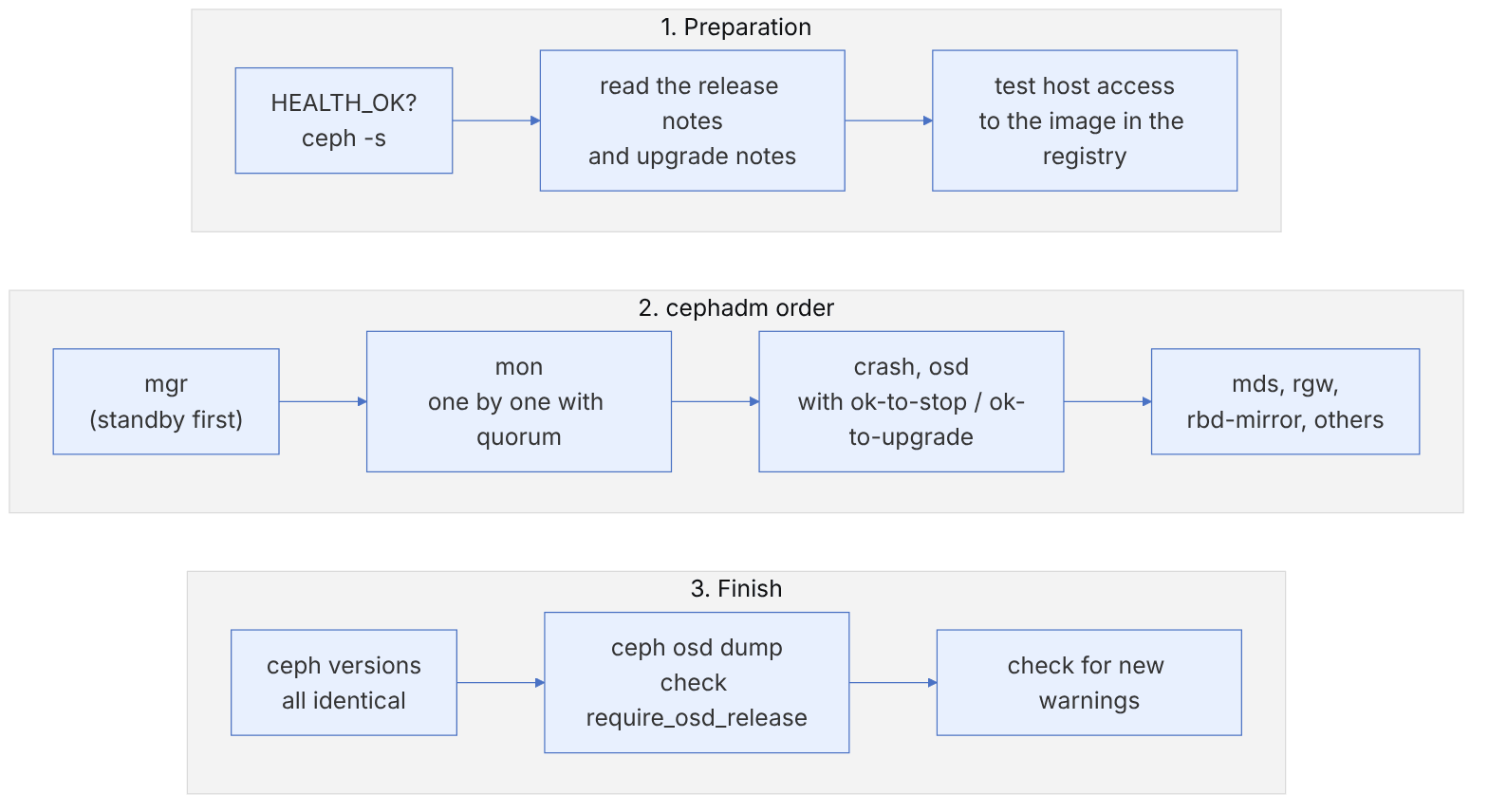
cephadm performs the upgrade as a rolling upgrade: first the mgrs (so that the new cephadm module carries on with the work), then the MONs one by one while keeping quorum, then the OSDs, checking that stopping them does not make PGs inactive, and finally the other services.
ceph -s
ceph versions
ceph orch upgrade start --ceph-version 20.2.5          # or --image quay.io/ceph/ceph:v20.2.5
ceph orch upgrade status
ceph -W cephadm                                        # live follow-up
ceph orch upgrade pause | resume | stopThe version in the example (Tentacle 20.2.5) is the latest Tentacle point release at the time of writing. Before upgrading, check the official release list at docs.ceph.com/en/latest/releases and read the upgrade notes for that version; some releases have prerequisites or manual steps.
19-2-1 Staggered upgrades#
cephadm can upgrade a subset of daemons (a staggered upgrade); for example only mgr and mon on a few hosts, or only specific RGW services with a limit on the count:
ceph orch upgrade start --image quay.io/ceph/ceph:v20.2.5 --daemon-types mgr,mon --hosts mon1,mon2
ceph orch upgrade start --image quay.io/ceph/ceph:v20.2.5 --services rgw.s3main --limit 2In the Umbrella documentation, OSD upgrades can proceed by CRUSH bucket: with --daemon-types osd --crush_bucket_type rack (and optionally --crush_bucket_name), cephadm calls the MON command ceph osd ok-to-upgrade for each bucket, capped by mgr/cephadm/max_parallel_osd_upgrades, and upgrades that bucket's OSDs together; if the bucket parameters are not given, it falls back to the default ok-to-stop gate. The bucket types supported in the documentation are host, rack and chassis. This feature greatly shortens the upgrade time of large clusters, because a whole failure domain is upgraded at once instead of one OSD at a time.
If a host is offline or in maintenance mode, the upgrade stops and waits. Before starting, check ceph orch host ls. Do not start an upgrade during heavy backfill or while there are inactive PGs.
19-3 Replacing a disk#
ceph osd tree | grep -E "down|destroyed"
ceph orch osd rm 17 --replace          # the id is kept and the OSD stays in CRUSH
ceph orch osd rm status
# after replacing the disk
ceph orch device ls stor-b3 --refresh
ceph orch device zap stor-b3 /dev/sdk --force      # only if the disk was used before
ceph orch ps --daemon-type osd | grep osd.17--replace keeps the OSD in the destroyed state rather than removing it entirely; so its CRUSH position and id are kept, and after the new OSD is created only that OSD's PGs are backfilled, not a general redistribution. Without --replace, removing the OSD and adding a new one moves the data twice.
ceph orch osd rm asks for no confirmation and starts immediately; the documentation points this out explicitly. Double-check the id. To stop: ceph orch osd rm stop <id>.
19-4 Host maintenance and removal#
ceph orch host maintenance enter stor-b3        # stop all Ceph daemons on the host
# ... kernel update, hardware repair, reboot ...
ceph orch host maintenance exit stor-b3
# permanent removal
ceph orch host drain stor-b3                    # the _no_schedule and _no_conf_keyring labels; daemons leave
ceph orch osd rm status
ceph orch host rm stor-b3Before stopping anything, maintenance enter checks that stopping the host's daemons is safe (for example that the PGs stay active) and refuses if it is unsafe; according to the documentation, --force overrides warnings (not alerts), and --force --yes-i-really-mean-it bypasses all safety checks and can lead to loss of data access or quorum. In the cephadm code (pybind/mgr/cephadm/module.py), entering maintenance sets the noout flag on that host's CRUSH subtree with the osd set-group command, so that data is not redistributed needlessly, and exiting removes it.
19-5 Inside the code: pg_autoscaler#
19-5-1 The problem#
The number of PGs in each pool has two opposing effects: few PGs mean an uneven data distribution and little parallelism; many PGs mean more memory and CPU use in the OSDs and heavier peering. The pg_autoscaler module in the mgr (src/pybind/mgr/pg_autoscaler/module.py) automates this balance. Its goal is for each OSD to host about mon_target_pg_per_osd PG replicas.
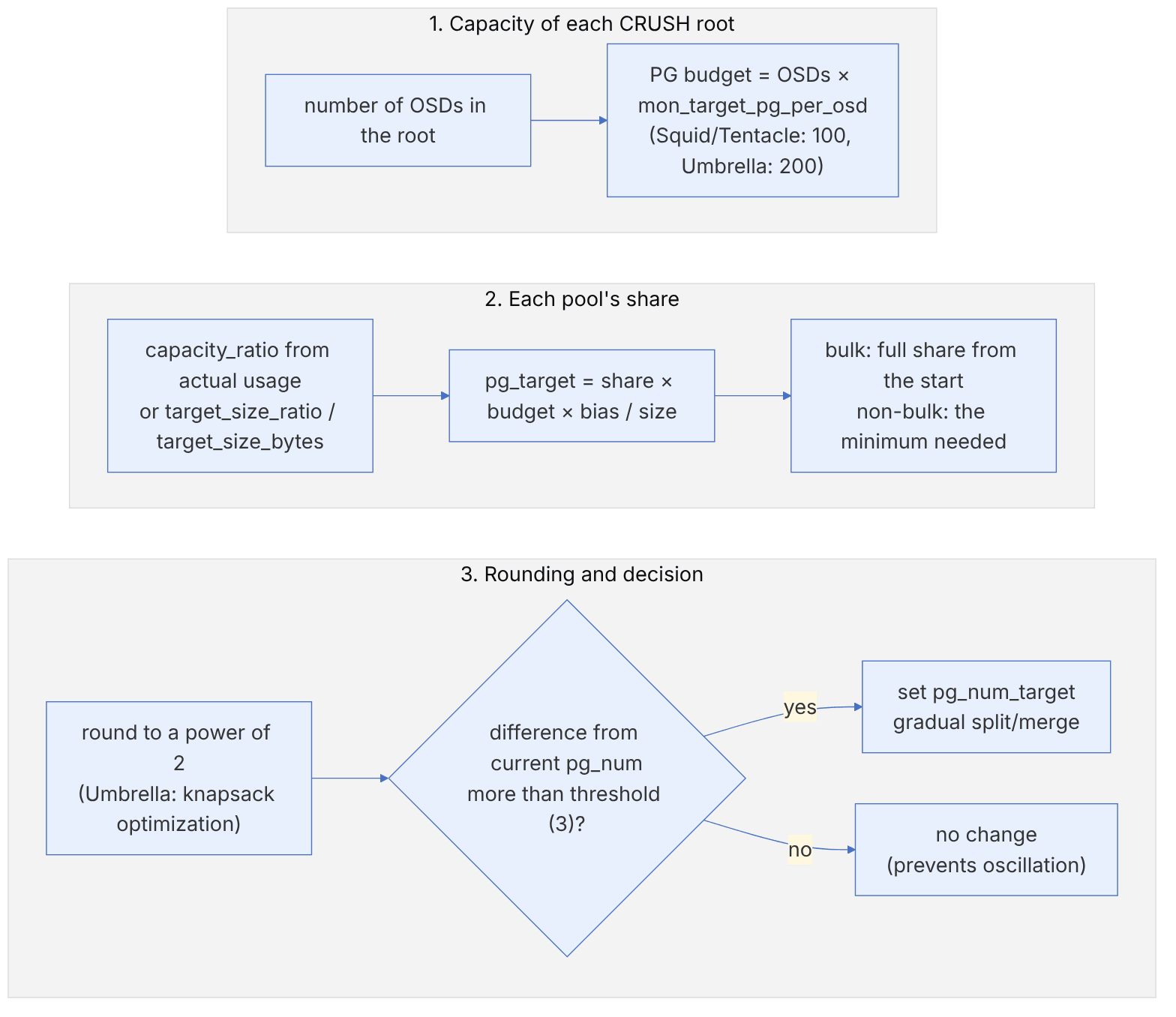
Version-dependent. The default value of mon_target_pg_per_osd in src/common/options/mgr.yaml.in is 100 at tags v19.2.0 and v20.2.0 and 200 at v21.2.0 (Umbrella). That is, after upgrading to Umbrella the autoscaler may recommend more PGs for existing pools, and PG splitting (and data movement) may begin. Before upgrading, save ceph osd pool autoscale-status and compare after the upgrade; if necessary, set the previous value explicitly with ceph config set global mon_target_pg_per_osd 100.
19-5-2 The algorithm#
pseudocode: pg_autoscaler (this book's rewrite)
  for root in crush_roots:
      budget[root] = osds_in(root) * mon_target_pg_per_osd
  for pool:
      root      = root_of(pool.crush_rule)
      ratio     = max(actual_used / root_capacity,
                      target_size_bytes / root_capacity,
                      normalized target_size_ratio)          # ratios are normalized
      pg_target = ratio * budget[root] * pool.bias / pool.size
      if pool.bulk:     start near full share
      else:             start small, grow with usage
      pg_final  = round_to_power_of_two(pg_target)            # Umbrella: optimal (knapsack) rounding
      pg_final  = clamp(pg_final, pg_num_min, pg_num_max)
      threshold = dynamic_threshold(pg_final) if scaling up else threshold   # default 3.0
      if pg_final > pg_num_target * threshold or pg_final < pg_num_target / threshold:
          if pool.mode == 'on':   set pg_num_target = pg_final
          elif pool.mode == 'warn': raise POOL_TOO_FEW_PGS / POOL_TOO_MANY_PGS
The threshold prevents oscillation: the autoscaler only changes pg_num when the ideal value is at least three times (default threshold=3.0) larger or smaller than the current value. The minimum allowed threshold is 1.0 (ceph osd pool set threshold).
In current code (and Umbrella), the threshold for increases is dynamic at a few common sizes:
# from ceph/ceph, LGPL — src/pybind/mgr/pg_autoscaler/module.py (excerpt)
def get_dynamic_threshold(self, final_pg_num: int, default_threshold: float) -> float:
    if final_pg_num in (512, 1024):
        return 1.0
    elif final_pg_num == 2048:
        return 2.0
    return default_threshold
That is, reaching 512 or 1024 PGs does not require a threefold difference (any increase is enough), and for 2048 a twofold difference is enough. For decreases, the default threshold applies. In Umbrella, rounding pg_target to a power of 2 is also no longer done separately for each pool: the function _find_optimal_pg_distribution uses dynamic-programming knapsack to decide which pools to round up and which down so that the total rounding error is minimized and the root's PG budget is respected (this function does not exist at tag v20.2.0).
ceph osd pool autoscale-status
ceph osd pool set vm-fast target_size_ratio 0.4       # predict the future share
ceph osd pool set archive bulk true                   # a large pool: full share from the start
ceph osd pool set archive pg_num_min 256
ceph osd pool get threshold
ceph osd pool set noautoscale                          # temporary global stop
ceph osd pool unset noautoscaleFor pools you know will become large (the main RGW or RBD data), enable bulk from the start. Otherwise the autoscaler starts with few PGs and, as the pool fills, splits the PGs several times, each time with data movement.
19-6 Inside the code: balancer#
19-6-1 Modes#
| Mode | Mechanism | Prerequisite |
|---|---|---|
| upmap (default) | Adding pg_upmap_items to move individual PGs | Luminous and later clients |
| crush-compat | Setting alternative weights in a compatible weight-set | Compatible with old clients |
| read and upmap-read | Balancing primaries (pg_upmap_primary) for read load | Reef and later clients |
19-6-2 The upmap algorithm#
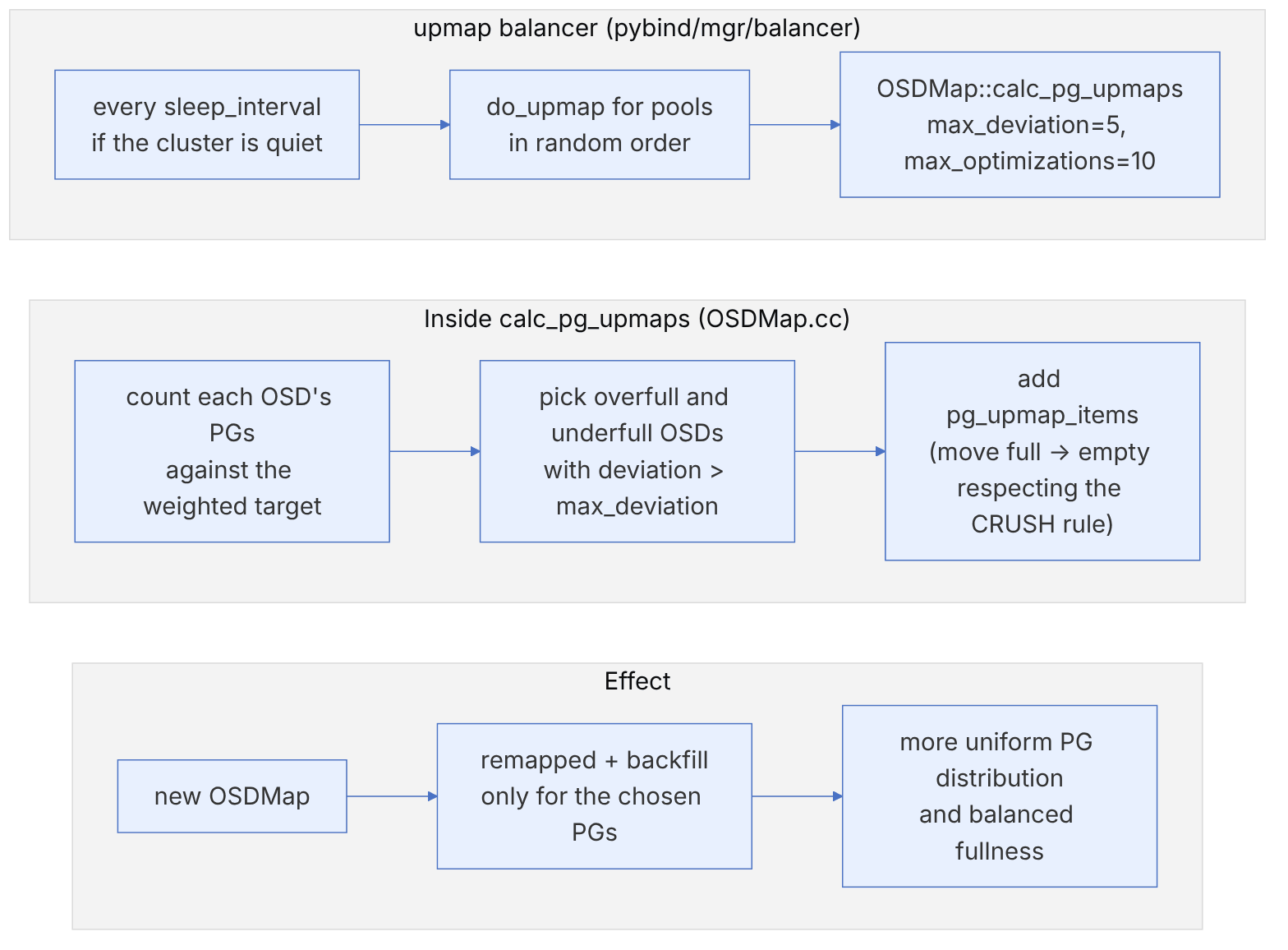
Module.do_upmap() in src/pybind/mgr/balancer/module.py, with the options upmap_max_optimizations (default 10, the maximum number of changes per round) and upmap_max_deviation (default 5 PGs), hands the work to OSDMap::calc_pg_upmaps() in C++. Its logic:
pseudocode: calc_pg_upmaps (this book's summary of OSDMap.cc)
  for osd: target[osd] = total_pgs * weight[osd] / total_weight      # weighted share
           deviation[osd] = pgs[osd] - target[osd]
  repeat up to max_optimizations:
      over  = OSDs with deviation >  max_deviation (fullest first)
      under = OSDs with deviation < -max_deviation
      if none: break
      for pg on over[0]:
          candidate = an OSD in under that keeps CRUSH rule valid
                      (same failure domain, no repeats in the up set)
          if found: add pg_upmap_items[pg] += (over[0] → candidate); update counts; break
      also: remove existing upmap items that no longer help
return pending incrementpg_upmap_items does not bypass the CRUSH mapping; it is applied on top of CRUSH's output: CRUSH computes the up set and then the (from → to) pairs are substituted. If a later CRUSH change makes an upmap violate the rule (for example two copies on one host), the OSDMap ignores it when applying it and the MON cleans it up (clean_pg_upmaps). That is why upmap is safer than changing weights by hand.
ceph balancer status
ceph balancer mode upmap
ceph balancer on
ceph config set mgr mgr/balancer/upmap_max_deviation 1     # a more precise distribution in a large cluster
ceph balancer eval
ceph osd df tree | sort -nk17 | tail # the VAR and PGS columnsThe balancer only works when the percentage of misplaced PGs is below target_max_misplaced_ratio (default 0.05); so in the middle of heavy backfill it starts no new work. The read balancer modes need Reef and later clients (ceph osd set-require-min-compat-client reef).
19-7 Three maintenance algorithms in numbers#
The previous sections explained the autoscaler and the balancer at the conceptual level. This section opens both down to the level of loops and numbers. Because the autoscaler's rounding algorithm changed in Umbrella, we give both versions separately.
19-7-1 Rounding to a power of two and the 3x threshold#
Source in code: src/pybind/mgr/pg_autoscaler/module.py :: PgAutoscaler._calc_final_pg_target, nearest_power_of_two (tag v20.2.0)
Complexity: O(P) for P pools per CRUSH root; rounding O(1) with bit shifts
pseudocode
budget[root] = Σ_osd mon_target_pg_per_osd / (number of roots of that OSD) ; pg_left = budget
pass 1 (non-bulk pools): used = capacity_ratio × pg_left ; pg_left −= used ; target = used / size × bias
pass 2 (bulk with ratio > even = 1/(pools − used_pools)): ratio = max(used, even) ; same calculation
pass 3 (remaining bulk): ratio = 1/(remaining) ; target = ratio × pg_left / size × bias
final = max(pg_num_min=32, nearest_power_of_two(target)) ; final = min(final, pg_num_max)
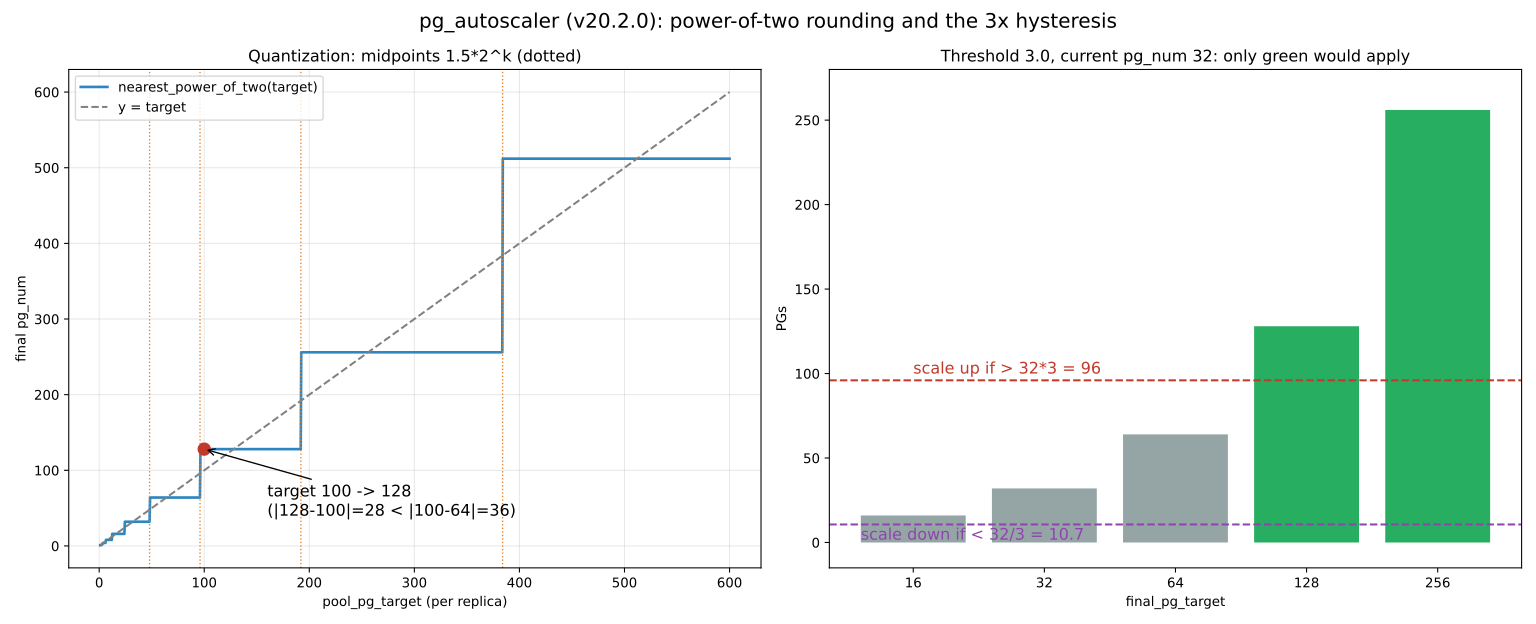
adjust = (final > current × 3) or (final < current / 3)       # default threshold 3.0
Numerical example. Ten OSDs in one root with mon_target_pg_per_osd = 100 (the v20.2.0 default) give a budget of 1000 PG replicas. A non-bulk pool named rbd with size 3 and capacity_ratio = 0.3 has used = 300 and target = 300/3 = 100. The function nearest_power_of_two(100) builds the bounds 64 and 128 (by ORing shifts: 99 → 127 → 128). Because 128 − 100 = 28 < 100 − 64 = 36, the result is 128. If the current pg_num is 32, 128 > 96 and the change is applied. If the current pg_num were 64, 128 < 192, and the autoscaler would only warn and change nothing. This hysteresis prevents back-to-back splits and merges. The rounding decision point is 1.5 times each power of two.
19-7-2 Global rounding with knapsack (Umbrella)#
Source in code: src/pybind/mgr/pg_autoscaler/module.py :: PgAutoscaler._find_optimal_pg_distribution, _calculate_final_pool_pg_target, get_dynamic_threshold, PoolGroup.update (tag v21.2.0)
Complexity: per the code's docstring O(n·log2(budget)); state space = possible sums of extra PGs
pseudocode
for each pool group (same target, same size, same bias): down = pow2_down(t)×size , up = pow2_up(t)×size
    cost_down = |down − t×size| , cost_up = |up − t×size| , extra = up − down
base = Σ down ; budget = pg_left − base
parent[0] = {0: (Σ cost_down)}
for group i: for each sum s in parent[i]:
    s' = s + extra_i ; c' = c − cost_down_i + cost_up_i
    if s' ≤ budget and (s' is new or c' is lower): parent[i+1][s'] = (c', s)
opt = lowest cost; on a tie, the most PGs ; then backtrack to find the "up" groups
dynamic threshold for increases: final ∈ {512, 1024} ⇒ 1.0 , final = 2048 ⇒ 2.0 , otherwise threshold
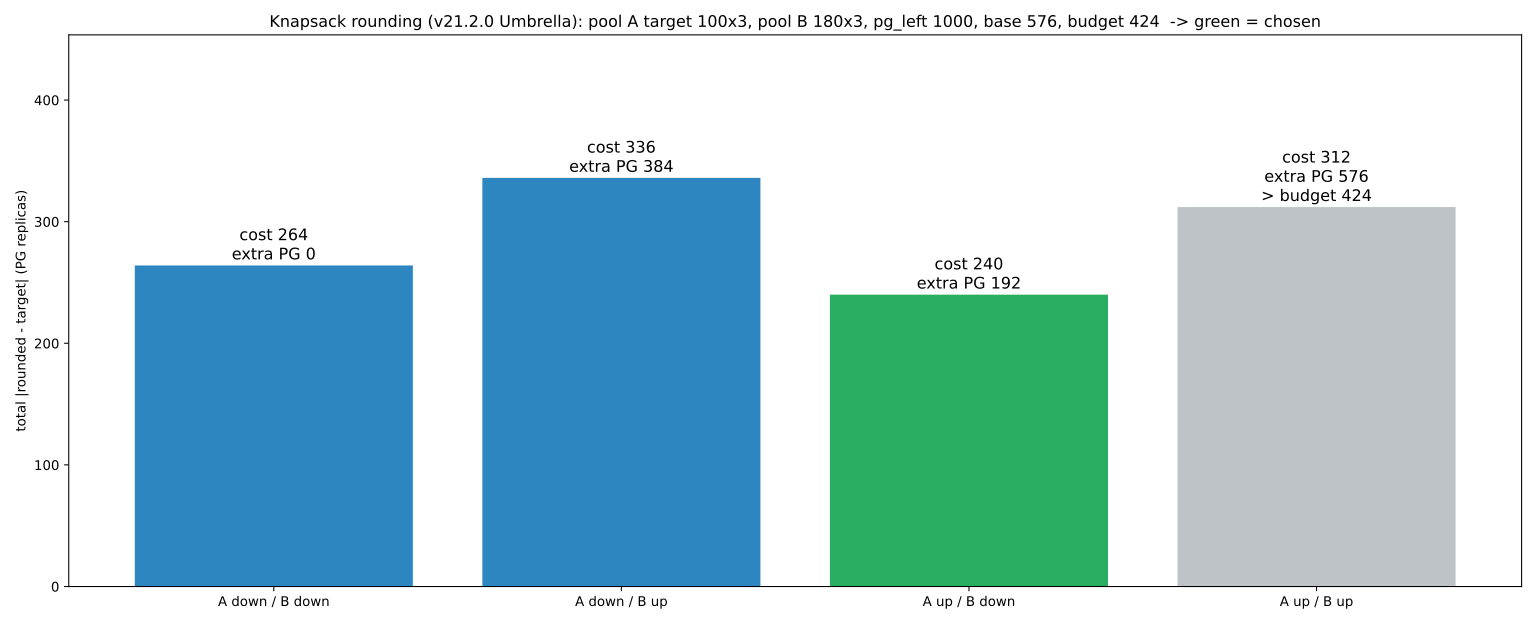
Numerical example. pg_left = 1000. Pool A has a target of 100 with size 3, and pool B a target of 180 with size 3.
- A: down = 64×3 = 192, up = 128×3 = 384, costs 108 and 84, extra = 192.
- B: down = 128×3 = 384, up = 256×3 = 768, costs 156 and 228, extra = 384.
base = 576 and budget = 424. There are four options:
- Both down: cost 264.
- Only B up: 336.
- Only A up: 240.
- Both up: 576 extra PGs, more than the budget.
So A = 128 and B = 128 are chosen. In this example the result is the same as local rounding. The difference appears when local rounding would round both up and break the root's budget. The three-pass version could not see that. The dynamic threshold also allows a change from 256 to 512 without the 3x condition.
Version-dependent. This algorithm does not exist at tag v20.2.0 and is present at v21.2.0. In the same version the default mon_target_pg_per_osd also went from 100 to 200, so after the upgrade both the budget and the rounding method change. In the main branch, the pg_num_min floor is read from osd_pool_default_pg_num instead of the constant PG_NUM_MIN = 32. Check your own version before relying on it.
19-7-3 Deviation and the balance score in upmap#
Source in code: src/osd/OSDMap.cc :: OSDMap::calc_pg_upmaps, calc_deviations, fill_overfull_underfull
Complexity: each iteration O(OSDs + PGs on the fullest OSD × CRUSH cost); at most upmap_max_optimizations = 10 changes per round
pseudocode
pgs_per_weight = total_pg_replicas / Σ weight
for osd: target = weight × pgs_per_weight ; dev = pgs − target
         bal_score += (dev/target)^2 × weight ; max_dev = max(|dev|)
if max_dev ≤ max_deviation (5): return 0
loop (max times): overfull = {dev > 5} , underfull = {dev < −5}
    if both empty: break ; if overfull is empty: use more_overfull (0 < dev ≤ 5)
    from the fullest OSD: find a PG whose move to underfull does not break the CRUSH rule ⇒ pg_upmap_items
    recompute the deviations ; accept only if bal_score improved
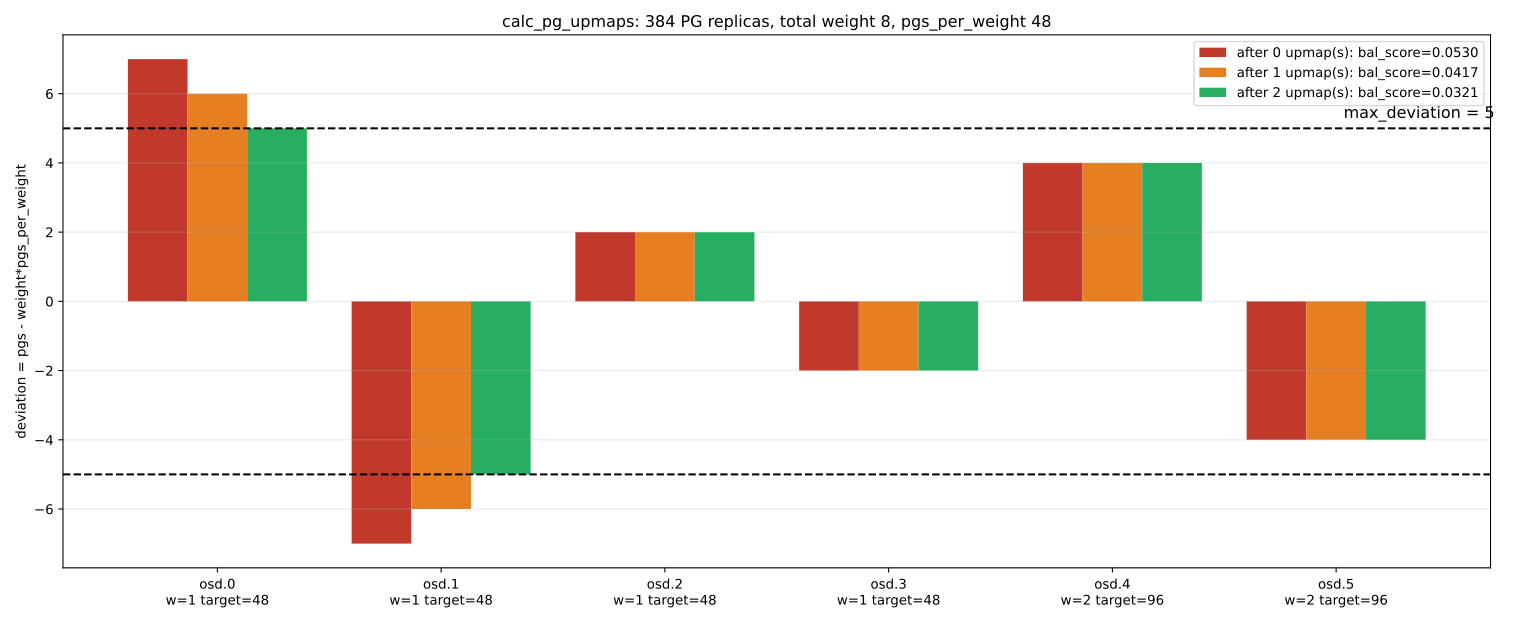
Numerical example. We have six OSDs with weights 1, 1, 1, 1, 2 and 2 (total 8) and 384 PG replicas (128 PGs × size 3), so pgs_per_weight = 48. The weight-1 OSDs have a target of 48 and the weight-2 ones 96. The current counts are 55, 41, 50, 46, 100 and 92, so the deviations are +7, −7, +2, −2, +4 and −4.
- bal_score = .
- First move, one PG from osd.0 to osd.1: deviation ±6 and score 0.0417.
- Second move: ±5 and score 0.0321.
Now no OSD deviates by more than 5, and the loop stops. In practice, the choice of PG is constrained by the CRUSH rule. If osd.0 and osd.1 are on the same host and the rule wants one copy per host, a direct move is impossible and the algorithm turns to another underloaded OSD. The code deliberately accumulates bal_score in a double, because in a float the change from one PG in large clusters fell below the number's precision and the balancer stalled.
ceph balancer eval reports this same score for the whole cluster or a pool. ceph osd df tree shows the PGS column, with which you can compute the deviation by hand. For a more uniform distribution than the default, try ceph config set mgr mgr/balancer/upmap_max_deviation 1, but this causes more data movement.
19-8 The balancer and splits on a real mapping#
The two experiments in this section were run on the same 120-OSD map (10 hosts × 12, straw2, chooseleaf host, size = 3) that we built in chapter 1. The tools were crushtool and osdmaptool from Ceph 18.2.7.
19-8-1 The upmap balancer on 1024 and 8192 PGs#
Source in code: src/osd/OSDMap.cc :: calc_pg_upmaps; src/pybind/mgr/balancer/module.py; the same code in osdmaptool --upmap
Complexity: each round O(pg_num × size) for counting and selection
pseudocode
for each OSD: target = pg_num × size × (OSD weight / total pool weight)
deviation(o) = PGs on o − target(o)
while max |deviation| > upmap_max_deviation and the number of changes < upmap_max:
    o_over = the largest positive deviation ; o_under = the largest negative deviation, with the same allowed failure domain
    take a PG from o_over that does not violate the CRUSH rule and move it to o_under
    ← a pg-upmap-items entry: pg  o_over  o_under
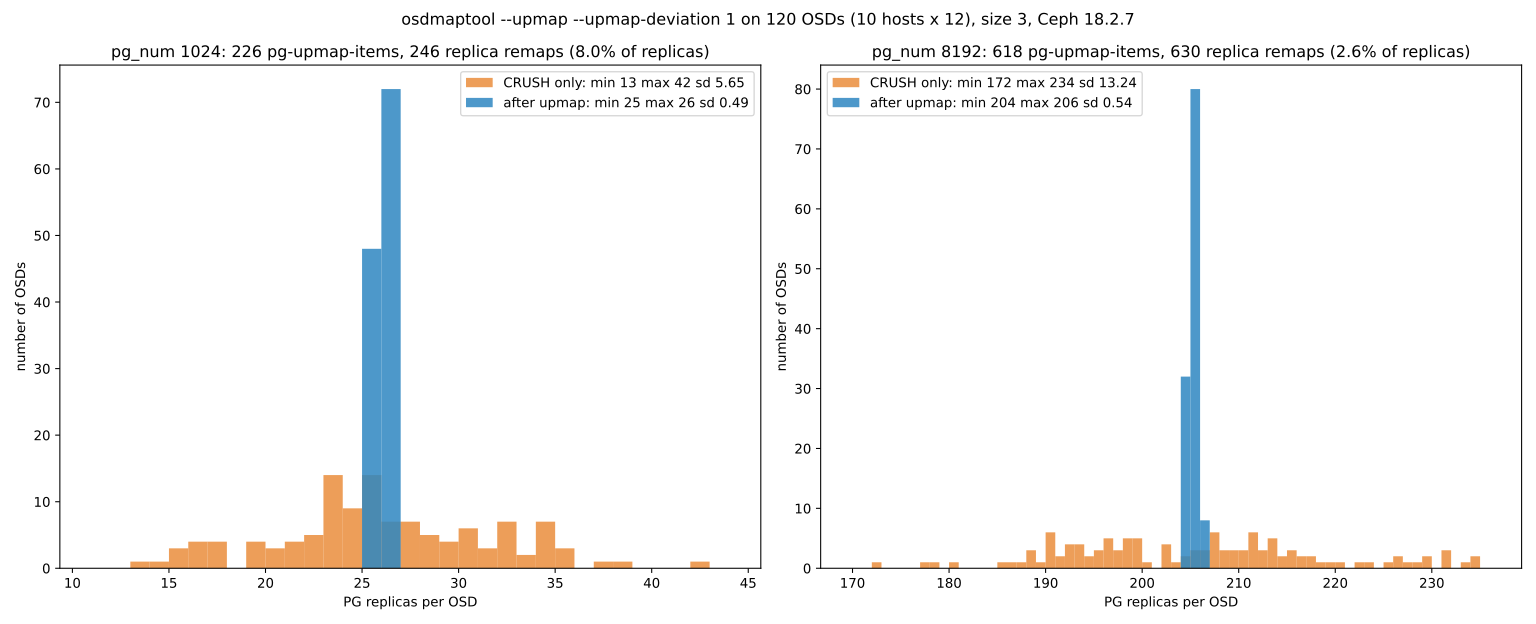
Measurement. The command osdmaptool om --mark-up-in --upmap out.txt --upmap-deviation 1 --upmap-max 10000 --upmap-pool rbd --save was run on two osdmaps.
With 8192 PGs, CRUSH alone gives each OSD between 172 and 234 PGs (a standard deviation of 13.24 against a mean of 204.8). After 618 pg-upmap-items entries (630 OSD pairs, that is 2.6% of the replicas), the range narrowed to 204 to 206 and the standard deviation to 0.54.
With 1024 PGs, the range went from 13 to 42 to 25 to 26. This needed 226 entries and 246 pairs, which is 8.0% of the replicas. That is, the share of movement needed to even things out is larger at a low pg_num.
Because CRUSH is more uniform at a high pg_num, the balancer also has less work. But in both cases removing the deviation moves a few percent of the data, and the balancer spreads it out in instalments under the same 5% cap (target_max_misplaced_ratio).
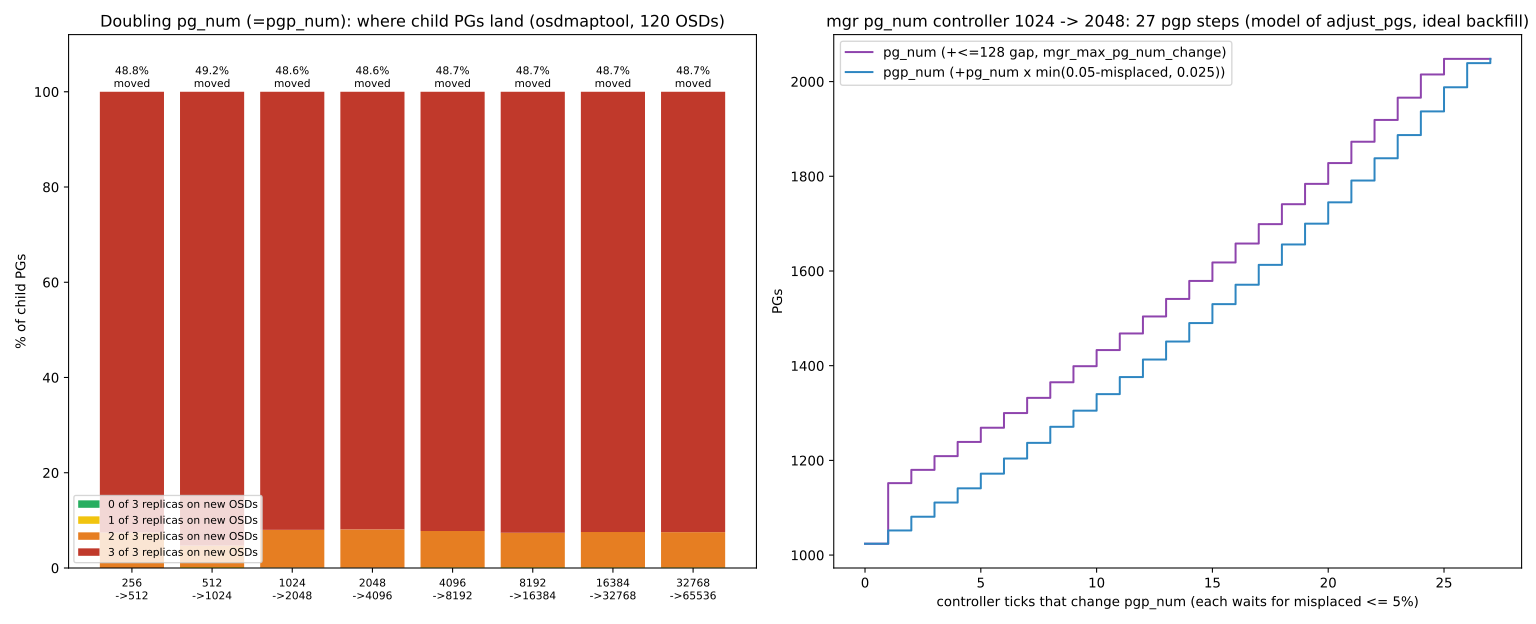
19-8-2 Doubling pg_num: half the data moves#
Source in code: src/mgr/DaemonServer.cc :: adjust_pgs; the options target_max_misplaced_ratio = 0.05 (global.yaml.in) and mgr_max_pg_num_change = 128 (mgr.yaml.in)
Complexity: O(number of pools) per round
pseudocode
if all of the pool's PGs are active and pg_num − pgp_num < 128:
    pg_num += min(128 − (pg_num − pgp_num), pg_num_target − pg_num)      # split, still no movement
target = min(pg_num_pending, pgp_num_target)
if inactive or degraded or unknown > 0  or  misplaced > 0.05: wait
if the pool is nearly empty (objects ≤ pgp_num_target): pgp_num = target in one go
otherwise: room = min(0.05 − misplaced, 0.025) ; estmax = max(⌊pg_num × room⌋, 1)
       pgp_num = clamp(target, pgp_num − estmax, pgp_num + estmax)       # the real movement is here
Measurement. For each doubling, the mapping of child PG ps + n was compared with the mapping of parent PG ps in the previous osdmap (pgp_num equal to pg_num). In every step from 256 to 512 up to 32768 to 65536, about 92% of the children landed on three new OSDs and the rest almost all on two new OSDs. In total, 48.6 to 49.2 percent of all data moved. No parent PG changed its location.
This number agrees with a simple estimate. Half the data goes to the children. The probability that a child replica happens to land on one of the parent's OSDs is about 3/120. So 0.5 × (1 − 3/120) ≈ 48.75%.
Until pgp_num is raised, the child is mapped with ceph_stable_mod(ps, pgp_num, mask) to the same place as the parent, and the split is metadata only. The real movement happens when pgp_num goes up.
The controller model shows that the mgr spreads this movement in steps of about 2.5% of pg_num. A simulation of 1024 to 2048, assuming backfill finishes before each round, gives 27 steps, the first of which is 1024 to 1052. So increasing pg_num on a full pool is equivalent to moving half of the pool's data, and depending on the volume takes from a few hours to a few days.
19-9 Configuration management#
Since Mimic, the central configuration is kept in the MON database, and ceph.conf on the hosts is only needed to find the MONs. This means configuration changes are traceable, reversible and identical across all daemons.
ceph config dump | head
ceph config get osd.12 osd_memory_target
ceph config show osd.12 | grep -E "osd_memory_target|osd_max_backfills"   # the effective value and its source
ceph config set osd/class:hdd osd_memory_target 6G                       # a mask by device class
ceph config set osd.12 debug_osd 10/10                                   # temporary, for troubleshooting
ceph config rm osd.12 debug_osd
ceph config log 20                                                        # change history
ceph config reset 1234                                                    # revert to a specific version
ceph config help osd_op_queueceph config log and ceph config reset <num> are the tools for quickly reverting a wrong change. Before any broad change, note the number of the last log entry.
Settings applied with ceph tell osd.* injectargs or ceph daemon ... config set are temporary and are lost on restart. For persistence, use ceph config set; for a temporary change during an incident, use tell deliberately and record it in the incident log.
19-10 Maintenance flags#
| Flag | Effect | Use |
|---|---|---|
| noout | Down OSDs are not marked out | Short maintenance (preferably set-group for one host) |
| norebalance | Movement for balancing stops | Consecutive CRUSH changes |
| nobackfill / norecover | Backfill or recovery stops | Reducing load at peak time (temporary and dangerous) |
| noscrub / nodeep-scrub | No new scrubs start | Upgrades or heavy load |
| pause | All reads and writes stop | Only specific emergencies |
ceph osd set-group noout stor-b3          # only one host's OSDs
ceph osd unset-group noout stor-b3
ceph osd set norebalance && ceph osd unset norebalance19-11 Periodic tasks#
| Interval | Task |
|---|---|
| Daily | ceph -s, new warnings, ceph crash ls-new, fullness (ceph df) |
| Weekly | ceph osd df tree (VAR and PGS), overdue deep scrubs, mirroring and multisite status |
| Monthly | Check versions and point releases, review disk SMART data (ceph device ls), a restore test |
| Quarterly | Failover drill, capacity review and growth forecast, review of caps and keys |
The devicehealth module in the mgr collects the disks' SMART data: ceph device ls, ceph device get-health-metrics <devid> and failure prediction with ceph device predict-life-expectancy <devid>; prediction is off by default (device_failure_prediction_mode=none), and for local mode you must enable the diskprediction_local module. With mgr/devicehealth/mark_out_threshold you can automatically mark out the OSD of a failing disk before it fails.
- Start an upgrade only on a healthy cluster and after reading the release notes.
- After upgrading to Umbrella, manage the change in the default mon_target_pg_per_osd (100 to 200).
- Always use
--replacefor disk replacement. - Set noout with set-group for one host, and temporarily.
- Make large pools bulk from the start.
- Make all configuration changes with ceph config, reversibly.
19-12 Supplementary and up to date#
- OSD upgrades by CRUSH bucket and the
ceph osd ok-to-upgradecommand appear in the Umbrella documentation. - In Umbrella, the default
mon_target_pg_per_osdhas reached 200 and PG rounding is done with global optimization. ceph-deployhas been archived and all procedures are done with cephadm; ceph-ansible is still maintained "for now", and migrating to cephadm is recommended (chapter 11).- The read balancer has been available since Reef for balancing primaries.
19-13 Hands-on exercise#
- 1. Perform a point upgrade in a test cluster and record the daemon upgrade order from
ceph -W cephadm. - 2. Remove and recreate an OSD with
--replace; compare the amount of backfilled data with a removal without--replace. - 3. Put a host into maintenance mode and look at the group noout flag in
ceph osd dump. - 4. Compare the output of
ceph osd pool autoscale-statusbefore and after settingbulkandtarget_size_ratio. - 5. Lower
upmap_max_deviationto 1 and follow the change in the PGS column ofceph osd df. - 6. In
pg_autoscaler/module.py, find wherepg_num_minandpg_num_maxare applied.
19-14 Review questions#
- 1. What is the daemon upgrade order in cephadm, and why is the mgr first?
- 2. What is the advantage of upgrading OSDs by CRUSH bucket?
- 3. Why does
--replacereduce data movement? - 4. What does maintenance enter do with the noout flag?
- 5. What is the basic pg_target formula in the autoscaler?
- 6. What problem does the autoscaler threshold solve, and when is the dynamic threshold applied?
- 7. What are the consequences of the change in the default mon_target_pg_per_osd in Umbrella?
- 8. How does the upmap balancer choose a PG to move?
- 9. Why is upmap safer than changing weights by hand?
- 10. What is the difference between ceph config set and injectargs?
Answers to these questions are in Appendix E: Answers to Review Questions. Answers to this chapter's questions →
19-15 Sources for this chapter#
- cephadm upgrade
https://docs.ceph.com/en/latest/cephadm/upgrade/ - cephadm upgrade (Umbrella
https://docs.ceph.com/en/umbrella/cephadm/upgrade/ - cephadm host management
https://docs.ceph.com/en/latest/cephadm/host-management/ - cephadm OSD service
https://docs.ceph.com/en/latest/cephadm/services/osd/ - Placement groups and autoscaling
https://docs.ceph.com/en/latest/rados/operations/placement-groups/ - Balancer
https://docs.ceph.com/en/latest/rados/operations/balancer/ - Configuring Ceph (central config
https://docs.ceph.com/en/latest/rados/configuration/ceph-conf/ - Source: src/mon/ConfigMonitor.cc (config log / reset
https://github.com/ceph/ceph/blob/main/src/mon/ConfigMonitor.cc - Device management
https://docs.ceph.com/en/latest/rados/operations/devices/ - Ceph releases
https://docs.ceph.com/en/latest/releases/ - Source: src/pybind/mgr/pg_autoscaler/module.py
https://github.com/ceph/ceph/blob/main/src/pybind/mgr/pg_autoscaler/module.py - Source: src/pybind/mgr/balancer/module.py
https://github.com/ceph/ceph/blob/main/src/pybind/mgr/balancer/module.py - Source: src/osd/OSDMap.cc (calc_pg_upmaps
https://github.com/ceph/ceph/blob/main/src/osd/OSDMap.cc