Lower Layers (1): Block Device, bufferlist, mempool and crc32c
TL;DR this chapter in a few lines
KernelDeviceopens the block device with O_DIRECT and submits I/O with libaio or io_uring; offsets, lengths and buffers must be aligned to the block size.flushends infdatasync, and discard can be synchronous or asynchronous; SPDK'sNVMEDevicebypasses the kernel completely.bufferlistis a list of reference-counted buffer pointers;c_str()on a fragmented list silently copies everything into one buffer.- mempools account memory per subsystem, and BlueStore checksums blocks with crc32c by default.
23-1 Where this part fits#
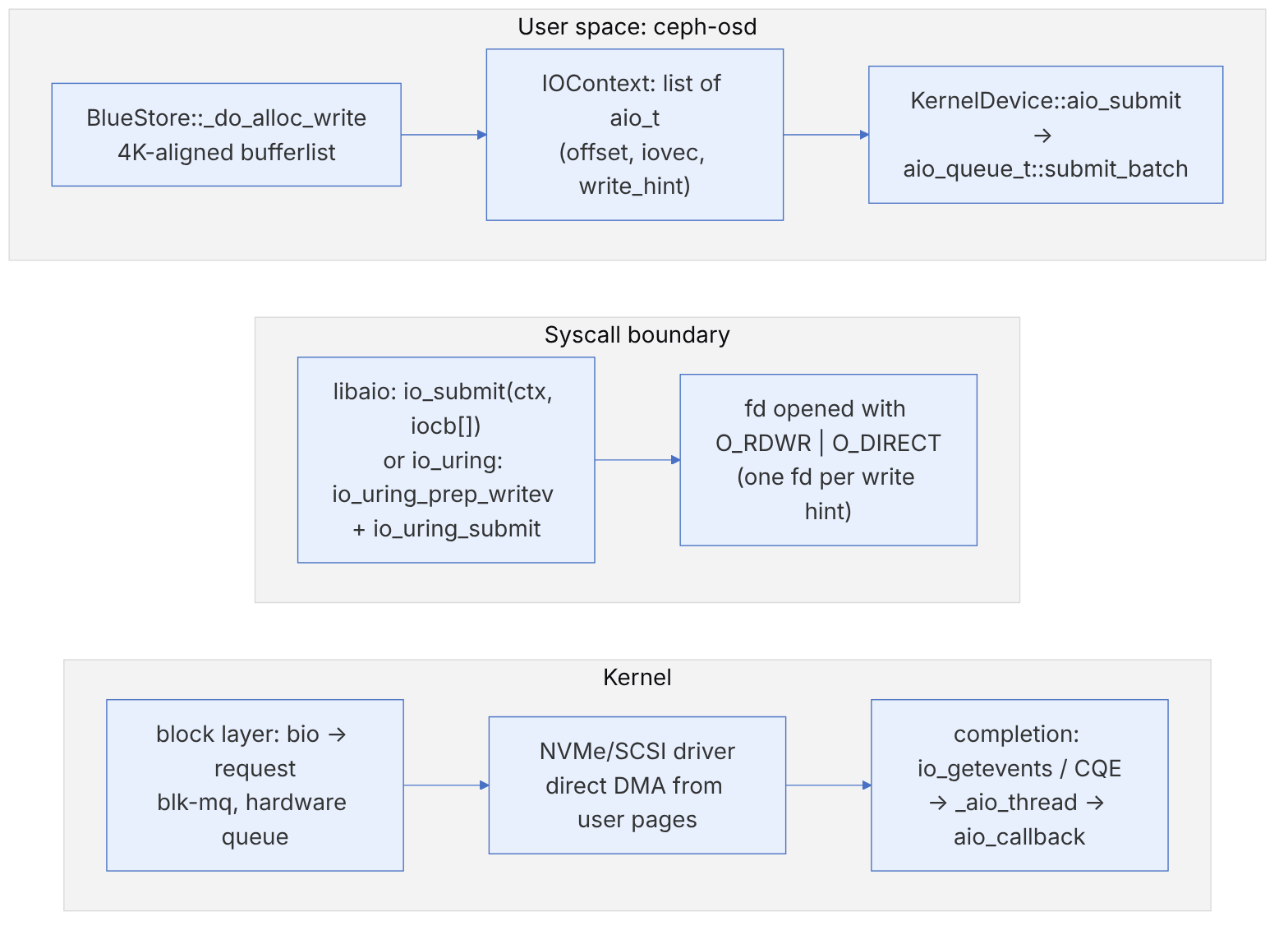
The "lower layers" part starts where the earlier chapters stopped: after BlueStore has decided "write these bytes at this offset", what happens? This chapter follows the path from a bufferlist in ceph-osd's memory to the DMA command on the device. The following chapters do the same for BlueStore's on-disk format, RocksDB, msgr2, erasure code mathematics, CRUSH at the bit level and the kernel clients. All names have been checked against the main branch of the ceph/ceph repository.
KernelDevice: opening the device with O_DIRECT, locking, write hints, discard and flush- libaio vs io_uring and the path from
aio_submitto the completion callback - Alignment and
bdev_block_size - The internal structure of
bufferlist,ptrandraw, zero copy and mempools - crc32c: choosing the hardware implementation and a numerical example
23-2 KernelDevice: BlueStore's window onto the disk#
src/blk/BlockDevice.h defines the abstract BlockDevice interface, and BlockDevice.cc chooses its type. On the main branch there are only two types: aio (the KernelDevice class in src/blk/kernel/) and spdk (the NVMEDevice class in src/blk/spdk/). The PMEM implementation that existed in older versions is no longer in block_device_t on main.
23-2-1 Opening the device#
KernelDevice::open() opens two fds for each write hint value from WRITE_LIFE_NOT_SET to WRITE_LIFE_MAX: one in fd_directs with O_RDWR | O_DIRECT and another in fd_buffereds without O_DIRECT for buffered paths (for example large BlueFS reads). If the kernel supports F_SET_FILE_RW_HINT, the corresponding hint is set on each fd with fcntl, so that SSDs with streams can keep data with different lifetimes apart. On the buffered fd, posix_fadvise(..., POSIX_FADV_RANDOM) is also set.
Exclusive lock: KernelDevice::_lock() first tries a record lock (struct flock with F_WRLCK) and, if needed, flock(fd, LOCK_EX | LOCK_NB), with at most bdev_flock_retry=3 retries. This lock prevents two processes (for example a running OSD and a mistaken ceph-bluestore-tool) from writing to the same device at the same time.
pseudocode: KernelDevice::open (this book's summary)
  for hint in WRITE_LIFE_NOT_SET .. WRITE_LIFE_MAX-1:
      fd_directs[hint]   = open(path, O_RDWR | O_DIRECT | O_CLOEXEC)
      fd_buffereds[hint] = open(path, O_RDWR | O_CLOEXEC)
      if F_SET_FILE_RW_HINT: fcntl(fd, F_SET_FILE_RW_HINT, &hint)
  _lock()                                   # flock/F_WRLCK, up to 3 retries
  fstat → size, block_size = bdev_block_size (4K); if st_blksize differs, only a warning
  detect rotational, discard support, NUMA node, device model/serial
  if bdev_aio: io_queue = io_uring (if bdev_ioring=true and supported) or libaio
  start _aio_thread ; start discard threads (bdev_async_discard_threads)
23-2-2 Alignment#
With O_DIRECT, the kernel DMAs data directly from user pages. So the offset, length and buffer address must be aligned to the device's logical block size. Ceph guarantees this with bdev_block_size=4_K and asserts on the write paths. Read buffers are allocated with bdev_read_buffer_alignment=4_K. The practical result: BlueStore never writes less than 4K to the device. A 100-byte client write becomes either a read-modify-write on one 4K block or (on HDD) a deferred write in the WAL (chapter 24).
Disks that are not "4K native" but report a 4K physical block in 512e format work correctly with bdev_block_size=4K. But a device with a logical block larger than 4K (some hardware arrays) is not compatible with the defaults, and the OSD fails at mkfs or open. Before buying, check the value of cat /sys/block/<dev>/queue/logical_block_size.
23-2-3 libaio or io_uring#
| Option | Default (main) | Role |
|---|---|---|
| bdev_aio | true | use asynchronous I/O |
| bdev_ioring | false | use io_uring instead of libaio (if the kernel and liburing support it) |
| bdev_ioring_hipri / bdev_ioring_sqthread_poll | false / false | hardware polling and a kernel submission thread |
| bdev_aio_max_queue_depth | 1024 | aio queue depth |
| bdev_aio_reap_max | 16 | maximum completions reaped at a time |
| bdev_aio_poll_ms | 250 | timeout when waiting for completions |
| bdev_block_size | 4_K | assumed block size |
| bdev_enable_discard | false | send discard/TRIM after space is freed |
| bdev_async_discard_threads | 0 | asynchronous discard (replaces the old bdev_async_discard option) |
| bdev_flock_retry | 3 | lock retries |
In libaio (src/blk/aio/aio.cc), aio_queue_t::submit_batch sends an array of iocbs with io_submit. The iocb field must be the first member of aio_t, so that the pointer returned by the kernel can be cast directly to aio_t (the code's own comment in aio.h). On EAGAIN, submission is retried after a short delay. get_next_completed waits for completions with io_getevents. In io_uring (src/blk/kernel/io_uring.cc) the same interface is implemented with io_uring_prep_writev, io_uring_prep_readv and io_uring_submit.
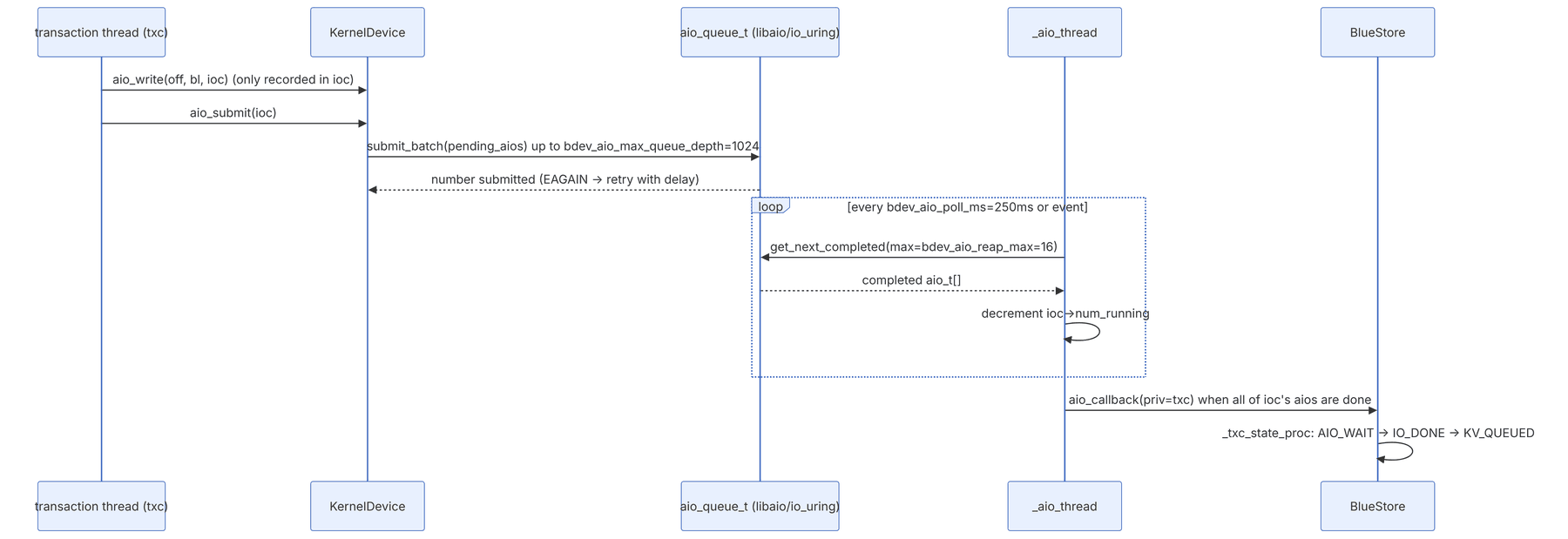
// from ceph/ceph, LGPL — src/blk/kernel/KernelDevice.cc, _aio_thread() (excerpt)
	if (--ioc->num_running == 0) {
	    aio_callback(aio_callback_priv, ioc->priv);
23-2-4 flush and discard#
KernelDevice::flush() finally runs fdatasync(fd_directs[WRITE_LIFE_NOT_SET]) to drain the device's write cache. In BlueStore::_kv_sync_thread there is logic named force_flush: if data and DB are on the same device, the BlueFS log commit itself flushes the device and a separate flush is not needed. Otherwise (or when there is nothing to commit in RocksDB), flushing the data device is forced, so that the aio data is durable before the metadata is recorded. discard is only sent when the device supports it and bdev_enable_discard=true. With bdev_async_discard_threads>0, discard is done in separate threads with a queue cap of bdev_async_discard_max_pending, so that it does not raise write latency.
Why discard is off by default: on many SATA SSDs, the TRIM command is synchronous and slow and can block the device queue for several milliseconds. Today's NVMe SSDs usually perform well even without discard, because they have internal over-provisioning. If you enable discard, make it asynchronous and measure p99 latency before and after.
23-2-5 SPDK#
NVMEDevice in src/blk/spdk/ separates the NVMe device completely from the kernel: SPDK's user-space driver manages the NVMe queues directly with polling, and there are no syscalls or interrupts on the data path. The device path is indicated with the spdk: prefix in bluestore_block_path. The cost is dedicating a CPU core to polling, needing hugepages and vfio, and losing the usual kernel tools (iostat, blktrace). In practice most deployments prefer KernelDevice, and crimson with SeaStore pursues another path to removing kernel overhead.
Seeing the real I/O path:
ceph osd metadata 4 | jq '{bluestore_bdev_type, bluestore_bdev_rotational, bluestore_bdev_dev_node}'
cat /sys/block/nvme0n1/queue/{logical_block_size,physical_block_size,write_cache}
ceph config get osd.4 bdev_ioring
strace -f -e trace=io_submit,io_getevents,io_uring_enter -p $(pgrep -f 'ceph-osd.*--id 4') 2>&1 | head
blktrace -d /dev/nvme0n1 -o - | blkparse -i - | head -30 # Q/G/D/C for each request23-3 bufferlist: Ceph's core data structure#
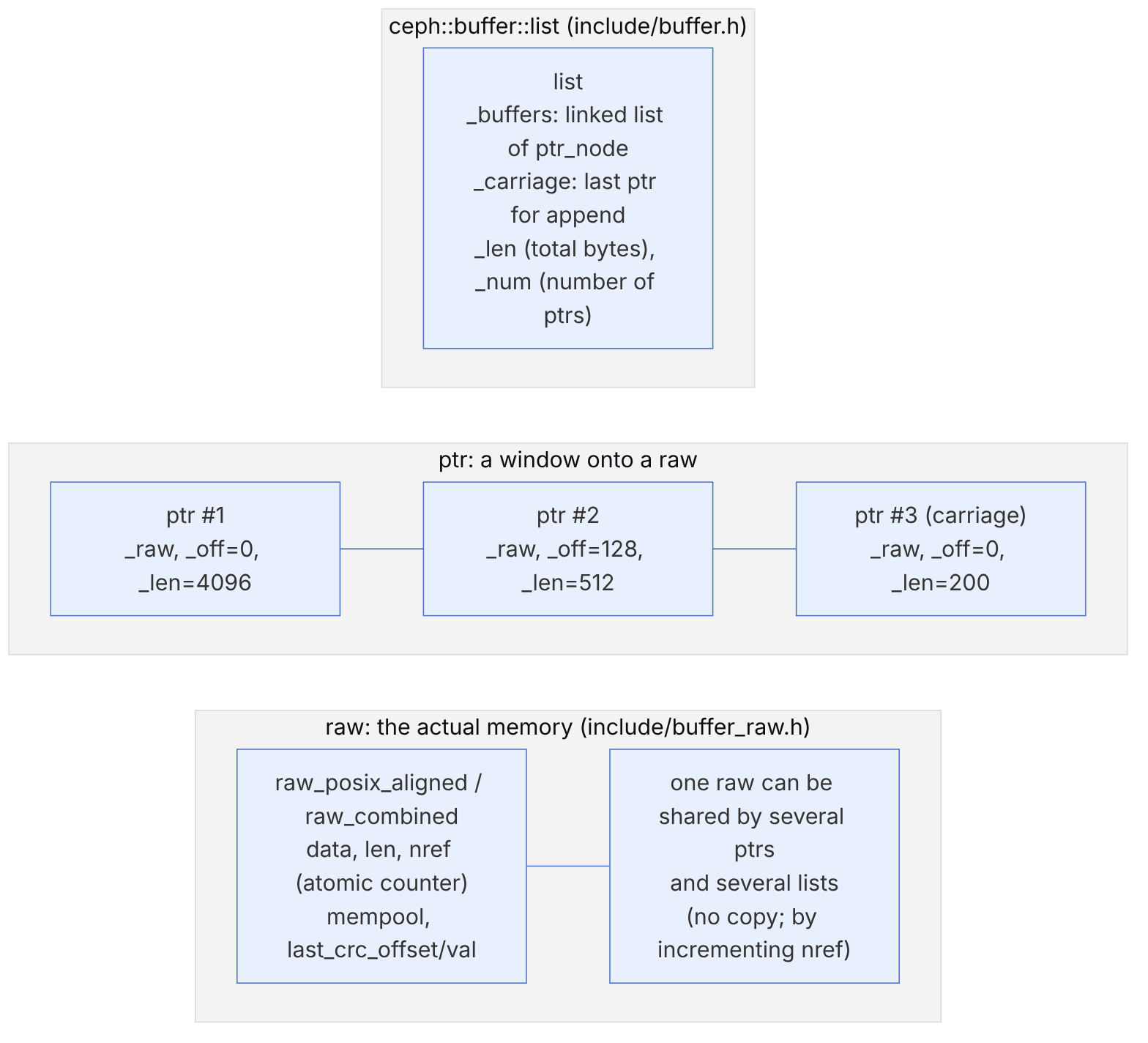
Almost every byte that moves in Ceph, whether a network message, object data or a RocksDB record, is inside a ceph::buffer::list (usually with the short name bufferlist). Its design has three goals: zero copy (joining pieces without moving bytes), sharing (several lists pointing to the same memory) and memory accounting (each piece belongs to a mempool).
| Type | File | Note |
|---|---|---|
buffer::ptr | include/buffer.h | fields _raw, _off, _len; methods c_str(), length(), is_aligned(), is_page_aligned() |
buffer::list | include/buffer.h | _buffers, _carriage, _len, _num; append, claim_append, splice, rebuild, c_str() |
buffer::raw | include/buffer_raw.h | data, len, nref, mempool, last_crc_offset/last_crc_val with crc_spinlock |
| raw implementations | common/buffer.cc | create_aligned, create_small_page_aligned, claim_char, claim_malloc, claim_buffer (with a custom deleter), raw_hack_aligned |
23-3-1 The real cost of c_str()#
list::c_str() returns a pointer to a contiguous region. If the list consists of several ptrs, rebuild() runs first, which creates a new raw and copies all the pieces into it. So an apparently harmless call can cause a copy of several megabytes. That is why data path code uses iterators (begin(), copy()) or rebuild_aligned_size_and_memory (for O_DIRECT).
pseudocode: the copy-free path of a write (this book's summary)
  msgr2 receive: the data segment is read into a new raw (with the alignment announced in the preamble)
  MOSDOp::decode: a ptr over the same raw (no copy) → OSDOp.indata
  PrimaryLogPG: t.write(oid, off, len, indata)                          # nref++
  BlueStore::_do_write: if aligned → the same ptrs become an iovec
                         if not → pad with zeros/previous data + rebuild_aligned (one copy)
KernelDevice::aio_write: iovec[] → io_prep_pwritev (DMA from the same pages)The crc cached on the raw: for each ptr, buffer::list::crc32c() checks with raw::get_crc whether the raw has already computed the crc for the same range and stored the (base seed, crc) pair with set_crc (last_crc_offset and last_crc_val). If the current seed differs from the stored seed, instead of reading the data again, the seed difference is corrected using the linearity of crc and the ceph_crc32c_zeros function (the crc of a zero region of the range's length). Any change to the raw (for example copy_in or zero) invalidates this cache with invalidate_crc(). This is a big saving for messages that are sent or checked with crc several times.
23-4 mempool: memory accounting#
src/include/mempool.h defines a fixed list of pools with the DEFINE_MEMORY_POOLS_HELPER macro. Each allocator of type mempool::<pool>::vector, map and so on records bytes and item counts in that pool in a sharded way (to reduce contention on cache lines). osd_memory_target and the BlueStore cache autotune make decisions based on these numbers.
| pool | What |
|---|---|
| bluestore_cache_onode / _meta / _data / _buffer / _other | parts of the BlueStore cache |
| bluestore_alloc | allocator structures |
| bluestore_extent / _blob / _shared_blob / _inline_bl | in-memory onode metadata structures |
| bluestore_txc / _writing / _writing_deferred | transactions and data being written |
| bluefs / bluefs_file_reader / bluefs_file_writer | BlueFS |
| buffer_anon / buffer_meta | buffers without a specific pool and their metadata |
| osd / osd_mapbl / osd_pglog / osdmap / osdmap_mapping / pgmap | OSD structures and maps |
ceph tell osd.4 dump_mempools | jq '.mempool.by_pool | to_entries | sort_by(-.value.bytes) | .[:6]'
ceph tell osd.4 dump_mempools | jq '.mempool.total'
ceph config get osd.4 osd_memory_target # default 4_GUncontrolled growth of buffer_anon usually means that network data or messages are being held somewhere (for example large op queues on a slow OSD, or clients that do not read replies). Growth of osd_pglog points to an excessively long pg log (the osd_min_pg_log_entries and osd_max_pg_log_entries options).
23-5 crc32c: from a CPU instruction to a block checksum#
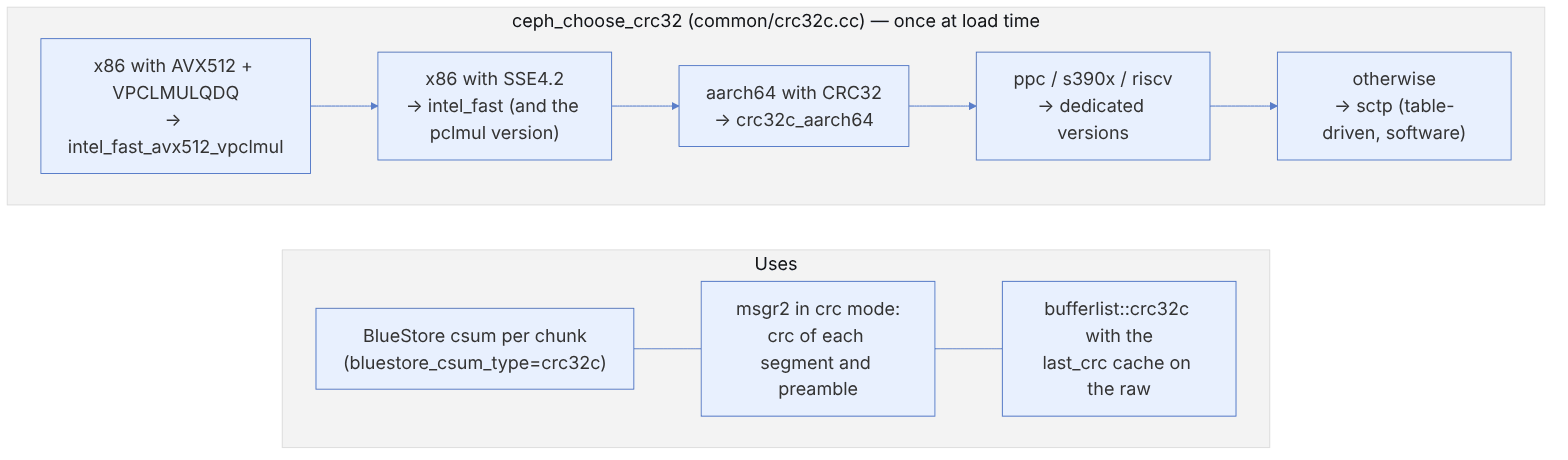
Ceph uses crc32c (the Castagnoli polynomial, in reversed form 0x82F63B78) both for data checksums in BlueStore and for message integrity in msgr2. ceph_choose_crc32() in common/crc32c.cc chooses the best implementation for the CPU once, at load time.
23-5-1 A numerical example#
ceph_crc32c(seed, data, len) works without the final inversion, and BlueStore starts with a seed of -1 (0xFFFFFFFF). For the reference string "123456789":
| Input | seed | ceph_crc32c output | After final XOR with 0xFFFFFFFF |
|---|---|---|---|
"123456789" (9 bytes) | 0xFFFFFFFF | 0x1CF96D7C | 0xE3069283 (the standard CRC-32C reference value) |
| 4096 zero bytes | 0xFFFFFFFF | 0x6706BE76 | — |
"ceph" | 0 | 0x575990D6 | — |
# this guide's own example: bit-by-bit crc32c (slow, only for understanding)
def crc32c(crc, data):
    for b in data:
        crc ^= b
        for _ in range(8):
            crc = (crc >> 1) ^ (0x82F63B78 if crc & 1 else 0)
    return crc
assert crc32c(0xFFFFFFFF, b"123456789") == 0x1CF96D7C
The hardware version does the same with the crc32 instruction on x86 (8 bytes per instruction) and with three parallel streams combined with PCLMULQDQ. On today's processors its speed is several tens of gigabytes per second per core, so the checksum is practically free.
23-5-2 Checksums in BlueStore#
Checksummer.h defines the types CSUM_XXHASH32=2, CSUM_XXHASH64=3, CSUM_CRC32C=4, CSUM_CRC32C_16=5 (the low 16 bits) and CSUM_CRC32C_8=6, and the default is bluestore_csum_type=crc32c. Each blob (chapter 24) has the fields csum_type, csum_chunk_order (chunk size equal to 1 << order bytes) and csum_data (the array of checksums).
Overhead arithmetic: with a 4K chunk and crc32c, every 4096 bytes of data have 4 bytes of checksum, that is about 0.1%. For an OSD with 10 TiB of data, this is about 10 GiB of checksums in onodes, part of which sits in the onode cache. If you make the chunk larger (large blobs and sequential reads, as with RGW), this overhead drops, but every small read has to read the whole chunk in order to verify it.
23-6 libaio and io_uring at the level of structures and locks#
The KernelDevice section showed the overall path. Here the same path is followed at the level of bytes, locks and threads. In KernelDevice::KernelDevice, based on bdev_ioring (default false), KernelDevice builds one of two queues: aio_queue_t (libaio) or ioring_queue_t (io_uring). The queue depth in both cases is bdev_aio_max_queue_depth (default 1024).
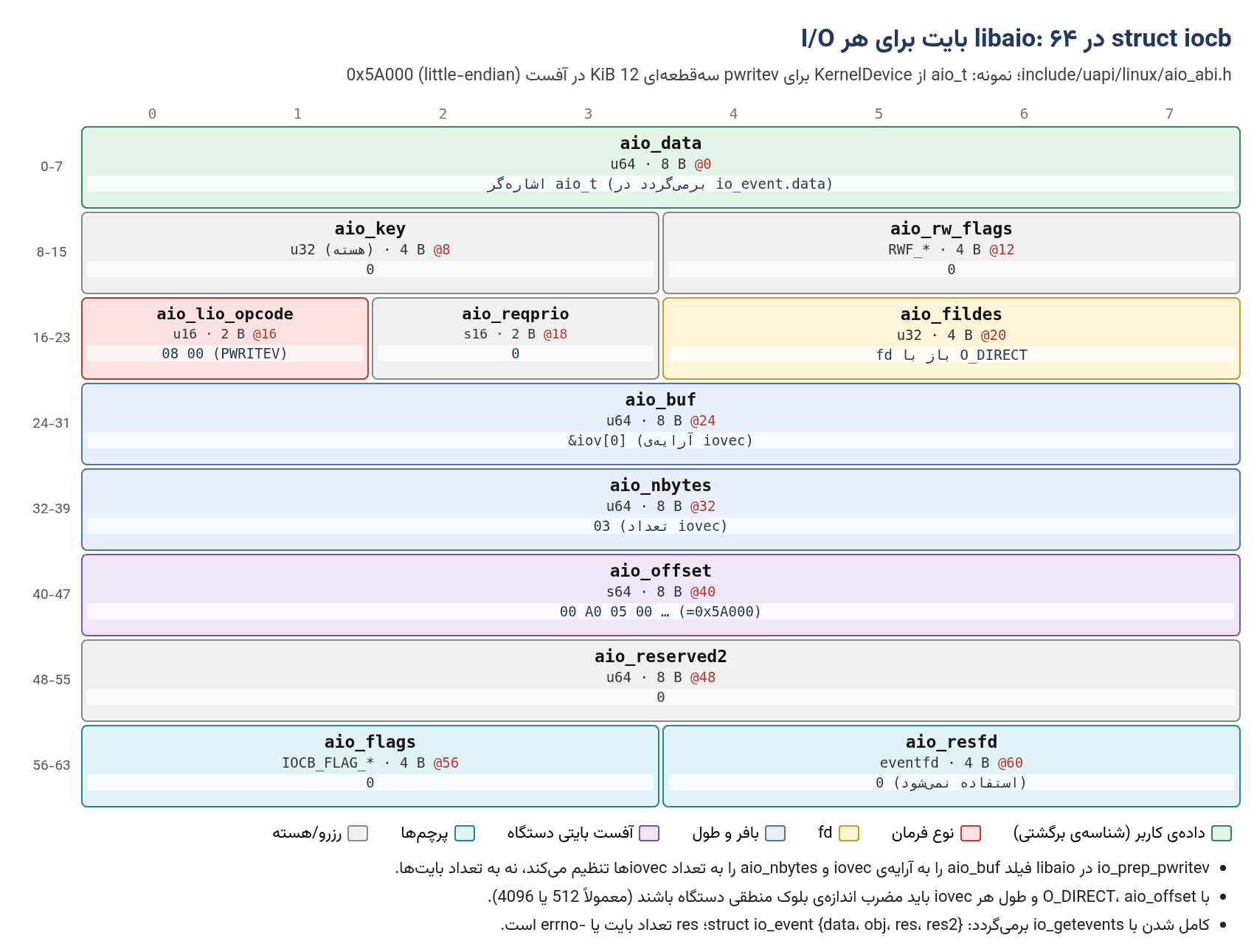
Source in code: src/blk/aio/aio.cc :: aio_queue_t::submit_batch
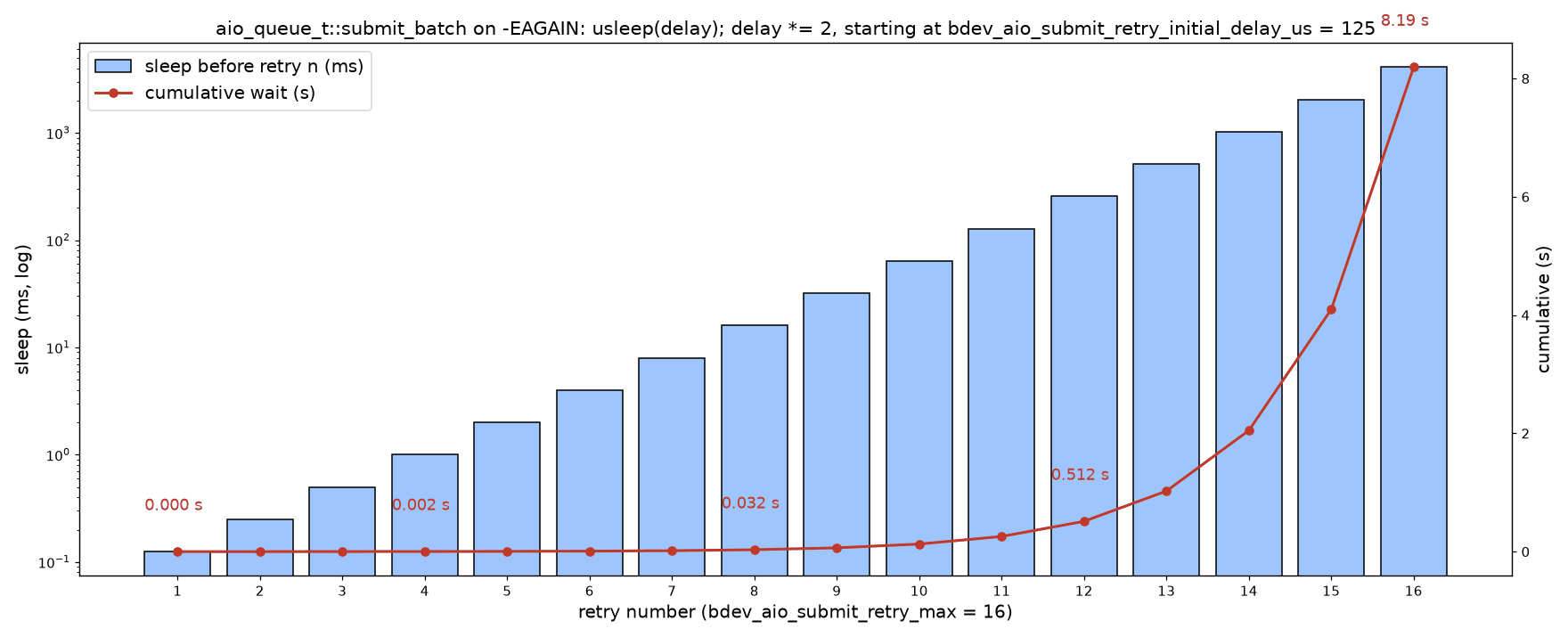
Complexity: O(N/max_iodepth) io_submit calls normally; in the worst case 16 attempts and about 8.2 seconds of cumulative waiting
pseudocode
attempts = bdev_aio_submit_retry_max (16) ; delay = 125 µs
while work remains:
    fill piocb[] from the list up to max_iodepth
    r = io_submit(ctx, pulled − pushed, piocb + pushed)
    if 0 ≤ r < toSubmit: pushed += r ; r = −EAGAIN      # partial acceptance
    if r == −EAGAIN and attempts−− > 0:
        usleep(delay) ; delay ×= 2 ; retries++ ; continue
    if r < 0: return r
    pushed = pulled = 0 ; reset attempts and delay
Numerical example. With 1024 requests pending in the kernel queue and a batch of 64, io_submit may accept only 10 requests. In that case pushed = 10, r becomes −EAGAIN, and a retry happens after 125 µs. If the queue stays full, the waits are 125, 250, 500 µs and so on, doubling up to 4.1 seconds for the sixteenth attempt. The total is seconds. The retries counter shows up in the log as "aio_submit retries". If this number appears often in the OSD log, the queue depth or device latency has a problem, not the CPU.
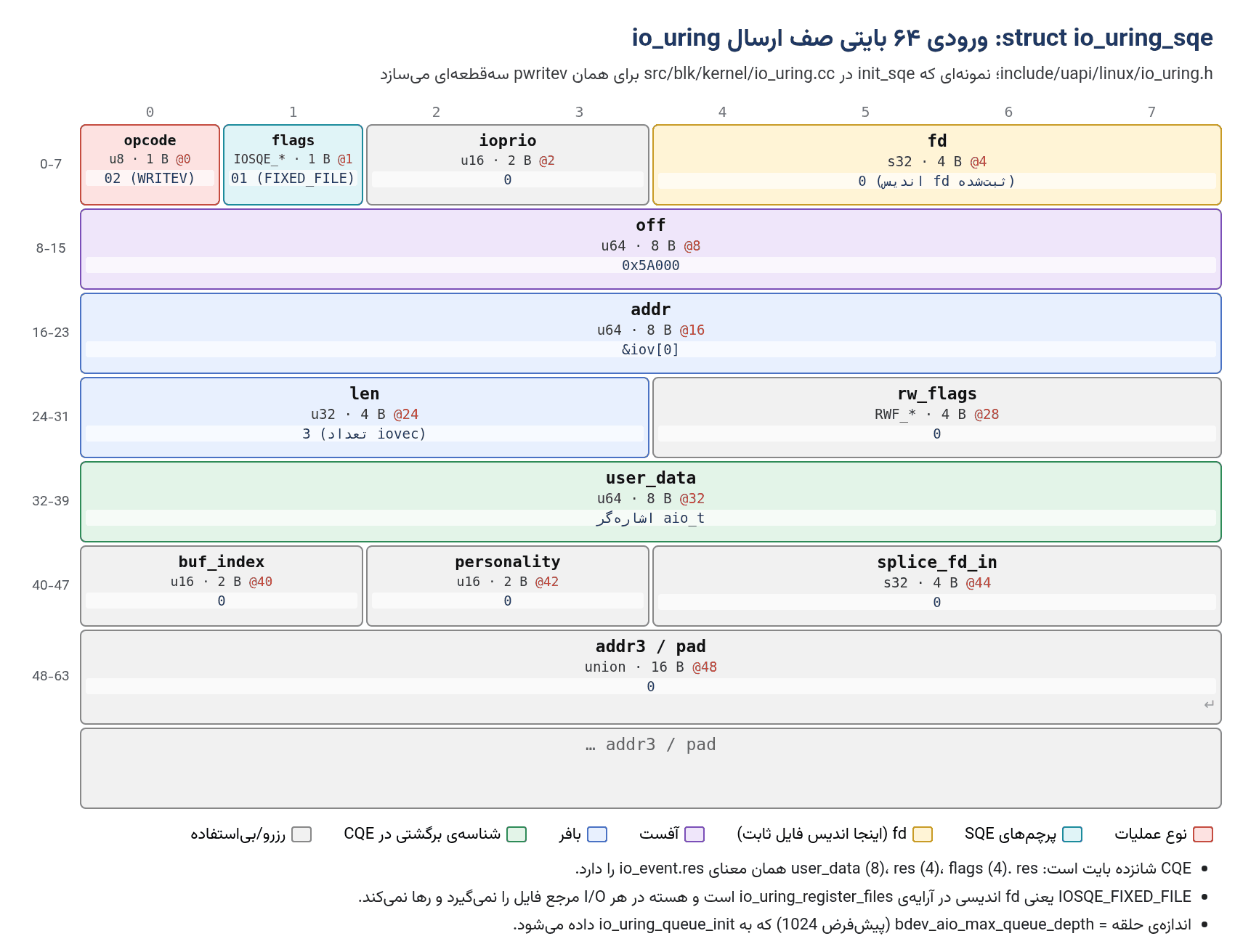
Source in code: src/blk/kernel/io_uring.cc :: ioring_queue_t::submit_batch, ioring_queue, ioring_get_cqe, get_next_completed
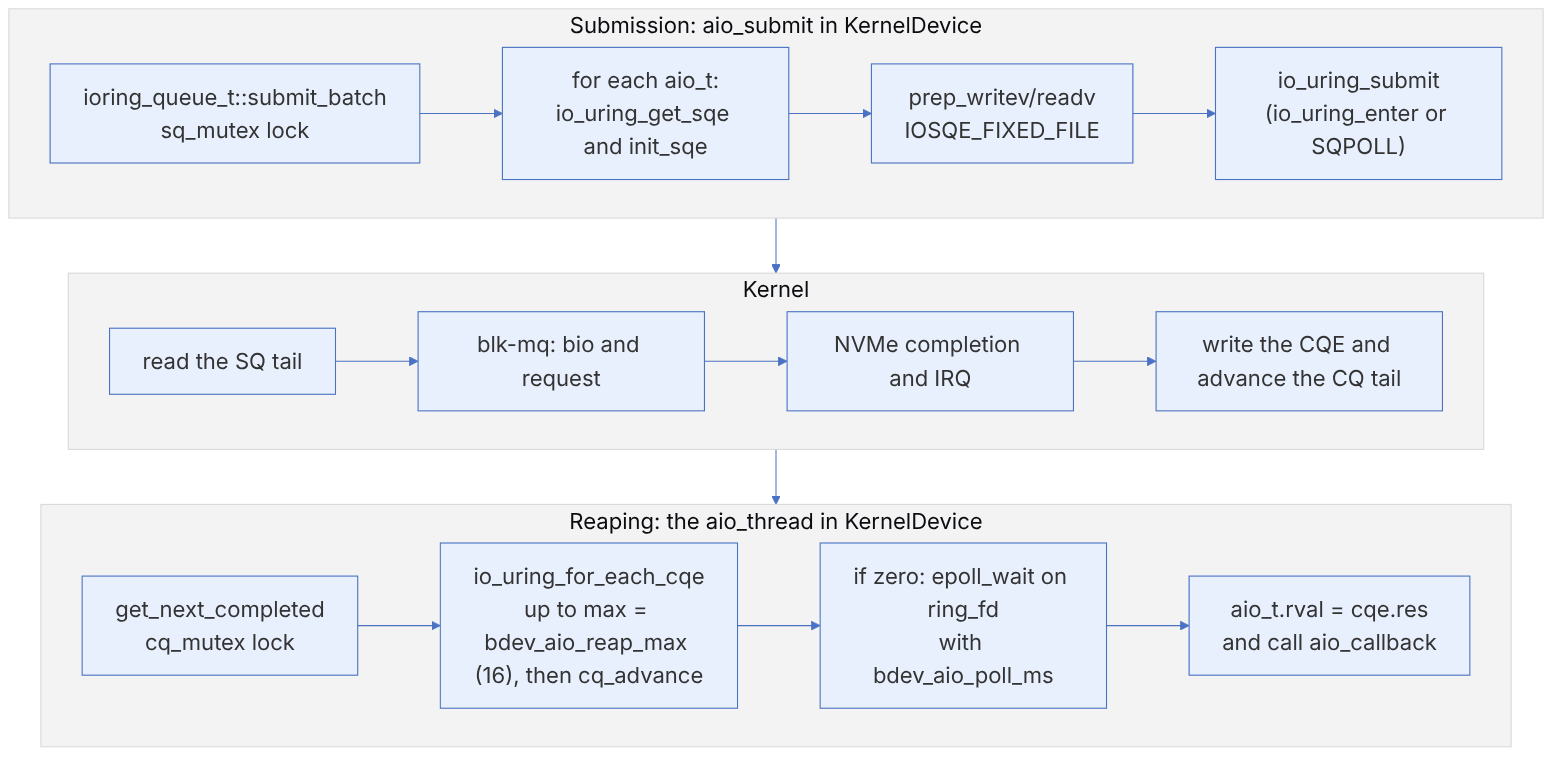
Complexity: submission O(N) SQE writes and one io_uring_submit; reaping O(min(ready, reap_max)) with no system call when a CQE is ready
pseudocode
submit_batch(beg, end):
    lock(sq_mutex)
    for io in [beg, end): sqe = io_uring_get_sqe() ; if null: break   # the ring is full
                          init_sqe(sqe, io)   # prep_writev/readv, FIXED_FILE, user_data=io
    rc = io_uring_submit()        # io_uring_enter, or just updating the tail in SQPOLL
    unlock(sq_mutex) ; return rc
get_next_completed(timeout, paio[], max):
    lock(cq_mutex) ; for each cqe up to max: io.rval = cqe.res ; paio[n++] = io
    io_uring_cq_advance(n) ; unlock(cq_mutex)
    if n == 0: epoll_wait(ring_fd, timeout = bdev_aio_poll_ms) ; if ready, go again
Numerical example and the difference from libaio. With a 1024-entry ring, the SQ is 1024 × 64 = 64 KiB and the CQ (which the kernel makes twice the SQ by default) is 2048 × 16 = 32 KiB. Both are shared between the kernel and Ceph with mmap. In libaio, each batch has at least one io_submit and each reap one io_getevents. In io_uring, when a CQE is ready, reaping is just reading shared memory. With bdev_ioring_sqthread_poll=true (the IORING_SETUP_SQPOLL flag), submission also has no system call, but a kernel thread spins on a CPU core. bdev_ioring_hipri sets the IORING_SETUP_IOPOLL flag: completion is done by polling the NVMe queue, and this only works for devices that have poll queues and with O_DIRECT.
io_uring is off by default in Ceph and may be disabled or restricted on some kernels and security policies (for example the kernel.io_uring_disabled sysctl in newer kernels). ioring_queue_t::supported() tests support by building a trial ring of 16 entries. If it fails, the OSD falls back to libaio with a warning.
23-7 Buffer growth in bufferlist::append#
Source in code: src/common/buffer.cc :: buffer::list::append(const char*, unsigned), refill_append_space
Complexity: amortized O(1) per small append; O(log(L/4K)) allocations up to the 256K cap and then L/256K allocations
pseudocode
append(data, len):
    first = min(len, free space at the end of _carriage)
    memcpy into the same raw (inline copy for length ≤ 32) ; _carriage.len += first
    if len − first > 0: refill_append_space(len − first).append(the rest)
refill_append_space(len):
    alen = round_up(round_up(len, 8) + S, 4096)          # S = sizeof(raw_combined)
    if _carriage is the last ptr:
        alen = max(alen, min(2 × round_up(_carriage.raw_length, 4096), 256 KiB))
    raw_combined::create(alen − S) ← data and header in one allocation
Numerical example. If encoding a structure appends 1 MiB of data in small pieces (for example u64s and short strings), the allocations are 4K, 8K, 16K, 32K, 64K, 128K and then 256K. After the first six buffers 252K is filled, and the remaining 772K goes into four more 256K buffers. The result is 10 ptr_nodes, with 1276 KiB allocated in total for 1024 KiB of data, instead of 256 4K buffers. The 256K cap is deliberately below tcmalloc's "small object" threshold. Each raw_combined keeps its control header at the end of the same allocation, so each buffer gets exactly a multiple of 4K of memory from the allocator.
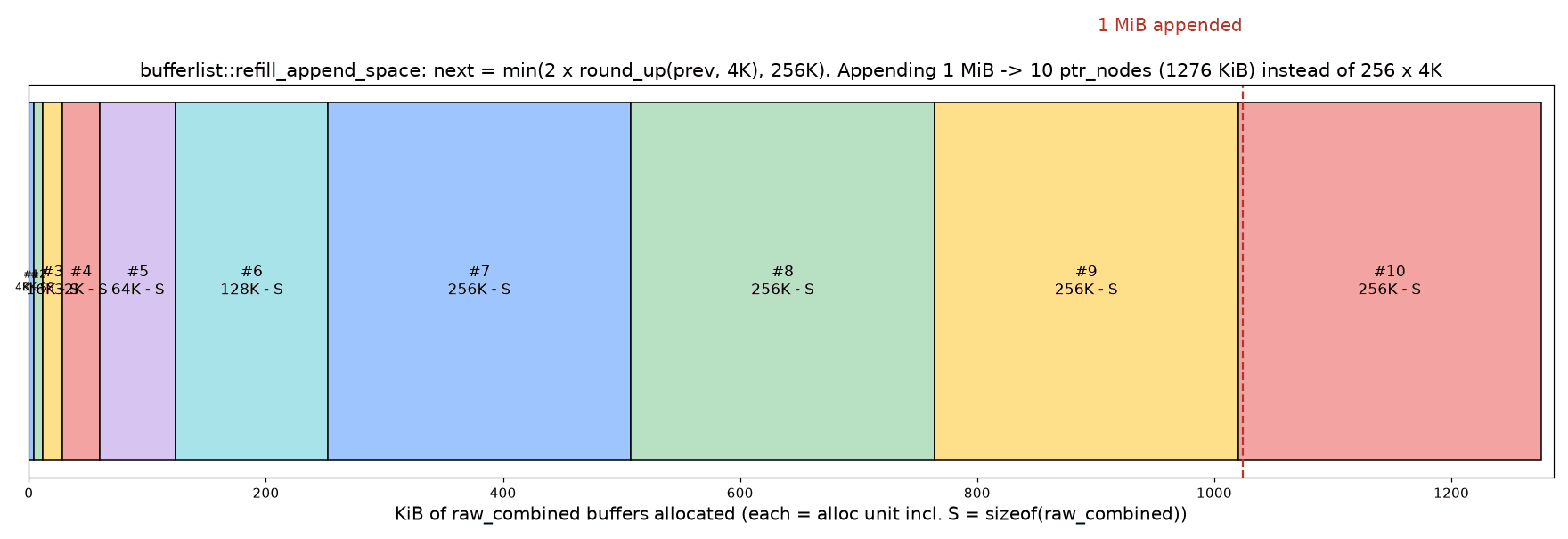
If the final size is known in advance, bl.reserve(n) or bl.push_back(buffer::create(n)) eliminates all these intermediate allocations. Ceph's hot paths use this method, for example encoding messages with encode(..., features) and the bound_encode pre-estimate in denc.
23-8 crc32c for zeros and seed adjustment#
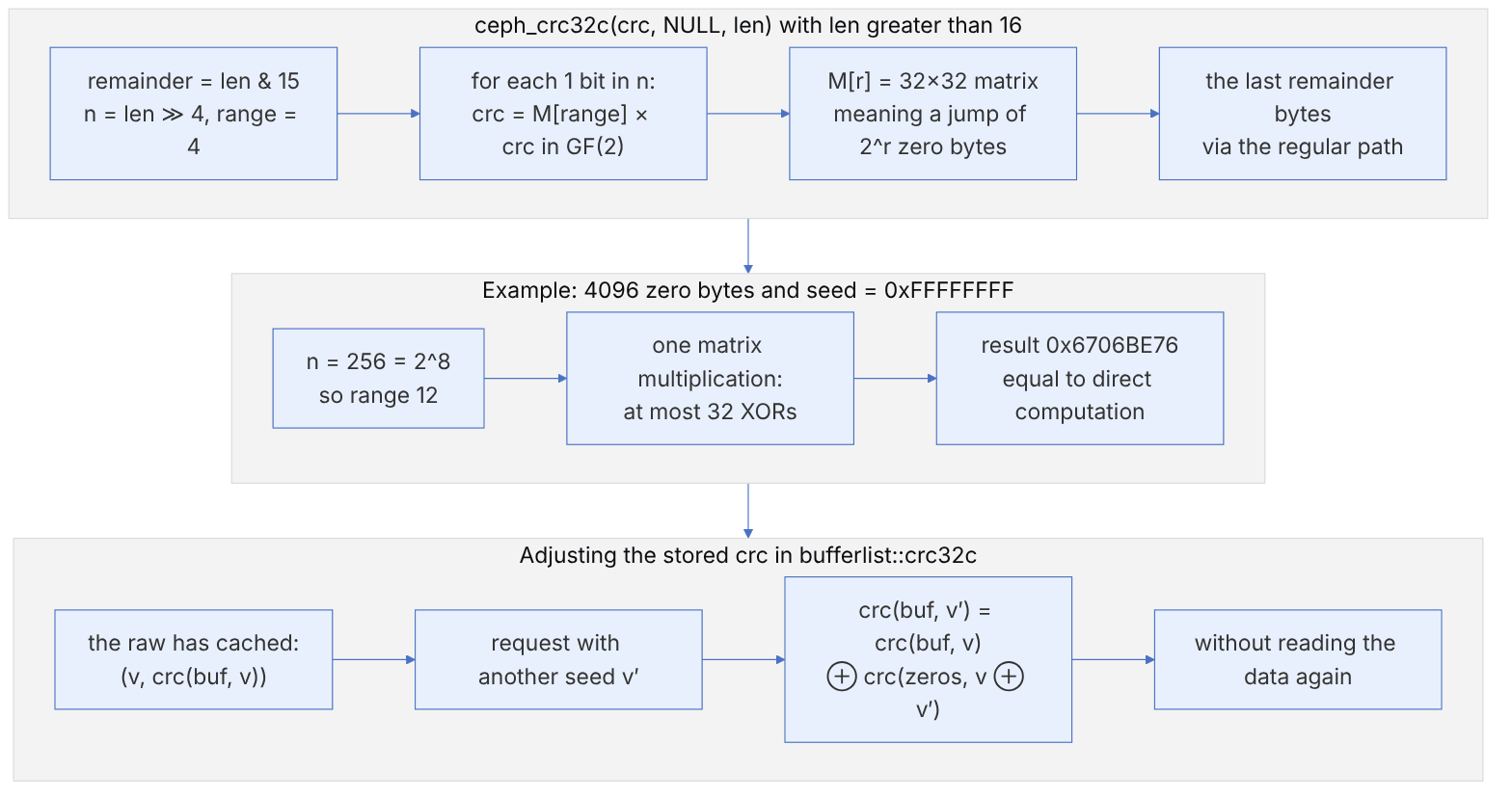
ceph_crc32c(crc, NULL, len) in include/crc32c.h has a special convention: if data is null and len is greater than 16, the crc of an all-zero region is computed, without reading memory. BlueStore and bufferlist use this for zero regions (buffer::list::append_zero, raw_zeros buffers) and for adjusting a stored crc.
Source in code: src/common/crc32c.cc :: ceph_crc32c_zeros, create_turbo_table (the crc_turbo_table[32][32] table)
Complexity: O(log len) 32×32 matrix multiplications over GF(2), each at most 32 XORs; independent of length (instead of O(len))
pseudocode
# M[0][bit] = crc(1≪bit, one zero byte) ; M[r] = M[r−1]², that is a jump of 2^r bytes
zeros(crc, len):
    rem = len & 15 ; n = len ≫ 4 ; r = 4                 # start from the 16-byte jump
    while n: if n & 1: crc = Σ_{bit j of crc = 1} M[r][j]   (XOR)
             n ≫= 1 ; r += 1
    if rem: crc = regular_crc(crc, rem zero bytes)
Numerical example. For 4096 zero bytes with seed = 0xFFFFFFFF: rem = 0 and , so only one multiplication with M[12] is needed, and the result is 0x6706BE76. Direct byte-by-byte computation (this guide's separate implementation) gives the same number. For 69637 = 65536 + 4096 + 5 bytes: two multiplications (M[16] and M[12]) and then 5 regular bytes, with the result 0xAC433F9D, which again matches the direct computation. The first four values of row M[0] (0xF26B8303, 0xE13B70F7, 0xC79A971F, 0x8AD958CF) are the same values as the crc_turbo_table in Ceph's code.
Source in code: src/common/buffer.cc :: buffer::list::crc32c; include/buffer_raw.h :: raw::get_crc, set_crc
Complexity: O(log len) instead of O(len) for each raw whose crc is cached
pseudocode
for node in _buffers:
    if raw.get_crc((off, off+len)) → (v, c):
        if v == crc: crc = c                                  # cache hit
        else: crc = c ⊕ ceph_crc32c(v ⊕ crc, NULL, len)       # adjust
    else: base = crc ; crc = ceph_crc32c(crc, data, len) ; raw.set_crc(..., (base, crc))
Numerical example. For a 1000-byte buffer, the crc with seed 0 is 0xACBE2A2C and is cached in the raw. Now the same buffer is requested with seed 0xFFFFFFFF. The adjustment gives 0xACBE2A2C ⊕ zeros(0 ⊕ 0xFFFFFFFF, 1000) = 0x8B0C0F84, which is exactly the direct crc with the new seed. This is where the messenger (msgr) and BlueStore checksum a buffer twice with different seeds, and the second time costs only a few dozen XORs. Its statistics can be seen with buffer_track_crc in the buffer_cached_crc and buffer_cached_crc_adjusted counters.
23-9 Supplementary and up to date#
- On main,
block_device_tonly hasaioandspdk. PMEM support (DAX devices) has been removed on main, but Tentacle still hasblock_device_t::pmem. If you use PMEM, check the release notes before upgrading. - The
bdev_async_discardoption has been replaced bybdev_async_discard_threads, and for compatibility the code maps the old value to one thread. - io_uring is still off by default (
bdev_ioring=false).
23-10 Hands-on exercise#
- 1. On a test OSD, measure the ratio of
io_submittoio_geteventswithstrace -c -f -p <pid>during arados bench. Then setbdev_ioring=true, restart the OSD and compare the difference withceph osd perf. - 2. Run this chapter's Python crc32c function and compare the result for a random 4K block with Python's
crcmodorcrc32c(remember to apply the final XOR). - 3. Save the output of
dump_mempoolsbefore and after a largerados benchand identify the 5 pools with the most growth. - 4. Collect
cat /sys/block/<dev>/queue/write_cacheandrotationalfor all OSD devices and compare them withceph osd metadata.
23-11 Review questions#
- 1. Why does KernelDevice open a separate fd for each write hint?
- 2. What limit does O_DIRECT alignment place on BlueStore's smallest write?
- 3. What are the roles of
bdev_aio_max_queue_depthandbdev_aio_reap_max? - 4. When does BlueStore force a separate flush of the data device?
- 5. Why is discard off by default?
- 6. What is the difference between
buffer::ptrandbuffer::raw? - 7. Why can
bufferlist::c_str()be expensive? - 8. How does mempool help memory autotuning?
- 9. Why does Ceph's crc32c of
"123456789"differ from the standard reference value? - 10. What is the checksum overhead with a 4K chunk, and what is the trade-off of making the chunk larger?
Answers to these questions are in Appendix E: Answers to Review Questions. Answers to this chapter's questions →
23-12 Sources for this chapter#
- KernelDevice code
https://github.com/ceph/ceph/blob/main/src/blk/kernel/KernelDevice.cc - libaio in Ceph
https://github.com/ceph/ceph/blob/main/src/blk/aio/aio.cc - bufferlist
https://github.com/ceph/ceph/blob/main/src/include/buffer.h - mempool
https://github.com/ceph/ceph/blob/main/src/include/mempool.h - crc32c
https://github.com/ceph/ceph/blob/main/src/common/crc32c.cc - BlueStore configuration (checksum and compression
https://docs.ceph.com/en/latest/rados/configuration/bluestore-config-ref/ - io_uring
https://kernel.dk/io_uring.pdf - CRC-32C (RFC 3720, appendix B.4
https://www.rfc-editor.org/rfc/rfc3720