Lower Layers (3): RocksDB Inside BlueStore
TL;DR this chapter in a few lines
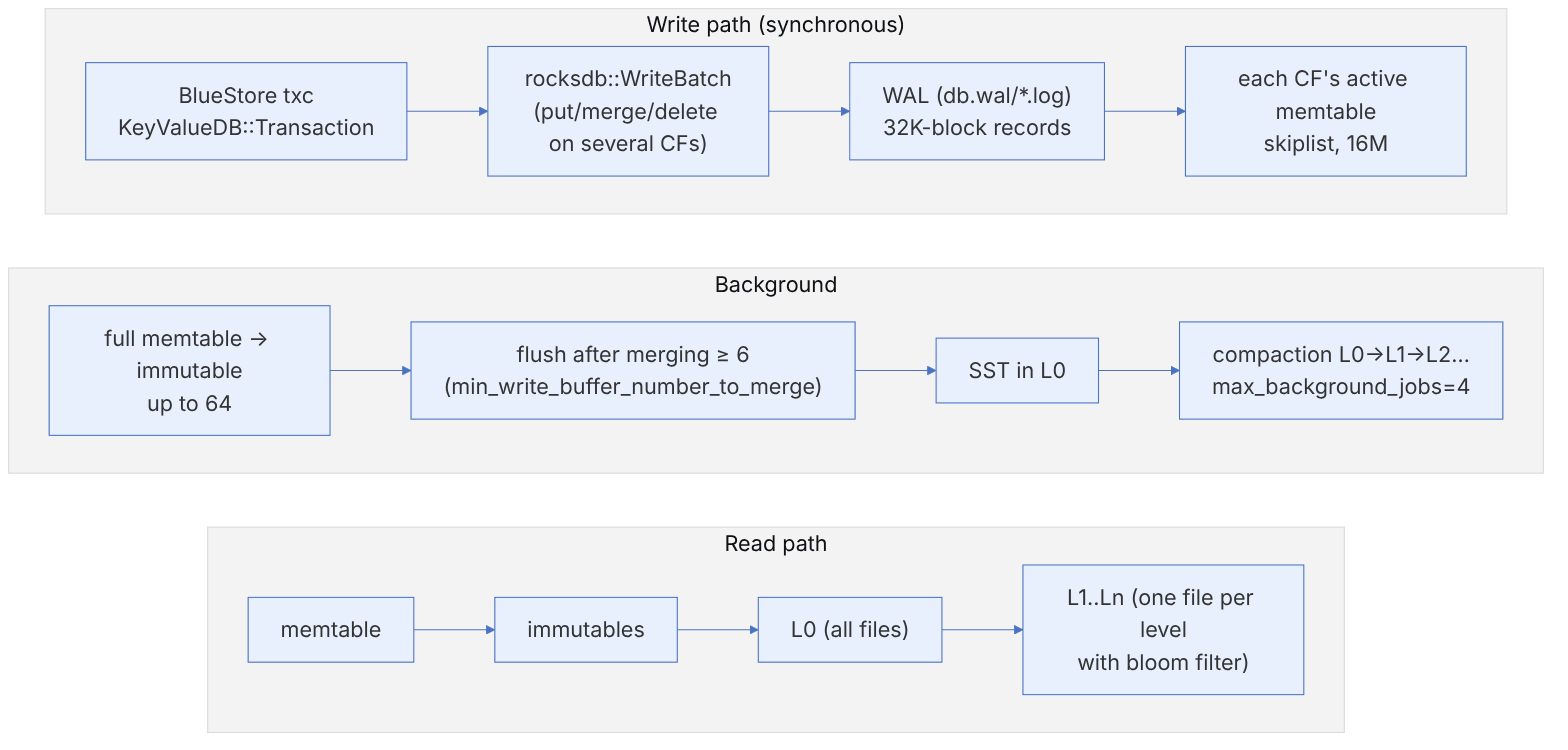
- RocksDB inside BlueStore is an LSM tree: writes go to the WAL and the memtable (a skiplist), then are flushed to SST files.
- Group commit batches writers into one WAL write; the WAL record format splits large records into fragments.
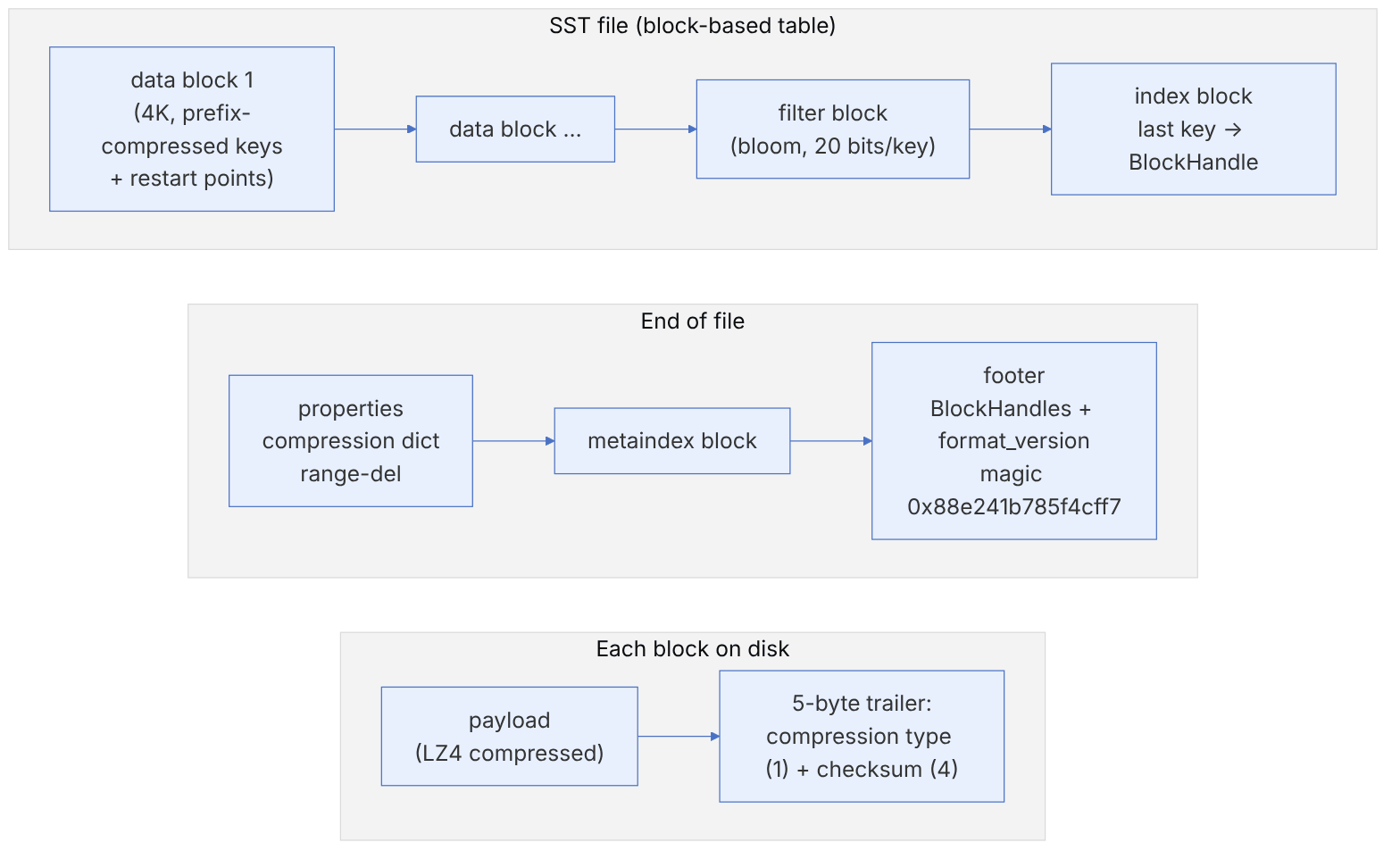
- SST data blocks use key deltas with restart points; Ceph's Bloom filters (
rocksdb_bloom_bits_per_key = 20) avoid useless reads. - Compaction score and dynamic level sizes decide when and where data is compacted, which drives write amplification.
25-1 Introduction: why RocksDB?#
BlueStore writes object data directly to the raw device, but all of its metadata, from onodes and omaps to the freelist and deferred writes, lives in RocksDB. RocksDB is a key-value database based on an LSM-tree: writes are first recorded in a sequential log (the WAL) and an in-memory structure (the memtable), and later, in the background, turned into sorted, immutable files (SSTs) and merged. This structure makes small writes cheap and sequential, which is ideal for BlueStore's frequently changing metadata. The cost is paid in compaction and write amplification. This chapter shows layer by layer how Ceph configures and shards RocksDB and places it on BlueFS.
- Ceph carries its own version of RocksDB as a submodule (
ceph/rocksdb) alongside the code. Its interface issrc/kv/RocksDBStore.cc, which implementsKeyValueDB. - The
bluestore_rocksdb_optionsdefaults include: a 16M memtable, at most 64 memtables, merging at least 6 memtables before a flush, L1 of 1G, a multiplier of 8 and LZ4 compression. - Column family sharding (
bluestore_rocksdb_cfs) splits them,pandOprefixes into several CFs with an rjenkins hash over part of the key. - BlueFS spreads RocksDB's levels across the WAL, DB and slow devices according to the
use_some_extrapolicy. Overflow to the slow device raises aBLUEFS_SPILLOVERwarning.
25-2 From a BlueStore transaction to a WriteBatch#
BlueStore::_txc_finalize_kv and _kv_sync_thread gather ready transactions. Each KeyValueDB::Transaction in RocksDBStore is a rocksdb::WriteBatch, and submit_transaction_sync hands it to RocksDB with WriteOptions.sync = true. Several BlueStore transactions are submitted back to back in one round of _kv_sync_thread, but only the last of them is synchronous. So several txcs become durable with one fsync on the WAL (group commit).
| KeyValueDB operation | RocksDB equivalent | Use in BlueStore |
|---|---|---|
set(prefix, key, bl) | Put(cf, key, value) | onode, omap, deferred |
rmkey | Delete | removing onodes and omaps |
rm_single_key | SingleDelete | keys written exactly once (such as L); the tombstone is removed sooner |
rm_range_keys | DeleteRange (above a threshold) | removing an object's whole omap; below rocksdb_delete_range_threshold=1M it deletes key by key |
merge | Merge with a registered operator | bitwise_xor for the freelist and int64_array for statistics |
25-3 The WAL: record format#
RocksDB's WAL (the *.log files in the BlueFS directory named db.wal) is divided into fixed 32-kilobyte blocks (kBlockSize = 32768). Each record has a 7-byte header (kHeaderSize = 4 + 2 + 1): a masked crc32c checksum (4 bytes), the length (2 bytes) and the type (1 byte). The type is one of: kFullType=1 (the whole record in this block), kFirstType=2, kMiddleType=3 or kLastType=4 (a record broken across several blocks). In recyclable mode, a 4-byte log number is added and the header becomes 11 bytes.
WAL record (logic from RocksDB db/log_format.h, Apache-2.0/GPL-2.0; drawing from this book)
 +--------+--------+------+---------------------------+
 | CRC(4) | Len(2) | T(1) |  payload: WriteBatch part  |
 +--------+--------+------+---------------------------+
WriteBatch = seq(8) | count(4) | {type, [cf id], key, value}*How the WAL and BlueFS interact: for each synchronous commit, RocksDB calls Sync() on the WAL file, and BlueRocksEnv turns it into BlueFS::fsync. BlueFS flushes the data. If the file has grown, it must also record the new fnode in the BlueFS log, which means a second synchronous write. Envelope mode in Tentacle and later (chapter 24) is designed precisely to eliminate this second write. Also, max_total_wal_size=1G means that if the WAL exceeds 1 gigabyte, older memtables are flushed sooner so the WAL can be truncated.
25-4 memtable and flush#
The memtable is a skiplist by default. With Ceph's defaults, each memtable has write_buffer_size=16M, and up to max_write_buffer_number=64 memtables (that is at most 1 gigabyte) can be in memory. min_write_buffer_number_to_merge=6 means a flush only happens when at least six immutable memtables are ready. Then all six are merged together, and keys that were written and deleted in the meantime (such as deferred writes and temporary pg log records) never reach an SST. For the L and P CFs this number is raised to 32 in bluestore_rocksdb_cfs, because their keys are very short-lived.
This design explains why removing or lowering min_write_buffer_number_to_merge in manual tuning usually multiplies write amplification. If you change bluestore_rocksdb_options, add only the keys you want in bluestore_rocksdb_options_annex, not the whole string.
25-5 SST: file format#
| Part | Content | Ceph option |
|---|---|---|
| data block | sorted keys with the shared prefix removed; a restart point every 16 keys | rocksdb_block_size=4_K |
| filter | a whole-file or partitioned bloom filter | rocksdb_bloom_bits_per_key=20 (false positive rate about 0.01%) |
| index | the last key of each block → (offset, size) | rocksdb_metadata_block_size=4_K |
| cache | data, index and filter blocks in the block cache | rocksdb_cache_size=512_M (varies with autotune), rocksdb_cache_type=binned_lru, rocksdb_cache_index_and_filter_blocks=true |
| footer | BlockHandles, format_version, magic | — |
The block checksum type and the default format_version depend on the RocksDB version bundled with Ceph. In upstream RocksDB (the main branch) the defaults are kXXH3 and format_version=7. Ceph builds its own version from the ceph/rocksdb repository, so to see the exact value, check the OPTIONS-* output inside BlueFS (with bluefs-export).
25-6 Compaction and levels#
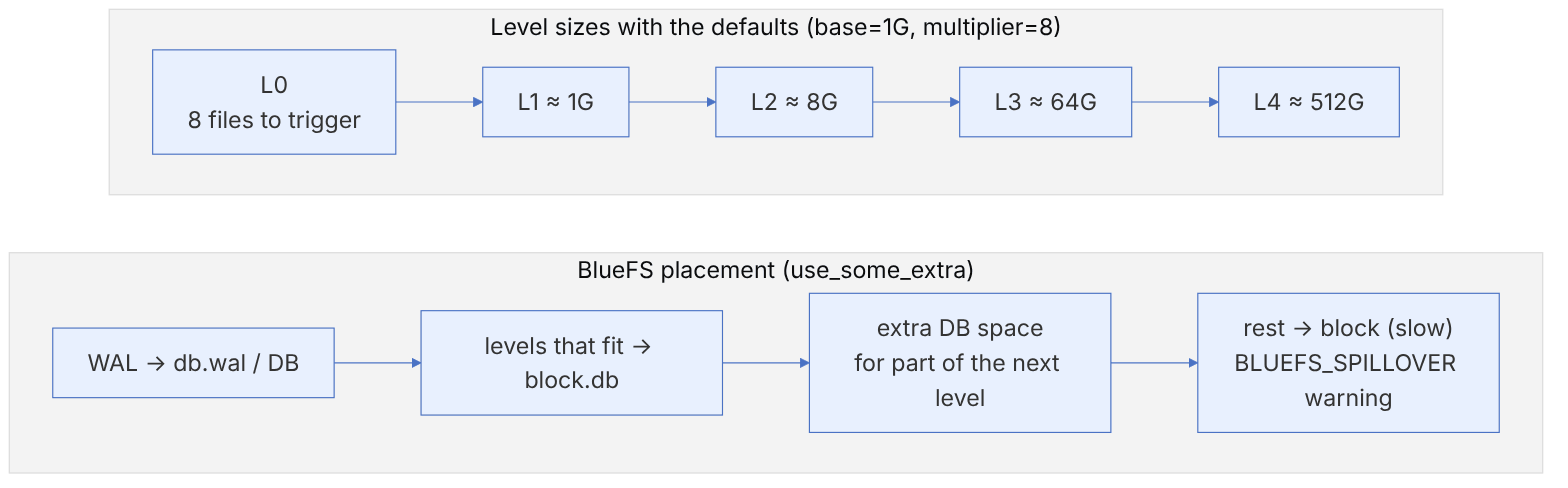
With compaction_style=kCompactionStyleLevel, each level Ln (n ≥ 1) is a set of SSTs with no key overlap. When the number of L0 files reaches level0_file_num_compaction_trigger=8, an L0→L1 compaction starts. When a level's size exceeds its target, part of it is merged into the next level. Ceph's defaults are max_bytes_for_level_base=1G, max_bytes_for_level_multiplier=8 and max_background_jobs=4 (flush and compaction together).
Numerical example of DB size: an OSD with 10 million 4M objects (about 40 terabytes) and onodes of about 800 bytes has about 8 gigabytes of data just for O. With omap and the pg log it may reach 20 to 30 gigabytes. With the defaults, L1+L2+L3 = 1 + 8 + 64 = 73G is needed on the DB to keep all level 3 data on the fast device. If block.db is only 30G, the use_some_extra policy puts part of L3 on the DB and the rest on the slow device, and BLUEFS_SPILLOVER is reported.
bluestore_volume_selection_policy policy | Behaviour |
|---|---|
rocksdb_original | only levels that fit completely go on the DB |
use_some_extra (default) | the DB's extra space is used for part of the next level; bluestore_volume_selection_reserved_factor=2 |
use_some_extra_enforced | like the previous one, with stricter enforcement |
fit_to_fast | 100% use of the fast device; allows enabling level_compaction_dynamic_level_bytes |
Why a multiplier of 8 and not 10? Write amplification in leveled compaction is roughly proportional to the level multiplier (each byte at each level is rewritten about multiplier times more), and the extra space is 1/(multiplier−1). A multiplier of 8 versus 10 takes a little more space but reduces write amplification and makes level sizes fit common DB device sizes better. This is a design choice in Ceph's defaults. Before changing it, compute its effect on your DB size.
25-7 Column family sharding#
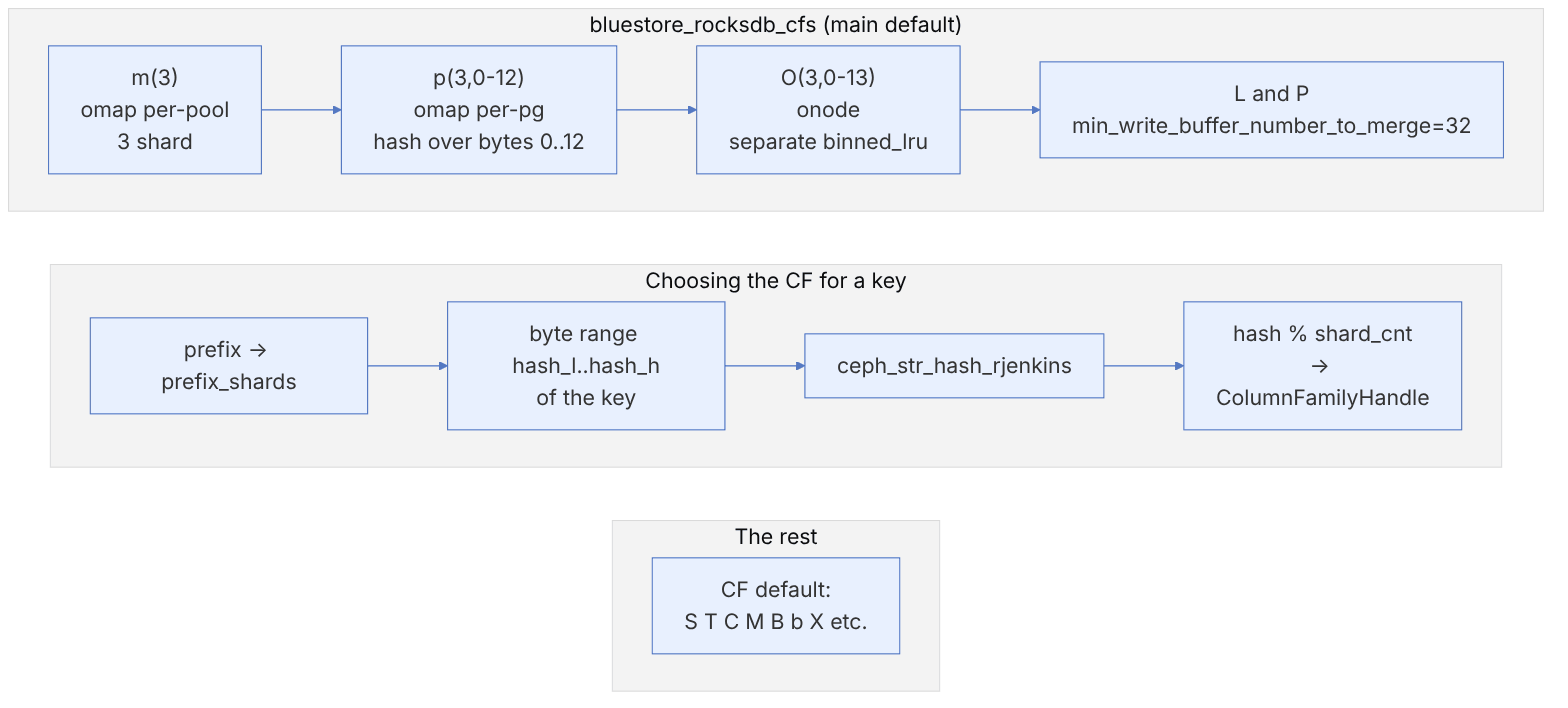
The definition syntax is <prefix>(<shards>[,<l>-<h>])[=<options>], which parse_sharding_def in RocksDBStore.cc interprets. get_key_cf hashes the [hash_l, hash_h) part of the key with ceph_str_hash_rjenkins and returns hash % shards.handles.size(). In p(3,0-12), bytes 0 to 12 of the key (that is the pool, the PG hash and the start of the nid) are used, so that a PG's omaps stay in one shard and a range scan runs on one CF.
Why shard? (1) Each CF has its own memtable and compaction. So frequently changing data (L and P) is not merged into the same SST as stable onodes (O), and write amplification drops. (2) Compaction runs in parallel across several CFs. (3) A separate cache for O (block_cache={type=binned_lru}) prevents onodes from being evicted by omap.
# OSD stopped:
ceph-bluestore-tool show-sharding --path /var/lib/ceph/osd/ceph-4
ceph-bluestore-tool reshard --path /var/lib/ceph/osd/ceph-4 \
    --sharding "m(3) p(3,0-12) O(3,0-13)=block_cache={type=binned_lru} L P"
ceph-kvstore-tool bluestore-kv /var/lib/ceph/osd/ceph-4 stats
# OSD running:
ceph tell osd.4 compact
ceph daemon osd.4 bluefs statsreshard runs on a stopped OSD and rewrites the whole DB. Before it, set noout for the OSD, check the DB's free space, and test on one OSD first. According to the documentation, OSDs created before Pacific remain unsharded after the upgrade (everything in the CF named default), and reshard is the official way to convert them.
25-8 Tuning and diagnosis#
| Symptom | Probable cause | Action |
|---|---|---|
high commit latency (ceph daemon osd.N perf dump bluestore → kv_sync_lat) | WAL on a slow device, or WAL and DB competing with data | WAL and DB on NVMe; check bluefs stats |
BLUEFS_SPILLOVER | block.db smaller than the needed levels | grow the DB (bluefs-bdev-expand) or migrate (bluefs-bdev-migrate) |
| slowness after mass deletion (for example removing a snapshot) | many tombstones in SSTs | rocksdb_cf_compact_on_deletion=true (default) or ceph tell osd.N compact |
| OSD memory growth | memtables (up to 1G) and the block cache | osd_memory_target, check dump_mempools and rocksdb in perf |
| L0 full and write stalls | compaction falling behind | check max_background_jobs and the DB device's bandwidth |
ceph daemon osd.4 perf dump rocksdb | jq '.rocksdb | {get_latency, submit_latency, submit_sync_latency, compact, compact_running}'
ceph config set osd bluestore_rocksdb_options_annex "max_background_jobs=6" # only the changed keys25-9 A WriteBatch at the byte level#
To see what a BlueStore transaction looks like on the WAL, we hand-encode a hypothetical WriteBatch with two operations: a Put in the CF with ID 3 (key Ok1o and value hello) and a SingleDelete in the CF with ID 7 (key L42). The sequence number is 1234567. The type constants come from db/dbformat.h in RocksDB: kTypeColumnFamilyValue=0x5 and kTypeColumnFamilySingleDeletion=0x8. The encoder is our own.
| Bytes | Meaning |
|---|---|
87 d6 12 00 00 00 00 00 | sequence = 1234567 (u64 little-endian) |
02 00 00 00 | count = 2 (u32) |
05 | type: Put in a non-default CF |
03 | CF ID (varint) |
04 4f 6b 31 6f | key length 4 + "Ok1o" |
05 68 65 6c 6c 6f | value length 5 + "hello" |
08 07 | SingleDelete-in-CF type + CF ID 7 |
03 4c 34 32 | key length 3 + "L42" |
These 32 bytes are then written as the payload of a WAL record, with a 7-byte header (crc + length + type kFullType), into the current 32K block. If the payload crosses the end of the block, it is split into First/Middle/Last records. If fewer than 7 bytes remain to the end of the block, those few bytes are filled with zeros.
Real BlueStore keys: for prefixes that have their own CF, the prefix's first character is not repeated in the RocksDB key, because the CF itself identifies the prefix. In the default CF, the key is combined as prefix + 0x00 + key (combine_strings). That is why, when you look directly at the default CF with ldb, you see keys like S\0nid_max.
25-10 BlueRocksEnv: RocksDB without the kernel file system#
BlueRocksEnv inherits from rocksdb::EnvWrapper and sends RocksDB's file calls to BlueFS:
| Env function in RocksDB | Implementation in BlueFS |
|---|---|
NewWritableFile | BlueFS::open_for_write → a FileWriter with a buffer and append |
NewSequentialFile / NewRandomAccessFile | open_for_read → a FileReader with prefetch |
Sync / Fsync | BlueFS::fsync: flush the data, and if the size changed, record the fnode in the log |
RenameFile | op_dir_link + op_dir_unlink in one log transaction (atomic) |
GetChildren | the dir_map listing |
LockFile | an in-process lock (BlueFS has only one user) |
BlueFS directories express the physical location: db (the DB device), db.wal (the WAL device) and db.slow (the main device). RocksDB creates files in these directories through the db_paths and wal_dir options, and the BlueFS volume selector (previous section) makes the final decision about the device.
pseudocode: fsync of a WAL file (this book's summary)
  BlueFS::fsync(h):
      _flush_F(h)                         # write the buffer to extents with aio
      if h.file.fnode.size changed (or allocated changed):
          log.t.op_file_update_inc(h.file.fnode)
          _flush_and_sync_log_LD()        # the second synchronous write: the BlueFS log
      else:
_flush_bdev(h) # only flush the device25-11 Algorithms inside RocksDB at the code level#
The previous sections described what RocksDB does inside BlueStore. This section examines seven key algorithms with the code of RocksDB 9.11, that is the version the src/rocksdb submodule on the main branch points to (the ceph/rocksdb repository). The Reef and Squid versions point to other commits. Defaults that changed across versions are marked separately.
25-11-1 The skiplist in the memtable#
The default memtable is an InlineSkipList. Ceph does not change the memtable factory, so this same structure is used for all column families. Its constructor has max_height = 12 and branching_factor = 4.
Source in code: rocksdb/memtable/inlineskiplist.h :: InlineSkipList::RandomHeight, FindGreaterOrEqual, Insert
Complexity: search and insert with an expected O(log_4 n) levels and about 4 comparisons per level, that is O(log n). Memory averages 4/3 pointers per node
pseudocode
RandomHeight(): h = 1
    while h < 12 and rnd.Next() < 2^32/4: h++          # probability 1/4 for each higher level
FindGreaterOrEqual(key):
    x = head ; level = max_height − 1
    loop: next = x.next[level]
          cmp = (next == null) ? +1 : compare(next.key, key)
          if cmp == 0 or (cmp > 0 and level == 0): return next
          if cmp < 0: x = next                       # move forward
          else: level −= 1                           # move down
Insert(key): height h ; find prev[] and next[] from top to bottom ;
             build the node with one allocation from the arena (pointers before the key) ;
             link from level 0 upward with CAS or store-release
Numerical example. With write_buffer_size = 16 MiB (Ceph's default) and entries of about 100 bytes, each memtable has about 160000 nodes. The expected number of nodes whose height is at least h is : 160000, 40000, 10000, 2500, 625, 156, 39, 10, 2.4 for h = 1..9. So the effective height is about 9, and a Seek walks about 9 levels with 1 to 3 horizontal steps per level, that is fewer than 30 key comparisons. The average height is 4/3, so each node has on average 8 × 4/3 ≈ 10.7 bytes of pointers. A separate simulation with 160000 nodes gave an average of 1.335.
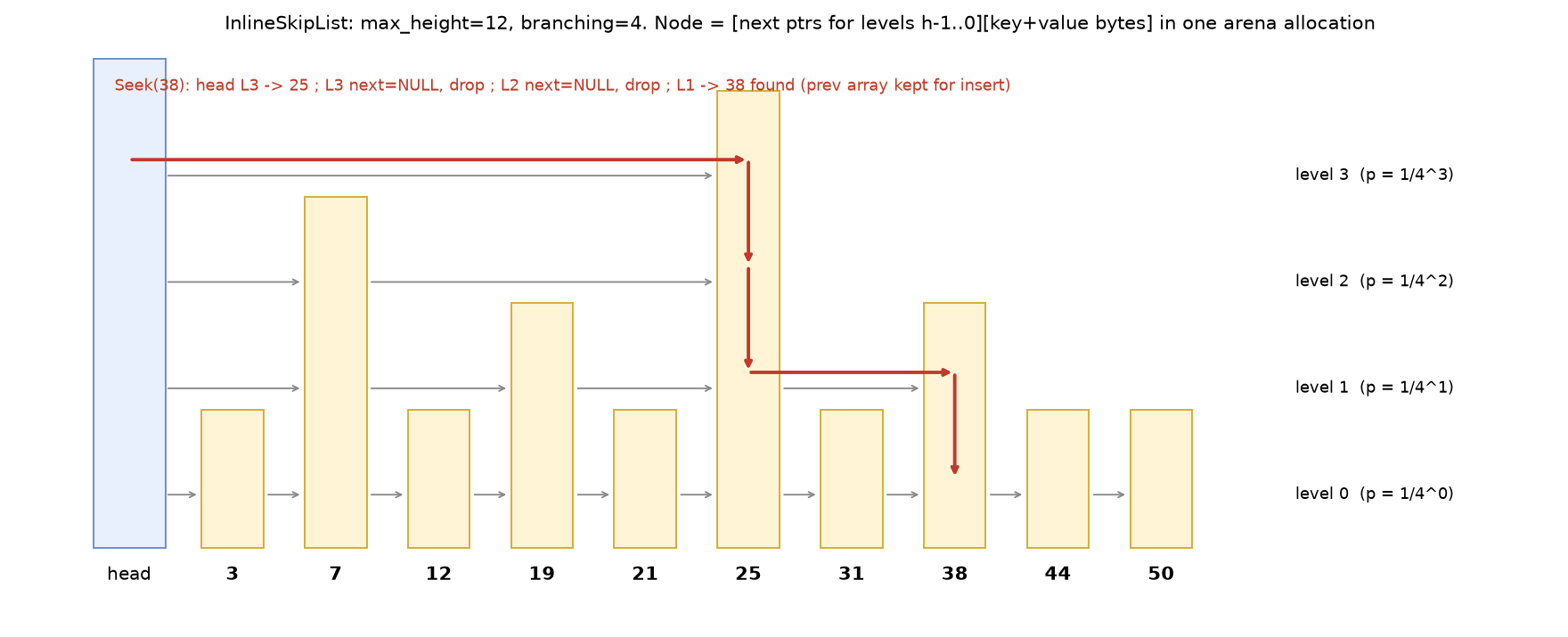
Concurrent insertion (allow_concurrent_memtable_write = true, RocksDB's default) uses InsertConcurrently with CAS at each level. In BlueStore most writes come from kv_sync_thread, so contention on the skiplist is low and the main cost is key comparison and cache misses.
25-11-2 The write group (group commit)#
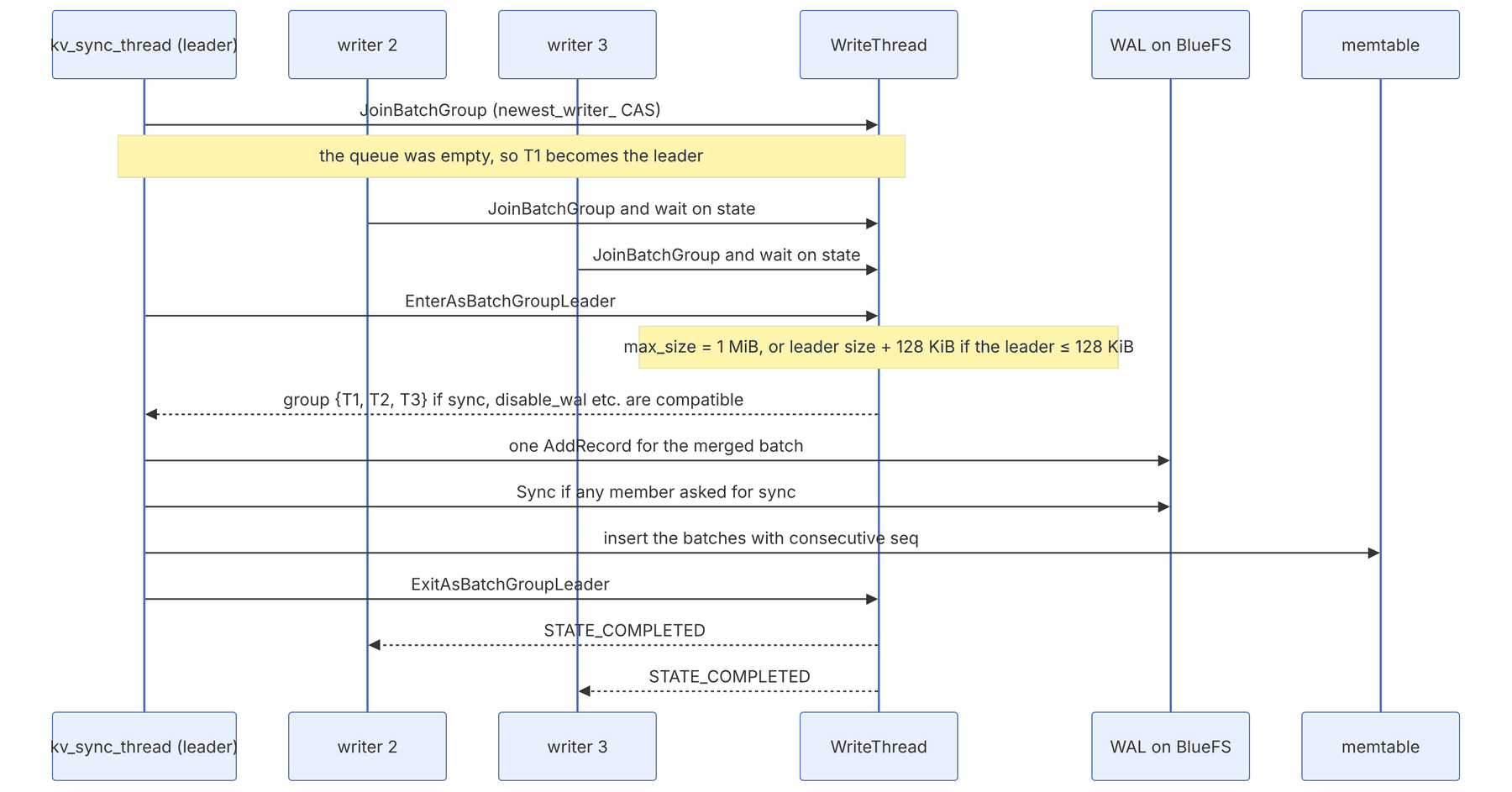
Source in code: rocksdb/db/write_thread.cc :: WriteThread::JoinBatchGroup, EnterAsBatchGroupLeader, ExitAsBatchGroupLeader
Complexity: O(g) for g writers in the group; one AddRecord and at most one fsync for the whole group
pseudocode
JoinBatchGroup(w): change newest_writer_ to w with CAS
    if the queue was empty: w is the leader
    else: wait on w.state (short spin, then futex/condvar)
EnterAsBatchGroupLeader(leader):
    max = max_write_batch_group_size_bytes                # 1 MiB
    if size(leader) ≤ max/8: max = size(leader) + max/8   # 128 KiB
    for w from oldest to newest:
        if (w.sync and not leader.sync) or w.disable_wal ≠ leader.disable_wal
           or w.no_slowdown ≠ … or size + size(w) > max: cut
        else: add w to the group
Numerical example. The leader has a sixty-kilobyte batch. Because 60K ≤ 128K, the group cap becomes 60K + 128K = 188K. The next three writers have 40K, 50K and 70K. 60 + 40 + 50 = 150K is accepted, but with 70K the sum becomes 220K, which exceeds 188K, so the group is cut there. If the leader has sync=false and the second writer sync=true, the group is cut before the second writer, because a leader without sync cannot guarantee an fsync for another writer.
25-11-3 WAL record format and fragmentation#
Source in code: rocksdb/db/log_writer.cc :: log::Writer::AddRecord, EmitPhysicalRecord; db/log_format.h
Complexity: O(L/32K) fragments for an L-byte record; overhead of 7 bytes per fragment (11 bytes in the recyclable format)
pseudocode
left = len(record) ; begin = true
do:
    leftover = 32768 − block_offset
    if leftover < 7: write zeros to the end of the block ; block_offset = 0
    avail = 32768 − block_offset − 7
    frag = min(left, avail) ; end = (frag == left)
    type = begin&&end ? FULL(1) : begin ? FIRST(2) : end ? LAST(4) : MIDDLE(3)
    EmitPhysicalRecord(type, ptr, frag)      # masked crc32c(type‖payload), len (2B), type (1B)
    left −= frag ; begin = false
while left > 0
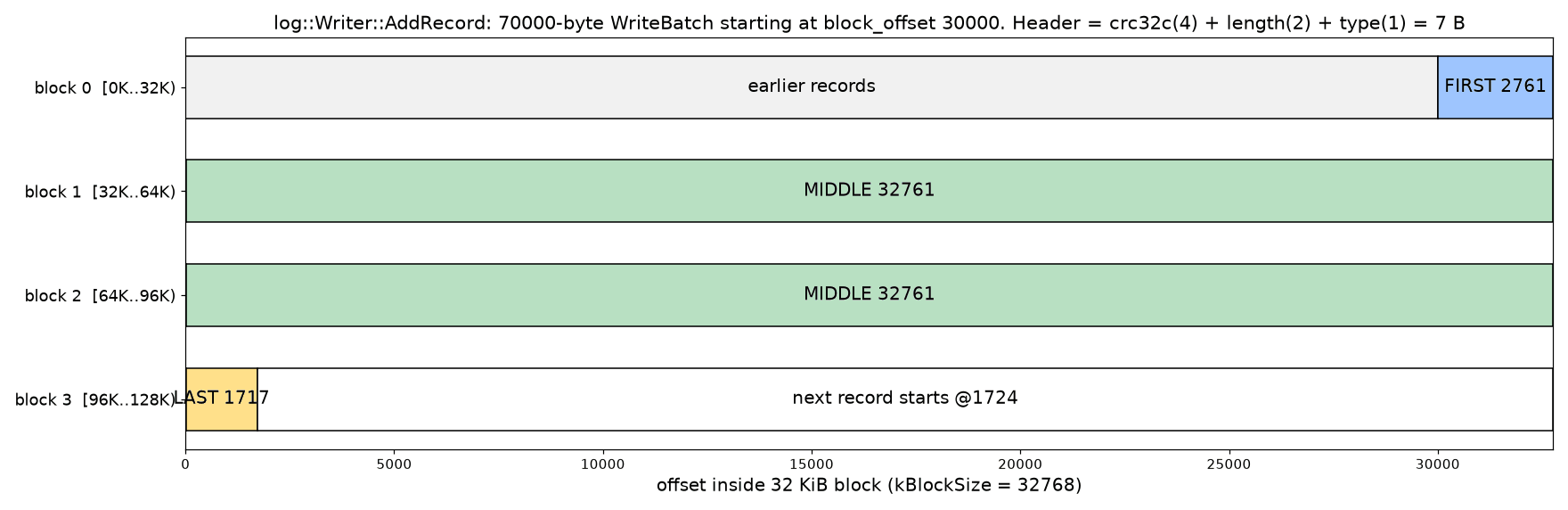
Numerical example. A seventy-thousand-byte WriteBatch starts at block_offset = 30000:
- leftover = 2768 and avail = 2761, so FIRST with 2761 bytes.
- Next block: avail = 32761, so MIDDLE.
- Third block: MIDDLE again with 32761 bytes.
- The remainder is 70000 − 2761 − 2×32761 = 1717 bytes, so LAST at the start of the fourth block.
The next block_offset is 7 + 1717 = 1724. The total overhead is 4 × 7 = 28 bytes.
25-11-4 The SST data block: key deltas and restarts#
Source in code: rocksdb/table/block_based/block_builder.cc :: BlockBuilder::AddWithLastKeyImpl, Finish; table/block_based/block.cc :: DataBlockIter::SeekImpl (BinarySeek); util/coding.h :: EncodeVarint32
Complexity: build O(L); Seek O(log R + I) with R restarts and I = block_restart_interval = 16
pseudocode
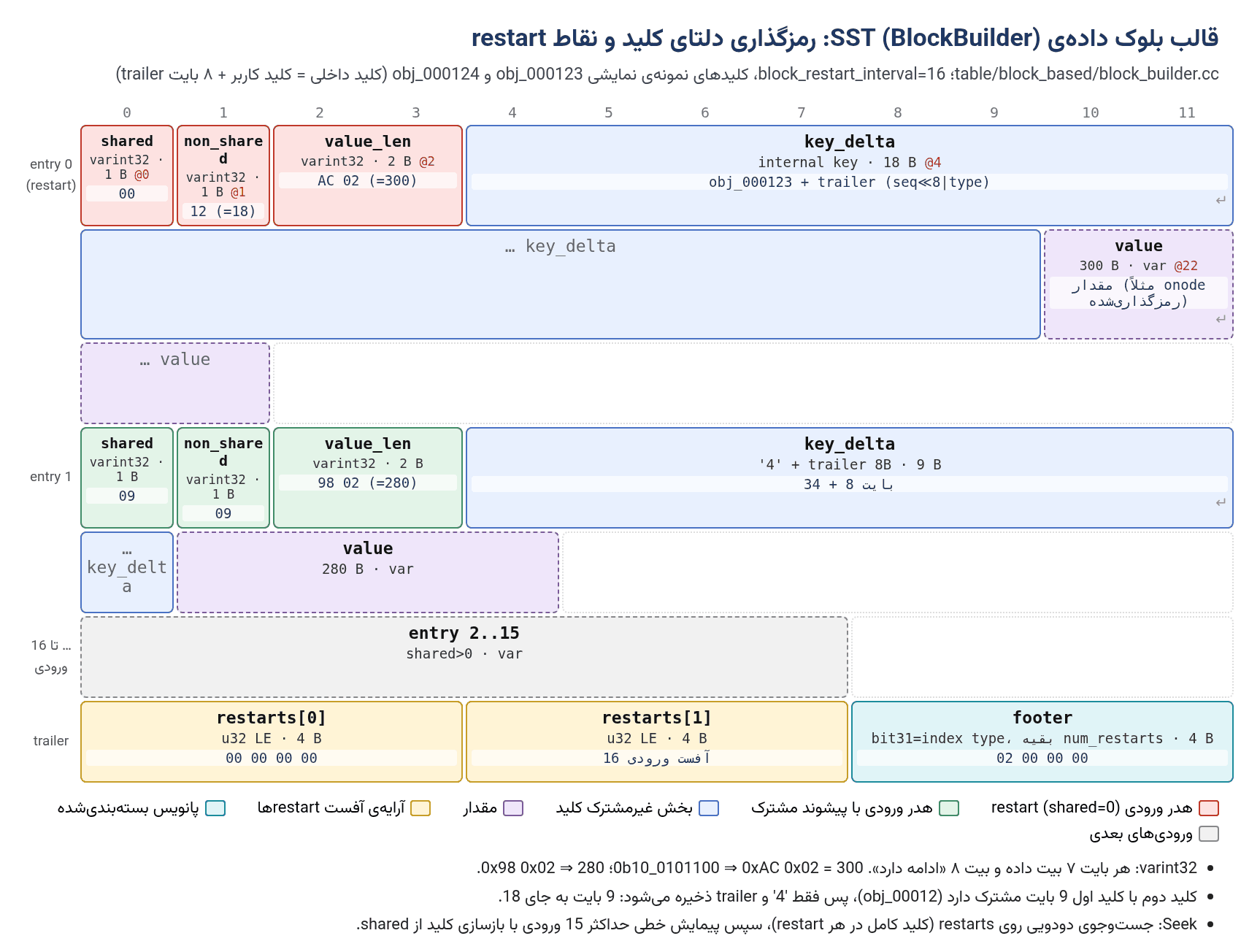
Add(key, value):
    if counter == 16: restarts.push(buffer.size) ; shared = 0 ; counter = 0
    else: shared = length of the prefix shared with the previous key
    PutVarint32 ×3 (shared, len(key)−shared, len(value)) ; append key[shared:] ; append value
Finish(): append restarts[] as u32 ; append Pack(index_type, num_restarts)   # bit31
Seek(target): binary search over restarts comparing each restart's full key
              then a linear walk, rebuilding key = prev[0:shared] + delta
EncodeVarint32(v): while v ≥ 128: emit (v & 127) | 128 ; v ≫= 7 ; emit v
Numerical example. With rocksdb_block_size = 4K (Ceph's default) and entries of about 300 bytes, each block has about 13 entries, that is fewer than 16, so only one restart. Seek within the block is effectively linear, but 13 comparisons on data that is in cache. In metadata blocks where values are small (for example 100 keys of 40 bytes), there are 7 restarts and the binary search takes 3 comparisons plus at most 15 linear steps. The varint encoding of 300 is the two bytes AC 02, and of 18 the single byte 12.
25-11-5 The cache-line-local Bloom filter#
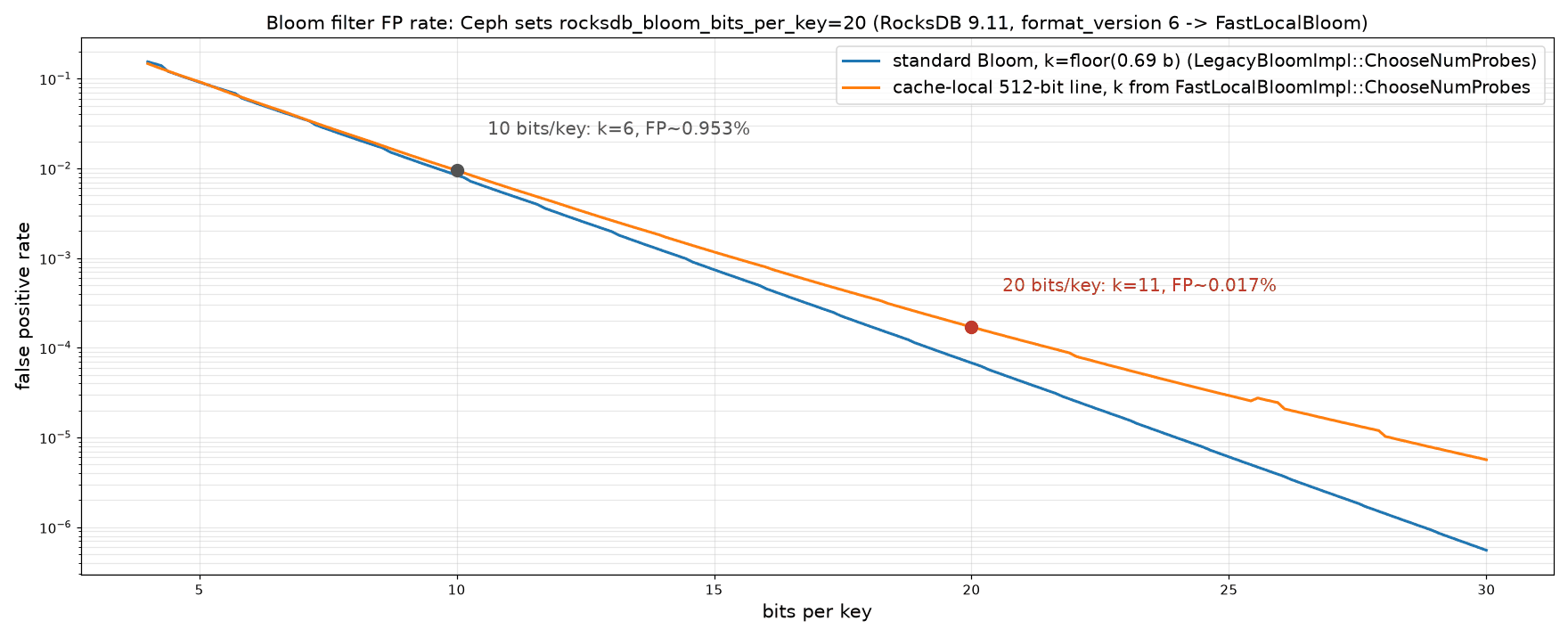
With rocksdb_bloom_bits_per_key = 20, Ceph calls NewBloomFilterPolicy(20) (RocksDBStore::load_rocksdb_options). In RocksDB 9.11 the default is format_version = 6, so the filter implementation is FastLocalBloomImpl: all probes of a key fall within one five-hundred-and-twelve-bit cache line.
Source in code: rocksdb/util/bloom_impl.h :: FastLocalBloomImpl::ChooseNumProbes, AddHash, HashMayMatchPrepared; BloomMath::CacheLocalFpRate
Complexity: O(k) bit reads in one cache line (up to 8 probes at once with AVX2); memory b bits per key
pseudocode
k = ChooseNumProbes(1000·b)            # empirical table: 20000 millibits ⇒ 11
AddHash(h1, h2): line = FastRange32(h1, len/64) · 64     # choose the cache line
    h = h2
    repeat k: bit = h ≫ 23 (top 9 bits ⇒ 0..511) ; line[bit] = 1 ; h ×= 0x9e3779b9
MayMatch: the same path ; if any bit is zero ⇒ "definitely not present"
FP ≈ the average of a standard Bloom for (keys per line ± standard deviation)
Numerical example.
- b = 20: k = 11, and each cache line has on average 512/20 = 25.6 keys. The standard deviation is , so the crowded and sparse cases have 30.66 and 20.54 keys per line. The estimated FP is about (0.017%), versus for a standard Bloom with the same memory.
- b = 10: k = 6 and FP about 0.95%.
- Memory: an SST with 1 million keys has bits, that is 2.5 MB of filter.
The price of locality is a slightly higher FP. In return, each query has only one cache miss instead of 11.
25-11-6 The compaction score and dynamic level sizes#
Source in code: rocksdb/db/version_set.cc :: VersionStorageInfo::CalculateBaseBytes, ComputeCompactionScore, MaxInputLevel
Complexity: O(number of files) on each Version change
pseudocode
CalculateBaseBytes (dynamic):
    max_level_size = the largest level ; cur = max_level_size
    for i = num_levels−2 down to first_non_empty: cur /= multiplier
    base_level = first_non_empty
    while base_level > 1 and cur > base_bytes_max: base_level−− ; cur /= multiplier
    target[base_level] = max(cur, base_bytes_max) ; target[i+1] = target[i]·multiplier (floor base_bytes_max)
ComputeCompactionScore: for level in 0 .. num_levels−2:
    L0: score = max(files/trigger, size/max_bytes_for_level_base …) and ×10 if > 1
    L>0: score = bytes_not_compacting / target   (or / (target + incoming) ×10 if ≥ 1)
highest score ⇒ first compaction
Numerical example (Ceph's defaults: base = 1 GiB, multiplier = 8, seven levels). Suppose L6 has two hundred gigabytes. From the bottom up: L5 = 25, L4 = 3.125 and L3 = 0.39 GiB. Because 0.39 is larger than base_bytes_min = 1/8 GiB, base_level = L3 and the targets are L3 = max(0.39, 1) = 1 GiB, L4 = 3.125, L5 = 25 and L6 = 200. With actual sizes of 0.31, 3.0 and 24, the scores are 0.31, 0.96 and 0.96. None has reached 1. If L0 has eight files, its score is 8/8 = 1, which becomes 10 after multiplying by kScoreScale, so L0→L3 has priority. L1 and L2 stay empty: this is exactly the dynamic level bytes behaviour, which takes data straight to the base level.
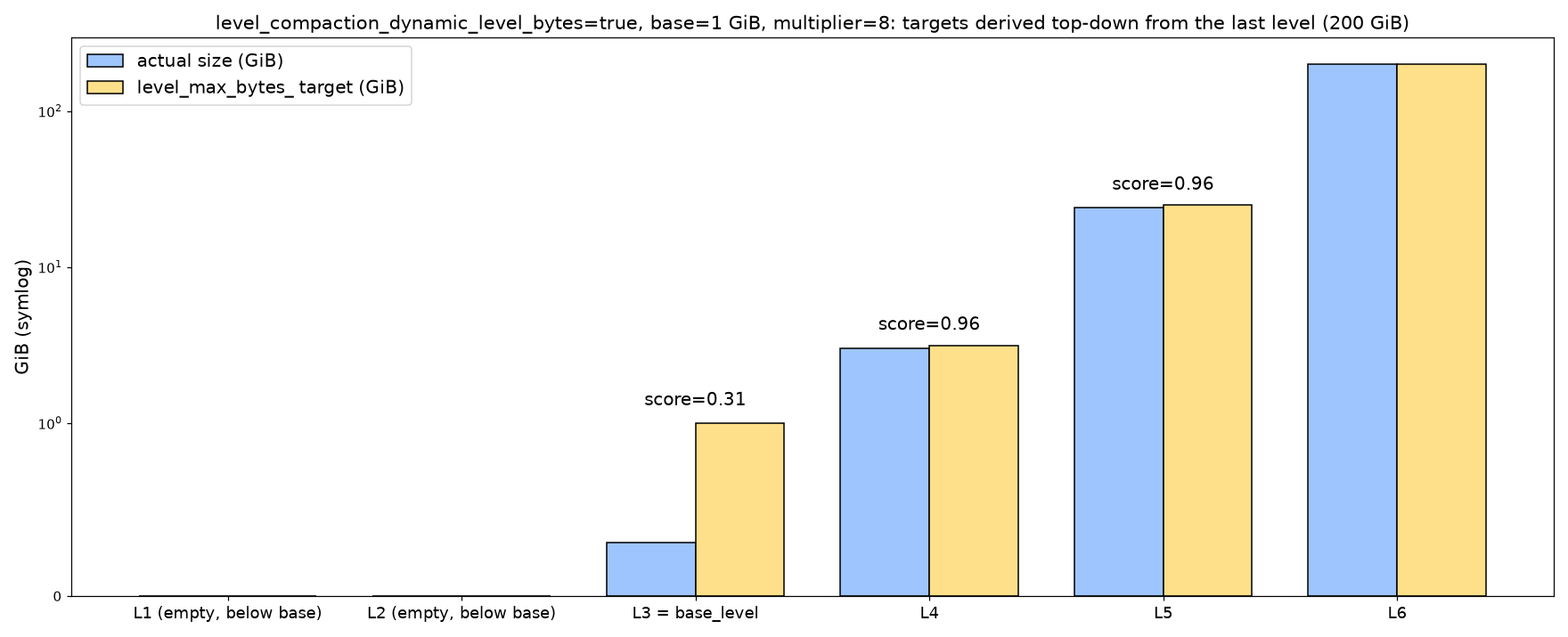
The default of level_compaction_dynamic_level_bytes in RocksDB changed to true in version 8.4. Ceph's bluestore_rocksdb_options string does not set this option explicitly. So the level behaviour depends on the RocksDB version inside each Ceph release. To be sure, check the output of ceph daemon osd.N config get bluestore_rocksdb_options and the OPTIONS-* file inside BlueFS (with ceph-bluestore-tool bluefs-export).
25-12 Supplementary and up to date#
- Sharding has been the default for new OSDs since Pacific. Compare main's default string,
m(3) p(3,0-12) O(3,0-13)=block_cache={type=binned_lru} L=min_write_buffer_number_to_merge=32 P=min_write_buffer_number_to_merge=32, withceph config help bluestore_rocksdb_cfson your version. bluefs_spillover_cleaner(present in Tentacle and main, default false) is a background thread that moves files that spilled over to the slow device back to the DB, if there is space.- According to the documentation, Pacific brought experimental support for
level_compaction_dynamic_level_bytes(together with thefit_to_fastpolicy).
25-13 Hands-on exercise#
- 1. Extract a test OSD's RocksDB files with
ceph-bluestore-tool bluefs-export, see the CFs withldb --db=... list_column_families, and read the sizes of data, index and filter withsst_dump --file=... --show_properties. - 2. Read the last 8 bytes of an SST with
tail -c 8 | xxdand confirm the magic number (mind the little-endian order). - 3. For your DB size (for example 60G), compute which levels fit with the defaults. Then read
bluefs statsand compare it with your prediction. - 4. Compare
submit_sync_latencybefore and after moving the WAL to NVMe.
25-14 Review questions#
- 1. How does group commit in
_kv_sync_threadreduce the number of fsyncs? - 2. How many bytes is a WAL record header, and what fields does it have?
- 3. Why is
min_write_buffer_number_to_merge=6important for Ceph? - 4. Why is this number 32 for the
LandPCFs? - 5. What role does an SST's filter block play on the read path?
- 6. With the defaults, how large is L3?
- 7. How does
use_some_extradiffer fromrocksdb_original? - 8. How is the CF of a per-pg omap key chosen?
- 9. Why should a PG's omap stay in one shard?
- 10. Why is changing the whole
bluestore_rocksdb_optionsstring dangerous, and what is the alternative?
Answers to these questions are in Appendix E: Answers to Review Questions. Answers to this chapter's questions →
25-15 Sources for this chapter#
- RocksDBStore
https://github.com/ceph/ceph/blob/main/src/kv/RocksDBStore.cc - BlueStore configuration and sharding
https://docs.ceph.com/en/latest/rados/configuration/bluestore-config-ref/ - RocksDB WAL format
https://github.com/facebook/rocksdb/wiki/Write-Ahead-Log-File-Format - Block-based table format
https://github.com/facebook/rocksdb/wiki/Rocksdb-BlockBasedTable-Format - Leveled compaction
https://github.com/facebook/rocksdb/wiki/Leveled-Compaction - Column families
https://github.com/facebook/rocksdb/wiki/Column-Families - log_format.h
https://github.com/facebook/rocksdb/blob/main/db/log_format.h - LSM-tree (O'Neil et al., 1996
https://www.cs.umb.edu/~poneil/lsmtree.pdf