Lower Layers (6): CRUSH at the Bit Level, from rjenkins to upmap
TL;DR this chapter in a few lines
- CRUSH is deterministic: rjenkins hashes of the input, bucket id and replica number drive every choice.
- straw2 draws a weighted "straw" per item and picks the longest, so a weight change moves only data to or from that item.
- firstn suits replication and indep suits erasure coding, where a shard's position must not shift; uniform, list and tree buckets move more data.
- upmap entries in the OSDMap override CRUSH for single PGs; the balancer uses them.
28-1 Introduction: how does CRUSH "compute"?#
In chapters 1 and 8 we saw CRUSH as an algorithm that determines the location of each PG without a central table. This chapter goes down to the bit level: the rjenkins hashes that make every decision deterministic, the straw2 algorithm with its fixed-point logarithm table, the step-by-step execution of crush_do_rule, the retries on collisions, and finally how choose_args, weight-set and upmap correct CRUSH's raw result. We follow a complete example from the object name to the choice of host, with numbers computed by compiling Ceph's own C code (src/crush/hash.c and mapper.c, LGPL) into a small test program.
- The object name is hashed with
ceph_str_hash_rjenkins.ceph_stable_modmaps it to a PG, and withHASHPSPOOLthe CRUSH input iscrush_hash32_2(ps, pool). - straw2 computes a "draw" for each item: draw = ln(u) / w, where u is a sixteen-bit hash and ln comes from a fixed-point table. The largest draw wins. The probability of each item winning is exactly proportional to its weight.
- A collision (a repeated choice) is resolved by increasing r (r = rep + ftotal), up to
choose_total_tries=50. reweightworks through a probabilisticis_out. A weight-set in choose_args is a substitute weight for CRUSH, and upmap explicitly replaces the result after CRUSH.
28-2 From the object name to x#
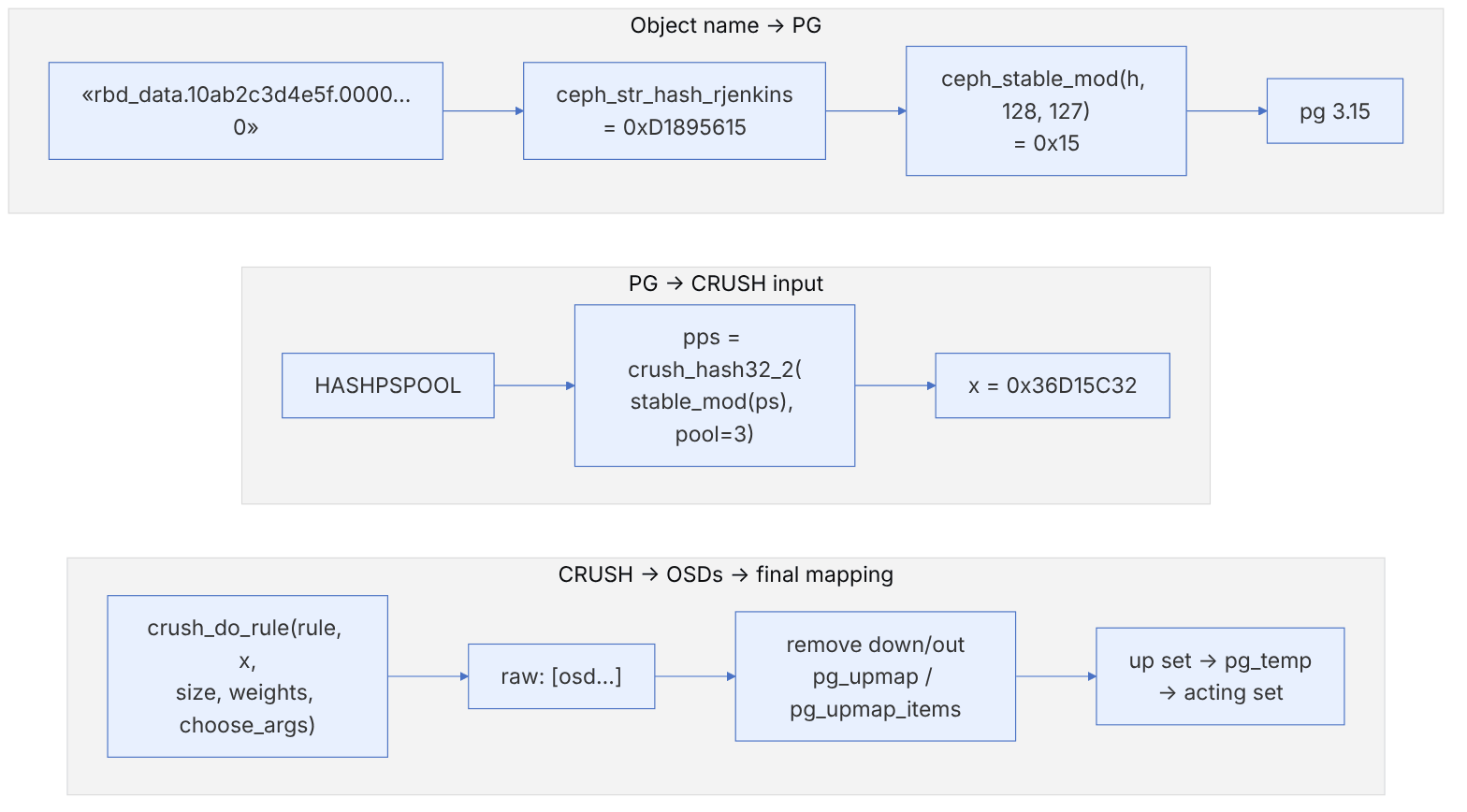
ceph_stable_mod(x, b, bmask) is defined in include/rados.h: if x & bmask is less than b it returns that, otherwise x & (bmask >> 1). This function is "stable" because when pg_num grows from 128 to 192, only the PGs that have the new bit move (split) and the rest keep their number. This is the mathematical reason a split moves only part of the data.
| Step | Value in the example | Function |
|---|---|---|
| hash of the name | 0xD1895615 | ceph_str_hash_rjenkins (common/ceph_hash.cc) |
| ps | 0x15 (= 0xD1895615 & 127) | ceph_stable_mod(h, 128, 127) |
| PG | 3.15 | pg_t(ps, pool) |
| x (pps) | 0x36D15C32 | crush_hash32_2(RJENKINS1, ps, 3) in pg_pool_t::raw_pg_to_pps |
28-2-1 The rjenkins hash#
crush_hashmix(a, b, c) is nine rounds of subtraction, XOR and shift on three 32-bit words, taken from Bob Jenkins's mixing function. The three-input version crush_hash32_rjenkins1_3(a, b, c) starts with hash = 1315423911 ^ a ^ b ^ c (the crush_hash_seed constant) and runs mix five times with the constants x = 231232 and y = 1232. Its important property is complete determinism on all architectures: it uses only unsigned 32-bit integer operations, no floating point. That is why the Linux kernel client (which has the same file in net/ceph/crush/) and librados get exactly the same result.
Any change to these functions, to the logarithm table or to the tunables (such as chooseleaf_stable) changes the mapping of almost every PG. That is why the tunables have named profiles (ceph osd crush tunables optimal), and changing them on a full cluster causes huge data movement.
28-3 straw2: an exponential draw#
Suppose each item i with weight w_i draws an exponential random variable with rate w_i. The probability that item i has the smallest value is exactly . straw2 implements exactly this without floating-point numbers:
straw2 (the logic of mapper.c, LGPL; a simplified rendering by this book)
  for each item i in bucket:
      u    = crush_hash32_3(bucket.hash, x, id_i, r) & 0xFFFF       # 16 bits
      ln   = crush_ln(u) − 2^48          # ≈ 2^44 · log2((u+1)/2^16) ≤ 0
      draw = ln / weight_i                # weight in 16.16 fixed point
  return item with max draw              # the smallest −ln/w = exponential with rate w
crush_ln(x) computes with two tables, __RH_LH_tbl and __LL_tbl (in crush_ln_table.h), using only integer operations. It first normalizes the input (the exponent), then looks up the top 8 bits of the mantissa in the first table (an approximation of 1/x and log2) and the next 8 bits in the second table (the correction). The results in our test program: crush_ln(0) = 0, crush_ln(0x7FFF) = 0xF00000000000 (that is ) and crush_ln(0xFFFF) = 0xFFFFF0000000 (about ).
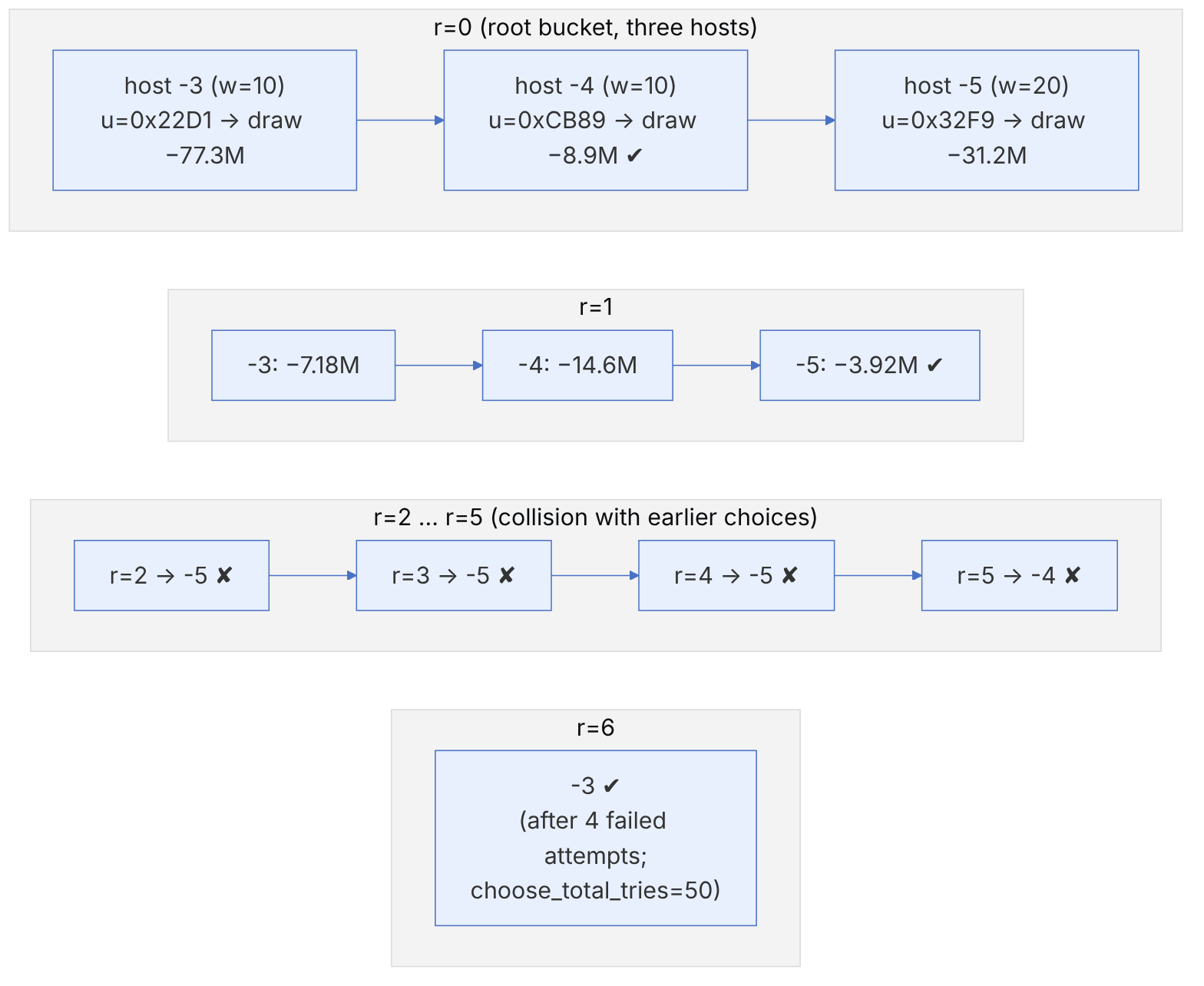
| r | draw(-3) | draw(-4) | draw(-5) | Winner |
|---|---|---|---|---|
| 0 | −77,259,388 | −8,880,361 | −31,248,985 | -4 |
| 1 | −7,177,981 | −14,582,287 | −3,918,635 | -5 |
| 2 | −11,854,384 | −59,760,693 | −2,413,629 | -5 (repeat) |
| 3 | −63,878,138 | −125,349,258 | −14,701,300 | -5 (repeat) |
Checking the distribution: in the same program, with three items of weights 1, 1 and 2 and 300,000 values of x, the winner counts were 75,274, 74,753 and 149,973, that is 25%, 25% and 50%, just as the theory predicts.
Why straw2 and not straw? In the old straw, the "straw length" of each item was computed from the weights relative to, and dependent on, the other items. So changing the weight of one item also changed the draws of the other items, and data moved between items whose weights had not changed. In straw2, the draw of each item depends only on (x, id, r, its own weight). If item A's weight increases, only some x values move from the other items to A, and no data moves between B and C. This is the minimal-movement property (optimal reorganization).
28-4 crush_do_rule step by step#
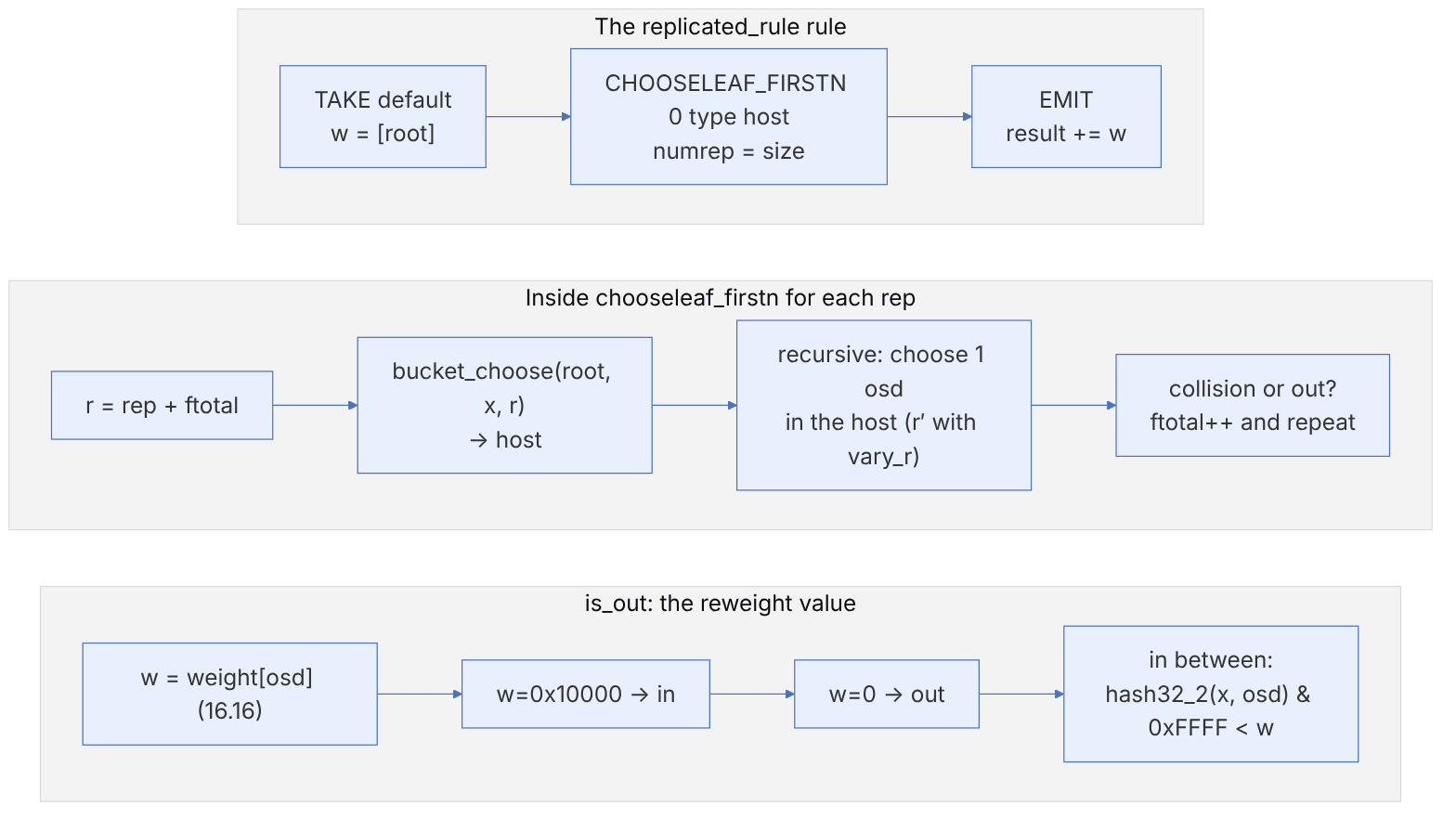
A rule is an array of steps (crush_rule_step with op, arg1 and arg2). crush_do_rule has a working vector w and an output vector o:
| op | Value | Action |
|---|---|---|
TAKE | 1 | w = [arg1] (for example the root id or a device class in the shadow tree) |
CHOOSE_FIRSTN | 2 | from each bucket in w, choose arg1 items of type arg2 (for replicated) |
CHOOSE_INDEP | 3 | the same, with fixed positions (for EC; a lost shard leaves an empty slot) |
EMIT | 4 | o += w; w is emptied |
CHOOSELEAF_FIRSTN / _INDEP | 6 / 7 | choose a bucket of type arg2 and then one leaf (OSD) inside it |
SET_CHOOSE_TRIES and similar | 8–13 | override tunables for this rule |
SET_MSR_DESCENTS / SET_MSR_COLLISION_TRIES / CHOOSE_MSR | 14 / 15 / 16 | MSR rules (several OSDs per failure domain) — in Squid and later, not in Reef |
numrep: if arg1 ≤ 0, numrep = result_max + arg1. So 0 means "as many as size" and -1 means "size minus one". This is used for rules such as "one in the first DC, the rest in the second DC".
28-4-1 firstn versus indep#
In firstn, order does not matter. If the second replica becomes unavailable, the third replica takes its place and everything shifts forward by one. For replication this is optimal, because only one new copy is needed. In indep, position r is always shard r. If the OSD of one shard is lost, only that position is chosen again with a new r (r + numrep · ftotal), and the other shards do not move. For EC this is vital, because shards are not interchangeable.
| tunable (jewel/optimal profile) | Value | Effect |
|---|---|---|
choose_local_tries | 0 | old local retry off |
choose_local_fallback_tries | 0 | off |
choose_total_tries | 50 | the retry limit; in our example there were 4 failed attempts |
chooseleaf_descend_once | 1 | in chooseleaf, descend once and, if it fails, retry from the top |
chooseleaf_vary_r | 1 | r in the leaf sub-choice depends on the parent's r, so that retries give different results |
chooseleaf_stable | 1 | when one OSD goes out, the other replicas do not move |
straw_calc_version | 1 | fix to the old straw calculation |
Collisions become frequent when the number of failure domains is close to size. In our example, with three hosts and size=3, the third replica was found after 4 attempts. If one of the hosts has a very small weight, even 50 attempts may not be enough, and the PG stays undersized with fewer than size members. crushtool --test --show-bad-mappings tests exactly this.
ceph osd getcrushmap -o cm.bin && crushtool -d cm.bin -o cm.txt
crushtool -i cm.bin --test --rule 0 --num-rep 3 --min-x 0 --max-x 1023 --show-utilization
crushtool -i cm.bin --test --rule 0 --num-rep 3 --x 0x36d15c32 --show-mappings
crushtool -i cm.bin --test --show-bad-mappings --rule 0 --num-rep 3
ceph osd map rbd rbd_data.10ab2c3d4e5f.0000000000000000 # pg and up/acting28-5 choose_args, weight-set and upmap#
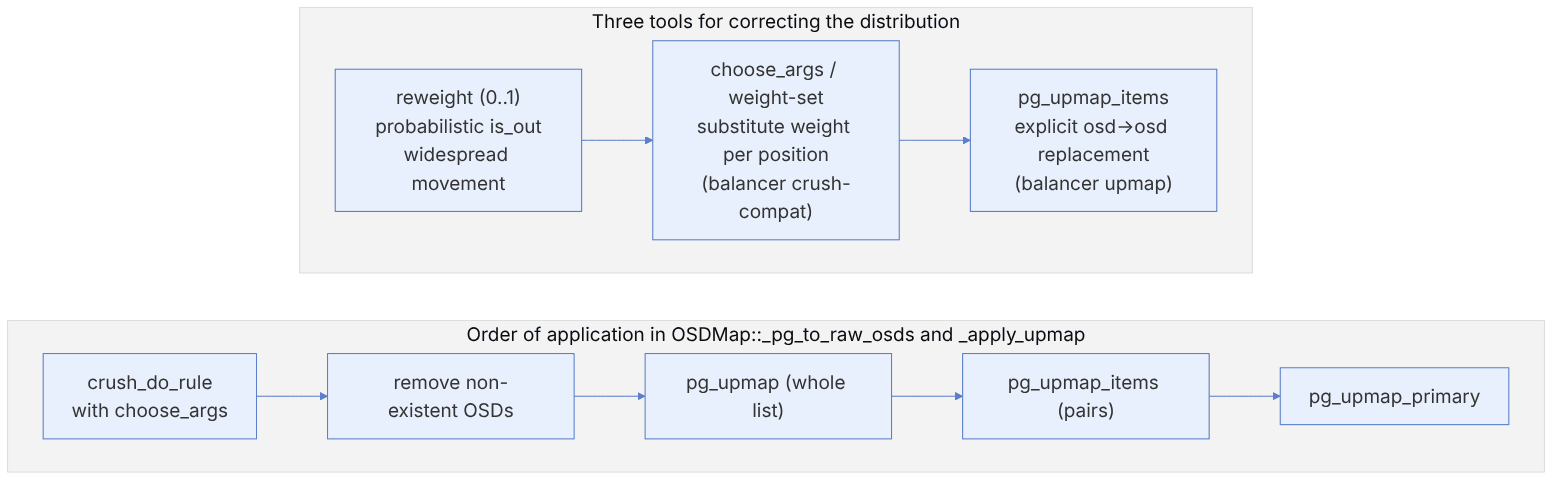
choose_args: in bucket_straw2_choose, the function get_choose_arg_weights uses weight_set[position] instead of item_weights if a weight_set exists. position is the number of the replica being chosen. This makes it possible to fix a subtle problem: in straw2 with unequal weights, the second and third replicas deviate slightly from the weight ratio, because the earlier choices have been excluded. The weight-set gives slightly different weights for each position. There are also substitute ids, so that the hash can be changed without changing the bucket's real id.
upmap: OSDMap::_apply_upmap first checks pg_upmap (replacing the whole list), then pg_upmap_items (from→to pairs) and finally pg_upmap_primaries (only setting the primary, for the read balancer). Upmaps that violate the CRUSH rule (for example two replicas on one host) are checked and removed by the mon (clean_pg_upmaps).
| Balancer mode | Mechanism | Release |
|---|---|---|
crush-compat | weight-set in choose_args | since Luminous; for old clients |
upmap | pg_upmap_items | the default; requires require-min-compat-client luminous |
read | pg_upmap_primaries (primary only) | Reef and later (according to the documentation) |
upmap-read | both | Reef and later |
ceph osd pg-upmap-items 3.15 4 11        # replace osd.4 with osd.11 for PG 3.15
ceph osd rm-pg-upmap-items 3.15
ceph osd crush weight-set ls
ceph balancer status && ceph balancer eval
ceph osd dump | grep -E '^pg_upmap(_items|_primary)?' | head28-6 is_out and reweight: a numerical example#
is_out in mapper.c interprets an OSD's reweight value (a 16.16 number between 0 and 0x10000) like this: if the weight is full, the OSD is in. If it is zero, it is out. Otherwise crush_hash32_2(x, osd) & 0xFFFF is compared with the weight, and if it is smaller, the OSD is in for this x. So a reweight of 0.5 means roughly half of the PGs CRUSH had given to this OSD are rejected and go elsewhere on retry.
| Example | Value |
|---|---|
| x | 0x36D15C32 (the same PG 3.15) |
| osd | 7 |
crush_hash32_2(x, 7) & 0xFFFF | 0xC425 |
| reweight 0.5 (0x8000) | 0xC425 ≥ 0x8000 → out for this PG |
| reweight 0.9 (0xE666) | 0xC425 < 0xE666 → in |
| fraction in with reweight 0.5 over 100,000 x | 50,069 (≈ 50%) |
The difference between ceph osd reweight (this probabilistic is_out, applied after the straw2 choice) and ceph osd crush reweight (the straw2 weight in the bucket itself) matters. Reweighting through is_out causes more retries and a subtle skew of the distribution, which is why the upmap-based balancer is a better alternative. Values close to 1 (for example 0.95) cause little movement, but small values (for example 0.3) can push the retries close to the limit of 50.
28-7 Device classes and the shadow tree#
When OSDs have classes (hdd, ssd, nvme), CrushWrapper builds for each bucket and each class a "shadow" with a new negative id and a name such as default~ssd that contains only the OSDs of that class. A rule such as step take default class ssd is in fact a TAKE on the shadow id. Because the shadows have their own ids, the straw2 hash (which includes the item id) for the shadows is independent of the main tree. Adding an hdd OSD does not move any PG in the ssd pools.
ceph osd crush tree --show-shadow
ceph osd crush rule create-replicated fast default host ssd
ceph osd crush class ls-osd ssdWhy do the shadow ids stay stable? The mapping from class to shadow id is stored in the CRUSH map itself (class_bucket). So rebuilding the shadows after adding an OSD or changing a weight keeps the same ids. If these ids changed, the x of every PG in the pools that depend on that class would get a different hash and all the data would move. The crushtool --reclassify tool, for converting old maps (with separate roots for ssd) to classes, sets exactly these ids so that the mapping does not change.
28-8 Three other bucket types: uniform, list and tree#
straw2 is the default today, but CRUSH had five bucket algorithms from the start: uniform, list, tree, straw and straw2. Each is a trade-off between selection speed and the amount of data movement on change. Old mappings and hand-written maps may still contain them. To understand why straw2 won, we ran all three with the real rjenkins hash. All the numbers in this section were computed with a small C program that takes hash.c and crush_ln from the Ceph code.
28-8-1 uniform: a pseudo-random permutation#
Source in code: src/crush/mapper.c :: bucket_perm_choose, bucket_uniform_choose
Complexity: r=0 in O(1); r=k in O(k); shared work in crush_work_bucket.perm
pseudocode (taken from bucket_perm_choose)
pr = r mod size
if x changed:
    if pr == 0: return items[hash3(x, bucket_id, 0) mod size]        # common shortcut
    perm = [0..size-1]; perm_n = 0
while perm_n ≤ pr:                         # incremental Fisher–Yates with a hash instead of random
    p = perm_n
    if p < size-1:
        i = hash3(x, bucket_id, p) mod (size − p)
        swap(perm[p], perm[p+i])
    perm_n += 1
return items[perm[pr]]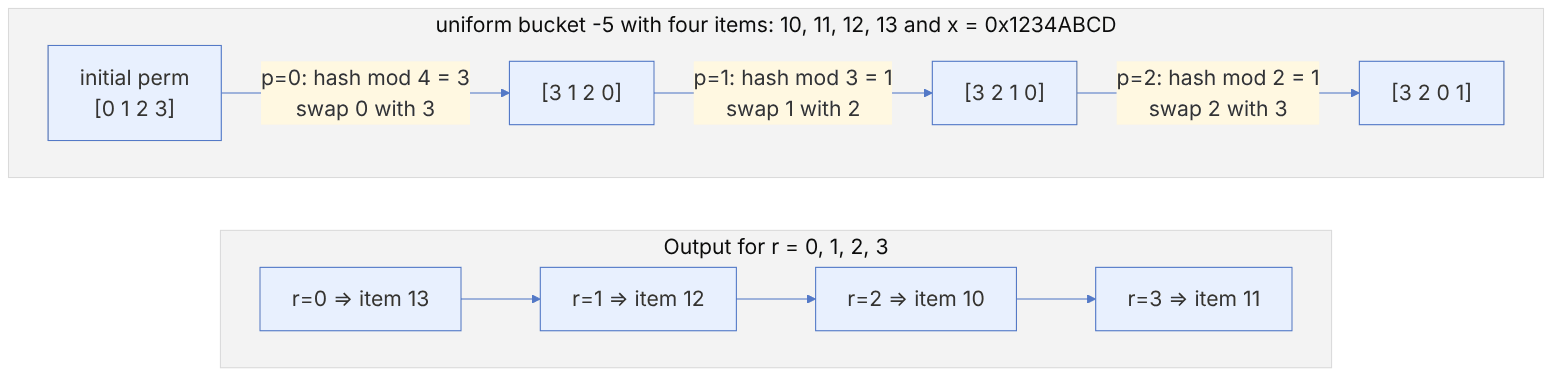
uniform only works correctly when all items have equal weight, because the weight is not part of the calculation at all. The bigger problem is that changing size changes the modulus of every hash. Our simulation shows that adding a fifth item to four items moves 80% of the inputs, while the minimum needed is 20%. This bucket was designed for hardware that is always bought and replaced all at once and in identical sizes.
28-8-2 list: walking from the end#
Source in code: src/crush/mapper.c :: bucket_list_choose
Complexity: O(n) in the worst case; appending at the end is optimal
for i = size-1 down to 0:
    h = hash4(x, items[i], r, bucket_id) & 0xFFFF                   # a 16-bit number
    if (h × sum_weights[i]) >> 16 < item_weights[i]: return items[i]
return items[0]
# sum_weights[i] = Σ_{j ≤ i} item_weights[j]  ⇒ probability of choosing i given we reach it = w_i / sum_i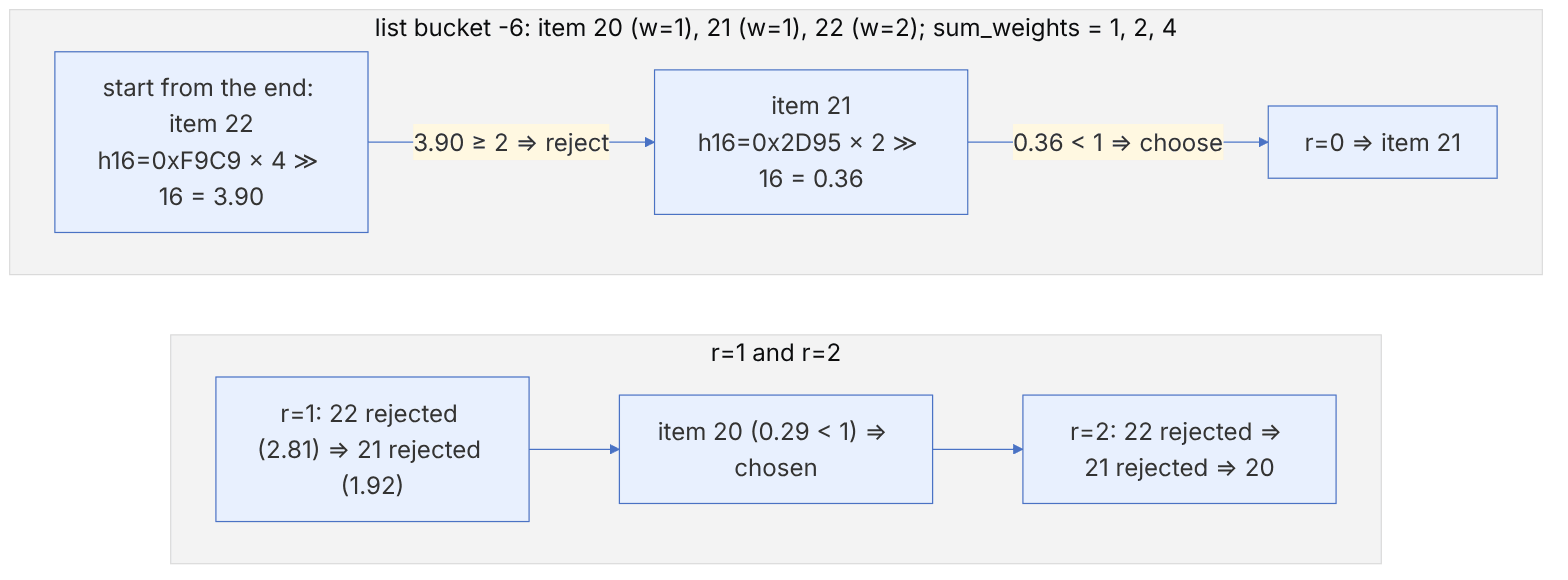
Why is this correct? The probability of choosing the last item is w₂/(w₀+w₁+w₂) = 2/4. If it is rejected, the probability of the middle item is w₁/(w₀+w₁) = 1/2. So P(21) = (1 − 1/2) × 1/2 = 1/4 and P(20) = 1/4. A count over 400 thousand inputs gave the same 1:1:2 ratio (100336, 99970, 199694). Adding an item at the end moves only the necessary data (20.1%). But removing an item from the middle breaks the order (36% instead of 25% in our simulation).
28-8-3 tree: a weighted binary tree#
Source in code: src/crush/mapper.c :: bucket_tree_choose; src/crush/builder.c :: crush_make_tree_bucket
Complexity: O(log n); node numbers stay fixed when items are added
node(i) = 2(i+1) − 1   (leaves are odd); height(n) = number of trailing zeros of n
n = num_nodes / 2                          # the root
while n is even:                           # an internal node
    t = (hash4(x, n, r, bucket_id) × node_weights[n]) >> 32     # a uniform number in [0, w)
    n = t < node_weights[left(n)] ? left(n) : right(n)
return items[n >> 1]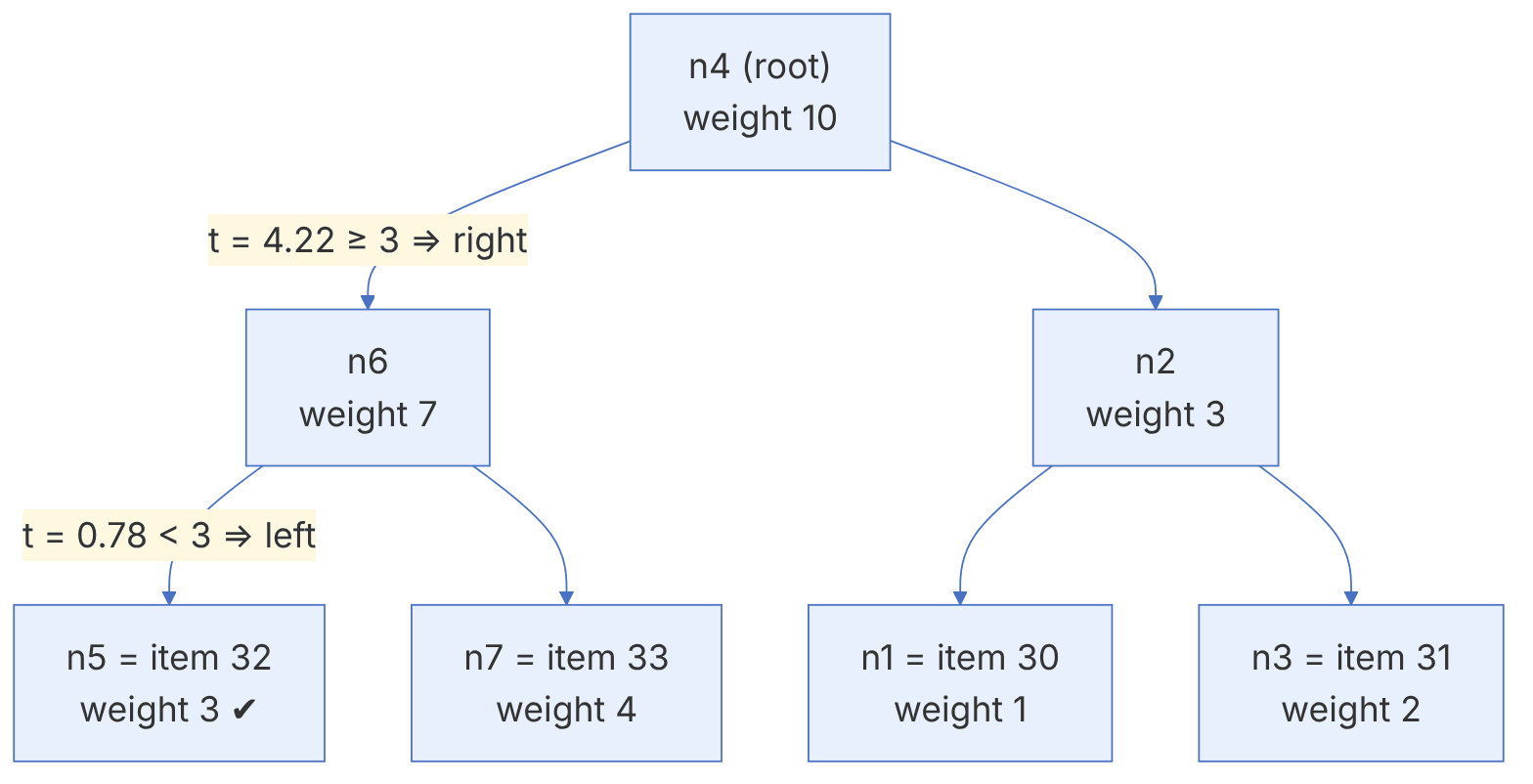
The elegant trick of tree is its node numbering. Because the hash depends on the node number, and the numbers of existing nodes do not change as the tree grows (the old root n4 becomes the left child of n8 in an eight-leaf tree), adding a fifth item moved exactly 20% of the data. But removing from the middle and rebuilding the tree changes the layout of the leaves, and in our simulation it caused 54% movement.
28-8-4 Comparing movement#
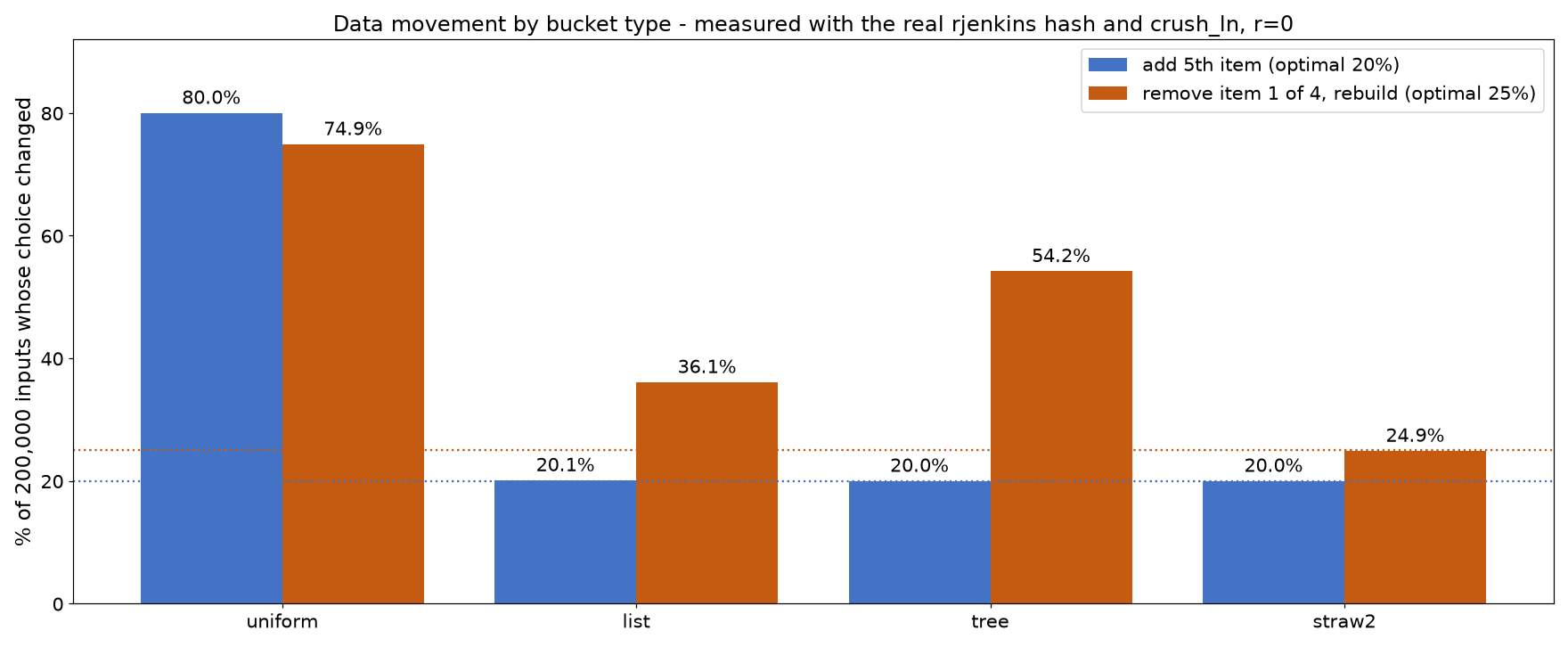
| Bucket type | Selection cost | Adding | Removing or reweighting | Use today |
|---|---|---|---|---|
| uniform | O(1) | bad (80% in the simulation) | bad | almost none |
| list | O(n) | optimal if at the end | bad in the middle | old grow-only clusters |
| tree | O(log n) | optimal | moderate | old, very large buckets |
| straw | O(n) | nearly optimal | nearly optimal, with a known error in the weights | obsolete, replaced by straw2 |
| straw2 | O(n) | optimal | optimal (movement only to/from the changed item) | the default |
The removal simulation rebuilds the bucket without the removed item. In practice, with ceph osd crush reweight to zero or crush remove, the behaviour depends on the bucket type and the item's position. For straw2, setting the weight to zero has the same effect as removal, because each item draws its own independent lot.
CRUSH playground
Build a root, hosts and OSDs, choose a rule, and watch straw2 place every PG; mark an OSD out or down or change a weight and see which PGs move.
Last change: osd.4 marked out. Moved shards are highlighted in the list.
PG → up set (64 PGs; primary underlined)
- 1.0[0,6,5]
- 1.1[7,4,0]
- 1.2[4,7,0]
- 1.3[4,8,2]
- 1.4[1,8,5]
- 1.5[4,8,0]
- 1.6[6,4,2]
- 1.7[1,7,5]
- 1.8[6,0,4]
- 1.9[8,4,2]
- 1.a[1,5,7]
- 1.b[1,8,5]
- 1.c[6,5,2]
- 1.d[7,4,2]
- 1.e[1,8,4]
- 1.f[6,2,4]
- 1.10[5,2,8]
- 1.11[4,8,0]
- 1.12[0,6,5]
- 1.13[4,6,1]
- 1.14[5,8,1]
- 1.15[8,5,2]
- 1.16[5,0,6]
- 1.17[8,0,5]
- 1.18[6,2,4]
- 1.19[6,0,4]
- 1.1a[4,2,8]
- 1.1b[8,1,4]
- 1.1c[8,4,1]
- 1.1d[6,0,5]
- 1.1e[8,4,0]
- 1.1f[8,5,2]
- 1.20[2,6,5]
- 1.21[6,0,4]
- 1.22[2,4,6]
- 1.23[0,5,7]
- 1.24[0,4,6]
- 1.25[8,5,0]
- 1.26[1,4,6]
- 1.27[1,7,5]
- 1.28[5,7,0]
- 1.29[8,2,4]
- 1.2a[5,2,6]
- 1.2b[8,0,4]
- 1.2c[7,0,4]
- 1.2d[2,7,4]
- 1.2e[6,2,4]
- 1.2f[0,4,6]
- 1.30[6,5,0]
- 1.31[0,6,4]
- 1.32[0,6,4]
- 1.33[4,6,2]
- 1.34[8,0,5]
- 1.35[8,2,4]
- 1.36[7,0,4]
- 1.37[4,7,0]
- 1.38[6,4,2]
- 1.39[0,5,6]
- 1.3a[0,8,4]
- 1.3b[4,1,6]
- 1.3c[5,6,0]
- 1.3d[5,8,2]
- 1.3e[5,1,7]
- 1.3f[7,4,1]
Follows:
src/crush/mapper.c :: crush_do_ruleruns the rule steps (take, chooseleaf, emit)src/crush/mapper.c :: crush_choose_firstn, crush_choose_indepthe replicated (firstn) and EC (indep) choice loops with retriessrc/crush/mapper.c :: bucket_straw2_choose, generate_exponential_distribution, crush_lnstraw2: the largest ln(hash)/weight winssrc/crush/mapper.c :: is_outthe reweight check that rejects an out OSDsrc/crush/hash.c :: crush_hash32_rjenkins1_2, _3the Jenkins hash that CRUSH usessrc/osd/osd_types.cc :: pg_pool_t::raw_pg_to_pps, hash_keythe PG's seed that enters CRUSHsrc/include/rados.h :: ceph_stable_modobject hash to PG while pg_num is not a power of twosrc/common/ceph_hash.cc :: ceph_str_hash_rjenkinsthe object-name hashsrc/osd/OSDMap.cc :: _pg_to_raw_osds, _raw_to_up_osdsraw set to up set (down OSDs are dropped or become NONE)src/crush/CrushWrapper.cc :: add_simple_rule_at, insert_item; CrushWrapper.h :: set_tunables_jewelthe rule ceph osd pool create makes and the jewel tunables
28-9 The balancer in upmap mode: calc_pg_upmaps#
The mgr balancer in upmap mode (chapter 19) hands the main work to OSDMap::calc_pg_upmaps in C++. This function makes a copy of the OSDMap, experiments with pg_upmap_items pairs and returns the result in an Incremental.
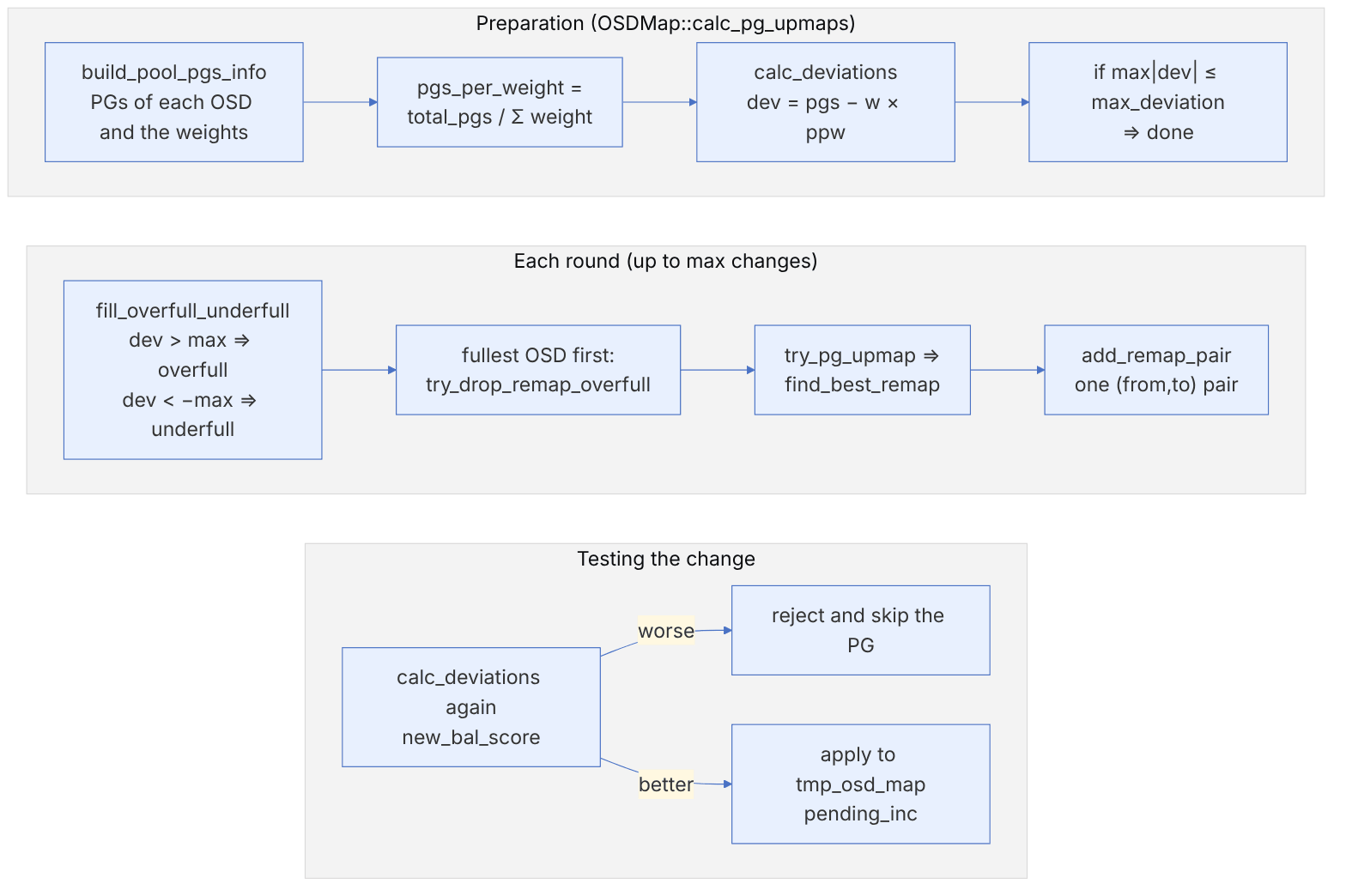
Source in code: src/osd/OSDMap.cc :: OSDMap::calc_pg_upmaps, calc_deviations, fill_overfull_underfull, try_pg_upmap, find_best_remap
Complexity: each round O(OSD × PG) for the scan and one CRUSH computation per candidate; at most max rounds
ppw = total_pgs / Σ weight
dev(osd) = pgs(osd) − weight(osd) × ppw
bal_score = Σ weight × (dev / target)²                  # 0 means perfect
repeat up to max times:
    overfull  = {dev > max_deviation};   more_overfull  = {0 < dev ≤ max_deviation}
    underfull = {dev < −max_deviation};  more_underfull = {−max_deviation ≤ dev < 0}
    if overfull and underfull both empty: break
    for osd in OSDs by dev descending (dev > max_deviation):
        if try_drop_remap_overfull(osd): goto test       # first take back old upmaps
        for pg on osd (without a manual pg_upmap):
            out = try_pg_upmap(pg, overfull, underfull)   # rerun CRUSH with zero weight for the overfull ones
            pos = find_best_remap(orig, out)            # the single best replacement
            if pos ≥ 0: add pair (orig[pos] → out[pos]); goto test
    for osd in underfull: try_drop_remap_underfull(osd) → test
    break
test: if new_bal_score > bal_score: reject (skip that PG)  else: apply
Numerical example. Four equal-weight OSDs, one pool with 64 PGs and size=3, so 192 copies and a target of 48 per OSD. The counts are [56, 50, 44, 42] and the deviations [+8, +2, −4, −6]. With upmap_max_deviation=5 (the balancer module's default): overfull={osd.0}, underfull={osd.3}. Score = (64 + 4 + 16 + 36)/48² = 0.0521.
| Step | upmap pair | Counts | Deviations | bal_score |
|---|---|---|---|---|
| 0 | — | 56, 50, 44, 42 | +8, +2, −4, −6 | 0.0521 |
| 1 | (0 → 3) | 55, 50, 44, 43 | +7, +2, −4, −5 | 0.0408 |
| 2 | (0 → 3) for another PG | 54, 50, 44, 44 | +6, +2, −4, −4 | 0.0313 |
| 3 | (0 → 2) | 53, 50, 45, 44 | +5, +2, −3, −4 | 0.0234 |
After step 3, no OSD deviates by more than 5, so overfull and underfull are empty and the loop ends. From step 2 on, underfull is empty and the replacements come from more_underfull. Three pg_upmap_items entries are recorded in the OSDMap. Each change adds only one pair. The code comment says this is deliberately "slow", so that every small step really moves the distribution toward the perfect state. This example assumes the CRUSH rule allows these replacements (for example, the OSDs are on different hosts). If a replacement breaks the failure-domain rule, try_pg_upmap rejects it.
osd_calc_pg_upmaps_aggressively (and its fast variant) shuffles the PG list and searches more exhaustively. In main, bal_score is summed as a double. The code comment says that with float, a change of one PG in large clusters could be smaller than the precision of the sum, and the balancer would stall.
28-10 MSR rules: several OSDs per failure domain#
In EC with k+m larger than the number of hosts (for example 4+2 on three hosts), the classic rule choose indep 3 type host followed by chooseleaf indep 2 type osd has a problem. If an OSD goes out, the second step looks for a replacement only in the same host. If that host has no other healthy OSD, the shard is left unplaced, because classic CRUSH cannot go back to the previous step. MSR (Multi-Step Retry) rules, from Squid, with the types msr_firstn and msr_indep and the choosemsr step, solve this: the whole descent from the root is retried.
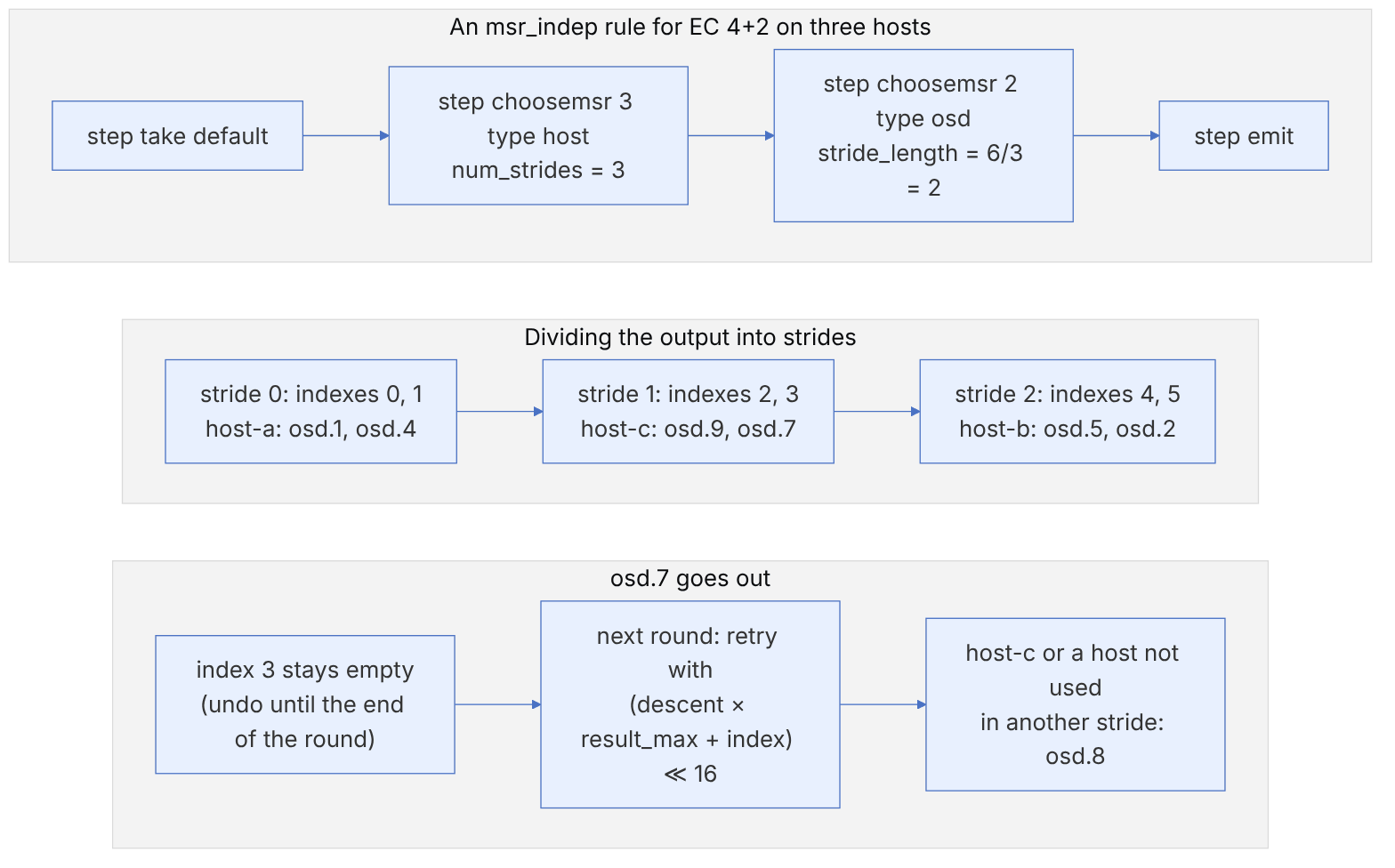
Source in code: src/crush/mapper.c :: crush_msr_do_rule, crush_msr_choose, crush_msr_descend, crush_msr_get_retry_value
Complexity: O(msr_descents × result_max × depth × bucket size) in the worst case; default msr_descents = msr_collision_tries = 100
pseudocode
total = Π(arg1 of choosemsr steps)      # for example 3 × 2 = 6
for descent in 0 .. msr_descents-1 while the output is not complete:
    crush_msr_choose(root, [0, total), step0, tryno = descent)
crush_msr_choose(bucket, [start, end), step):
    num_strides = step.arg1 (or result_max if 0)
    stride_length = (end − start) / num_strides
    for each stride:
        if all indexes of the stride are filled: continue
        for local_try in 0 .. msr_collision_tries-1:
            r = ((descent × result_max + index) << 16) + local_try
            cand = crush_msr_descend(bucket, step.type, r)          # straw2 etc. down to the target type
            if cand is used in another stride (collision): continue
            if last step: if the OSD is out ⇒ leave the index empty (undo after the round)
            else: crush_msr_choose(cand, [stride], step+1) for the next level
Numerical example. With choosemsr 3 host and choosemsr 2 osd, total_descendants = 6, num_strides = 3 and stride_length = 2. In the recursive call for each host, total_descendants = 2 and stride_length = 1 (these are the same numbers as in the comment above crush_msr_choose in the code). The try value for descent=1, result_max=6, index=3 and local_try=0 is ((1×6+3) ≪ 16) + 0 = 9 × 65536 = 589824. So the hashes are completely different in each round. The guarantee of the choosemsr 3 host step is "at least" three hosts, not "exactly" three: one stride may use two hosts after an OSD goes out, provided those hosts are not in other strides.
MSR rules need the CRUSH_MSR feature (bit 38 in ceph_features.h), and only clients and OSDs that know it (Squid and later) can compute the mapping. At the time of writing, net/ceph/crush/mapper.c in the Linux kernel mainline has no MSR implementation, so krbd and ceph.ko cannot use a pool with an MSR rule. Check ceph features before creating an MSR rule.
28-11 Supplementary and up to date#
- MSR rules (
CRUSH_RULE_CHOOSE_MSRand the typesCRUSH_RULE_TYPE_MSR_FIRSTNandMSR_INDEP) exist in the Squid and main code and are not in Reef. Their goal is placing several shards in one failure domain with precise control (for example EC 8+6 on 4 racks). - The Linux kernel has the same
mapper.c,hash.candcrush_ln_table.hinnet/ceph/crush/. Its support for new CRUSH features (such as MSR) depends on the kernel version, and the cluster's features must be aligned withceph osd set-require-min-compat-client.
28-12 Hands-on exercise#
- 1. Rebuild this chapter's test program: take
hash.candcrush_ln_table.hfrom the Ceph code and runbucket_straw2_choosefor a bucket with five items and arbitrary weights. Measure the distribution for one million x. - 2. Map a few objects with
ceph osd mapand match ps against a manual calculation ofceph_stable_mod. - 3. Increase the weight of one host by 10% in a test map and use
crushtool --compareto see the number of PGs moved and their destinations (they should move only to that host). - 4. Create a manual pg-upmap-items that puts two replicas on one host and see what the mon does with it.
28-13 Review questions#
- 1. How does ceph_stable_mod limit data movement when pg_num is increased?
- 2. Why is HASHPSPOOL needed?
- 3. Why does CRUSH use only integer operations?
- 4. In straw2, how is the draw computed and why does the largest draw win?
- 5. What does crush_ln return, and with what precision?
- 6. Why does straw2 have minimal movement, and why did the old straw not?
- 7. How is a collision resolved in firstn, and what is its limit?
- 8. What is the difference between firstn and indep for EC?
- 9. What problem does the weight-set in choose_args solve?
- 10. What is the order in which upmaps are applied, and what does the mon do with an invalid upmap?
Answers to these questions are in Appendix E: Answers to Review Questions. Answers to this chapter's questions →
28-14 Sources for this chapter#
- The CRUSH paper (Weil et al., SC 2006
https://ceph.io/assets/pdfs/weil-crush-sc06.pdf - mapper.c
https://github.com/ceph/ceph/blob/main/src/crush/mapper.c - hash.c
https://github.com/ceph/ceph/blob/main/src/crush/hash.c - CRUSH maps
https://docs.ceph.com/en/latest/rados/operations/crush-map/ - Editing a CRUSH map
https://docs.ceph.com/en/latest/rados/operations/crush-map-edits/ - upmap
https://docs.ceph.com/en/latest/rados/operations/upmap/ - balancer
https://docs.ceph.com/en/latest/rados/operations/balancer/ - crushtool
https://docs.ceph.com/en/latest/man/8/crushtool/ - Bob Jenkins's hash function
https://burtleburtle.net/bob/hash/doobs.html