Specialist Part (4): RBD — Layout on RADOS, Striping, Object Map and Fast-Diff, and the rbd Reference
TL;DR this chapter in a few lines
- A format 2 image is
rbd_id, anrbd_header.<id>omap and data objectsrbd_data.<id>.<objectno>; metadata changes only through the rbd class. - Default striping is consecutive 4 MiB objects; custom striping spreads small sequential writes round-robin over
stripe_countobjects. - The object map keeps two bits per object, so fast-diff and
rbd duneed not query every object. - The chapter ends with an rbd command reference.
37-1 Before we begin#
Chapter 2 showed which objects a format 2 image has and how its id is generated (algorithm 2-1). This chapter opens that same layout key by key: exactly which omap keys an image header has, what the pool-level objects (rbd_directory, rbd_trash, rbd_mirroring, rbd_namespace and others) hold, how striping with stripe_unit and stripe_count maps an offset to an object, how the object map packs and stores its bits, and how fast-diff finds the changes between two snapshots without reading data. The chapter ends with a complete reference for the rbd command and rbd-nbd. Names have been checked against the main branch of the ceph/ceph repository (November 2026).
37-1-1 What questions does this chapter answer?#
- What keys does an image header have, and who writes each of them?
- How does the data object name differ with a separate data pool?
- With
stripe_unit=64Kandstripe_count=4, which object holds offset 1000000? - How many bits does the object map keep per object, and in what order are the bytes on disk?
- What does
EXISTS_CLEANmean, and when is it set? - Which states does fast-diff use to detect a change?
- How are pools, namespaces, the trash and groups indexed in RADOS?
37-1-2 Prerequisites#
Chapter 2 (RBD), chapter 15 (cls), chapters 34 and 36 (omap, SnapContext and clones).
37-2 The objects of an image#
37-2-1 The header#
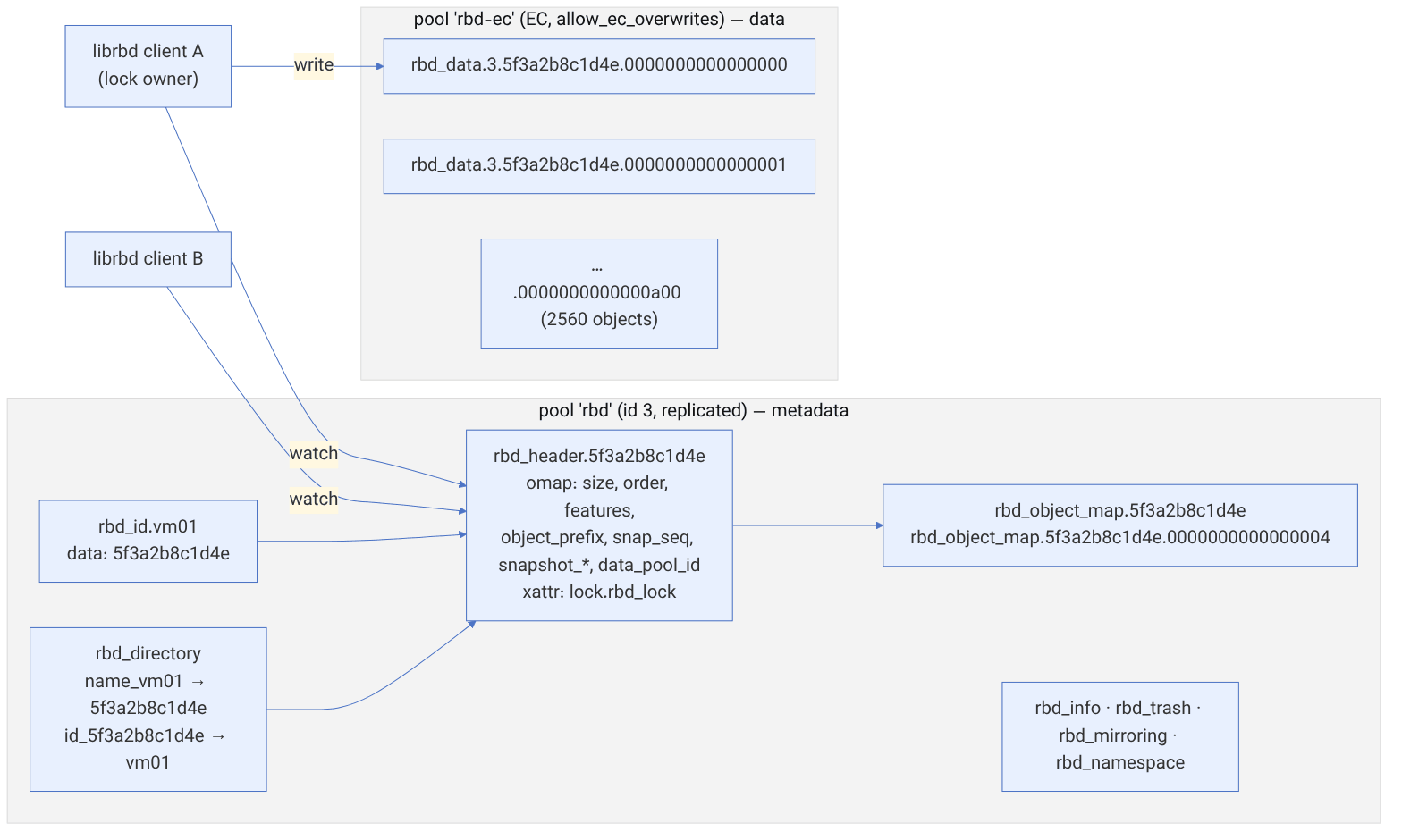
All the metadata of a format 2 image is in the omap of the object rbd_header.<id> and changes only through the methods of the rbd class (src/cls/rbd/cls_rbd.cc):
| omap key | Type | Content |
|---|---|---|
size | u64 | the image size in bytes |
order | u8 | the binary logarithm of the object size (22 means 4 MiB) |
object_prefix | string | the prefix of the data objects, for example rbd_data.5f3a2b8c1d4e |
features | u64 | the feature bits (next table) |
flags | u64 | OBJECT_MAP_INVALID (1) and FAST_DIFF_INVALID (2) |
op_features | u64 | operational features such as clone-parent, clone-child, group, snap-trash |
snap_seq | u64 | the largest snap id created for this image |
snapshot_<id:016x> | cls_rbd_snap | the name, size, parent, flags and namespace of each snapshot |
snap_children_<id:016x> | set | the format 2 clone children on that snapshot |
parent | cls_rbd_parent | the parent's pool, namespace, image and snap, and the overlap (for a clone) |
stripe_unit, stripe_count | u64 | only if striping is custom |
data_pool_id | s64 | only if there is a separate data pool |
create_timestamp, access_timestamp, modify_timestamp | utime | timestamps |
snap_limit | u64 | the cap on the number of snapshots |
metadata_<key> | string | image metadata; for example conf_rbd_cache for per-image settings |
migration | cls_rbd_migration | the live-migration state |
Besides the omap, the xattr lock.rbd_lock (the lock class) holds the advisory lock that ManagedLock uses for exclusive-lock (chapter 38). This same header object is the watch target of all clients that have the image open.
| Feature | Bit | Default |
|---|---|---|
layering | 1 | yes |
striping | 2 | only if the stripe is custom |
exclusive-lock | 4 | yes |
object-map | 8 | yes |
fast-diff | 16 | yes |
deep-flatten | 32 | yes |
journaling | 64 | no |
data-pool | 128 | only if --data-pool is given |
operations | 256 | internal |
migrating | 512 | internal |
non-primary | 1024 | internal, for a mirror destination image |
dirty-cache | 2048 | internal, for the PWL persistent cache |
The default sum (rbd_default_features) is 1+4+8+16+32 = 61.
37-2-2 Data objects and the object map#
Data objects are named <object_prefix>.<objectno:016x>. If the image is created with --data-pool, the header and metadata stay in the main pool (which must be replicated) and the data is written to the second pool (often EC with allow_ec_overwrites). In this case the prefix includes the main pool's id: rbd_data.<metadata-pool-id>.<image-id>, so that objects of images from several different pools do not collide in a shared data pool.
The object map is stored in the object rbd_object_map.<id> for the head and rbd_object_map.<id>.<snapid:016x> for each snapshot.
37-2-3 Pool-level objects#
| Object | omap or data | Use |
|---|---|---|
rbd_id.<name> | data: the image id | finding the id from the name |
rbd_directory | name_<name> → id and id_<id> → name | the list of images in the pool or namespace |
rbd_trash | id_<id> → name, deletion time, earliest restore time, source | images in the trash |
rbd_children | key: parent spec, value: children | only for format 1 clones |
rbd_info | the omap conf_<option> and a pool validation marker | pool-level settings (rbd config pool set) and the result of checking overwrite support in the data pool |
rbd_namespace | name_<ns> | the list of the pool's namespaces |
rbd_mirroring | mirror_mode, mirror_uuid, mirror_peer_<uuid>, image_<id>, global_<gid>, status_global_<gid>, instance_<id>, image_map_<gid> | the mirroring state (chapter 39) |
rbd_group_directory and rbd_group_header.<id> | omap | consistency groups |
rbd_task | omap | the mgr's background task queue (rbd task add flatten and the like) |
A namespace in RBD is the same as a namespace in RADOS (chapter 34). All the objects listed above are created separately in each namespace. With the cap profile rbd pool=P namespace=N a client can be restricted to one namespace without creating a separate pool for each tenant.
# example: reading the header directly (for inspection only; never change it with rados)
rados -p rbd listomapkeys rbd_header.5f3a2b8c1d4e
rados -p rbd getomapval rbd_header.5f3a2b8c1d4e object_prefixexample (output):
access_timestamp
create_timestamp
features
flags
modify_timestamp
object_prefix
order
size
snap_seq
snapshot_0000000000000004
value (25 bytes) :
00000000 15 00 00 00 72 62 64 5f 64 61 74 61 2e 35 66 33 |....rbd_data.5f3|
00000010 61 32 62 38 63 31 64 34 65 |a2b8c1d4e|The first four bytes (15 00 00 00, that is 21) are the string length in little-endian; all strings in Ceph's encoding have this format.
37-3 Striping#
By default stripe_unit equals the object size and stripe_count is 1, so the image is simply divided into consecutive 4 MiB pieces. With custom striping, data is spread round-robin across stripe_count objects, so that small sequential writes go to several OSDs at once.
Source in code: src/osdc/Striper.cc :: Striper::file_to_extents
Complexity: O(len / stripe_unit) pieces
pseudocode
su = stripe_unit ; sc = stripe_count ; os = object_size
if sc == 1: su = os
stripes_per_object = os / su
while left > 0:
    blockno     = cur / su
    stripeno    = blockno / sc
    stripepos   = blockno % sc
    objectsetno = stripeno / stripes_per_object
    objectno    = objectsetno * sc + stripepos
    x_offset    = (stripeno % stripes_per_object) * su + cur % su
    x_len       = min(su - cur % su, left)
    emit (objectno, x_offset, x_len) ; cur += x_len ; left -= x_len
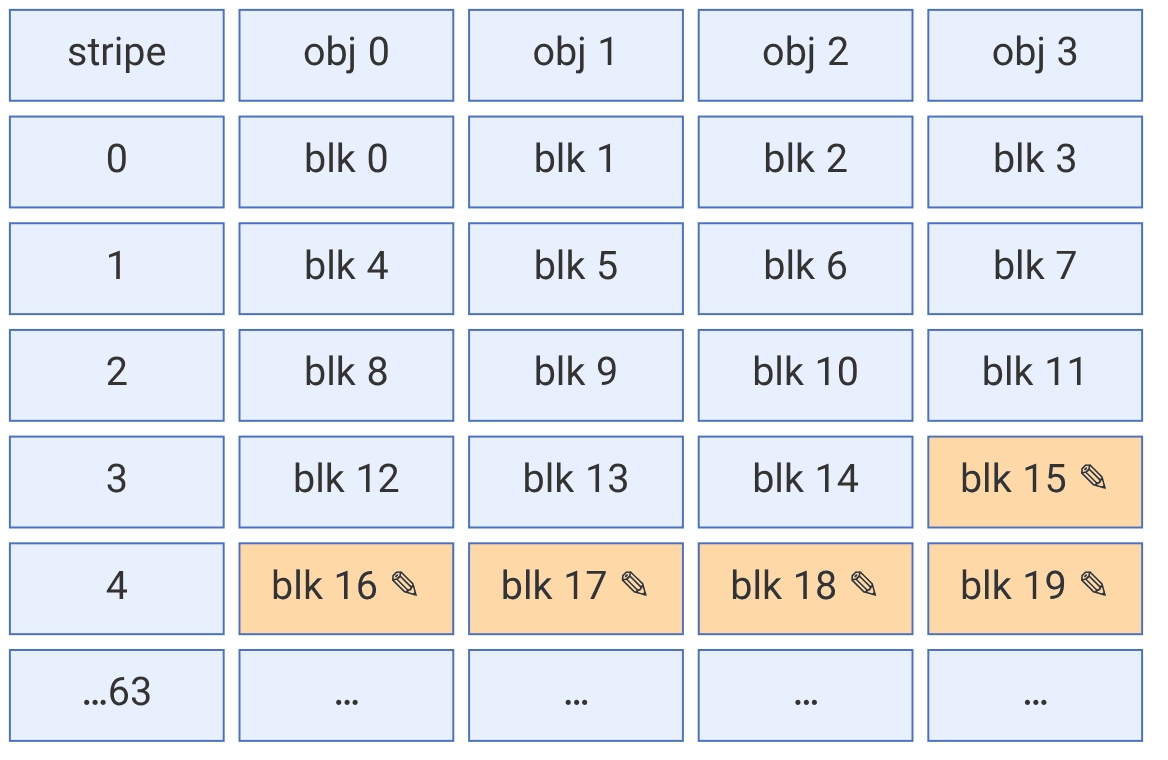
Numerical example. object_size = 4 MiB, stripe_unit = 64 KiB, stripe_count = 4, a write of 300000 bytes from offset 1000000. Each object has 64 stripes and one "object set" of 4 objects covers 16 MiB.
| block | stripe | stripepos | object | offset within object | length |
|---|---|---|---|---|---|
| 15 | 3 | 3 | 3 | 213568 | 48576 |
| 16 | 4 | 0 | 0 | 262144 | 65536 |
| 17 | 4 | 1 | 1 | 262144 | 65536 |
| 18 | 4 | 2 | 2 | 262144 | 65536 |
| 19 | 4 | 3 | 3 | 262144 | 54816 |
The 300 KB write reaches all four objects. With default striping, the same write would touch only object 0 (offsets 1000000 to 1300000). Striping helps a single-stream sequential load with a low queue depth, but for a random 4K load it only increases the number of objects involved. krbd supports custom striping from kernel 4.17 (chapter 29).
RBD striping mapper
Set an image's object size, stripe_unit and stripe_count and an I/O's offset and length: see which rbd_data objects it touches and where.
| 0 | 1 | 2 | 3 | |
|---|---|---|---|---|
| s0… | ||||
| s2… | ||||
| s4… | ||||
| s6… | ||||
| s8… | ||||
| s10… | ||||
| s12… | ||||
| s14… | ||||
| s16… | ||||
| s18… | ||||
| s20… | ||||
| s22… | ||||
| s24… | ||||
| s26… | ||||
| s28… | ||||
| s30… | ||||
| s32… | ||||
| s34… | ||||
| s36… | ||||
| s38… | ||||
| s40… | ||||
| s42… | ||||
| s44… | ||||
| s46… | ||||
| s48… | ||||
| s50… | ||||
| s52… | ||||
| s54… | ||||
| s56… | ||||
| s58… | ||||
| s60… | ||||
| s62… |
| Object | Offset in object | Length | buffer_extents |
|---|---|---|---|
rbd_data.10226b8b4567.0000000000000000 | 262144 | 65536 | [48576, 65536] |
rbd_data.10226b8b4567.0000000000000001 | 262144 | 65536 | [114112, 65536] |
rbd_data.10226b8b4567.0000000000000002 | 262144 | 65536 | [179648, 65536] |
rbd_data.10226b8b4567.0000000000000003 | 213568 | 103392 | [0, 48576] [245184, 54816] |
rbd create pool/img --size 10G --object-size 4M --stripe-unit 64K --stripe-count 4Follows:
src/osdc/Striper.cc :: Striper::file_to_extentsan image range to object extentsStriper.cc :: get_num_objects, get_file_offset, object_truncate_sizeobject counts and the reverse mappingsrc/librbd/ImageCtx.cc :: ImageCtx::init (format_string "%s.%016llx")the data object namesrc/include/rbd_types.h :: RBD_DATA_PREFIX "rbd_data."the name prefixsrc/test/test_striper.cc :: the upstream test vectors used by tests/simsthe vectors the tests compare against
37-4 The object map#
37-4-1 States and bit packing#
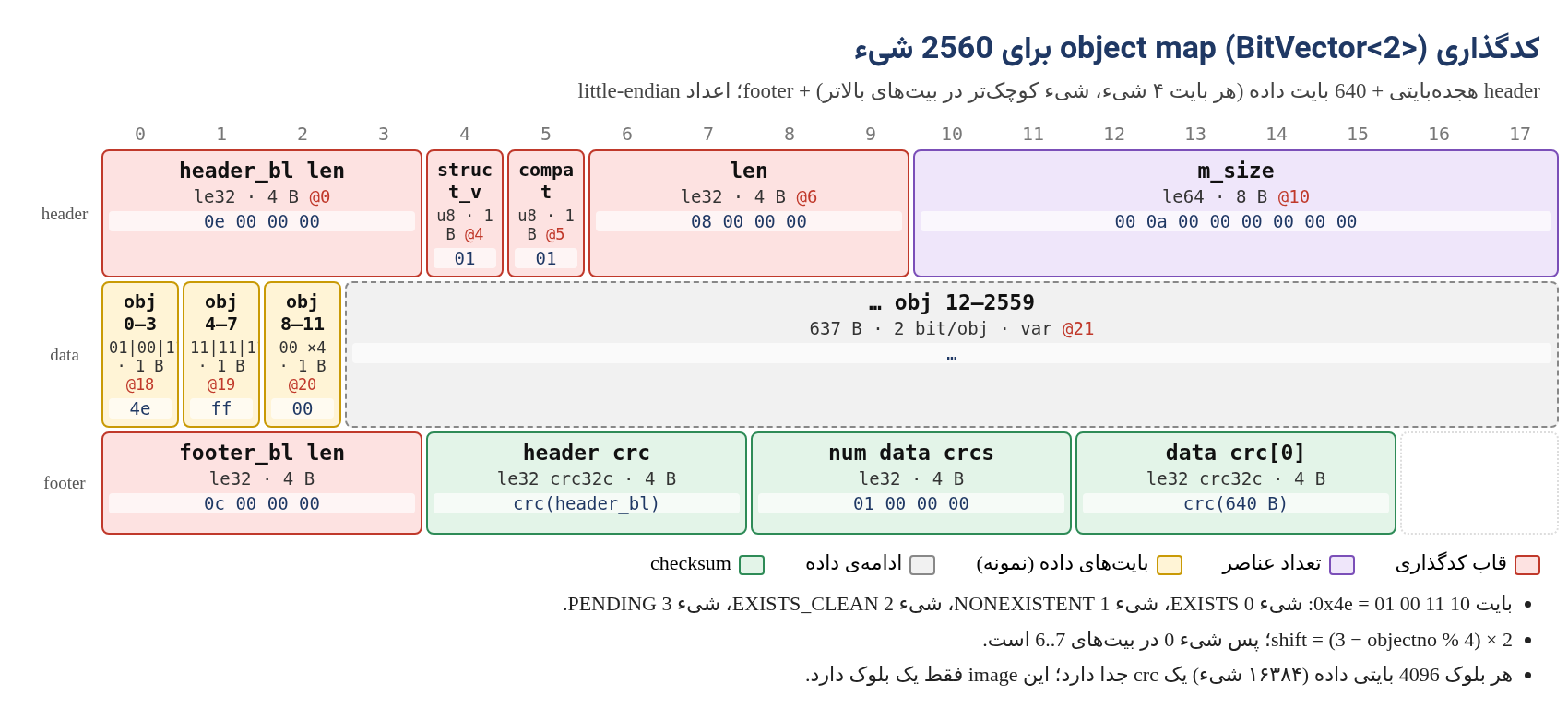
The object map has 2 bits per object (BitVector<2>):
| Value | Constant | Meaning |
|---|---|---|
| 0 | OBJECT_NONEXISTENT | the object does not exist; a read returns zeros and there is no need to go to the OSD |
| 1 | OBJECT_EXISTS | the object exists and has changed since the last snapshot |
| 2 | OBJECT_PENDING | a deletion is in progress (discard or resize) |
| 3 | OBJECT_EXISTS_CLEAN | the object exists and has not changed since the last snapshot |
Each byte holds four objects, and the object with the lower number is in the higher bits: shift = (3 − objectno % 4) × 2. The on-disk encoding has three parts: a header (length, version and element count), the raw data, and a footer containing the crc32c of the header and one crc32c for each 4096-byte block of data. So updating one object rewrites only one 4 KiB block and its crc (the object_map_update method in cls_rbd).
37-4-2 Who changes the state?#
- A write to an object that is NONEXISTENT or EXISTS_CLEAN updates the object map to EXISTS before the write is sent (first in memory, then with
object_map_updateon RADOS). If the object is already EXISTS, it costs nothing. - A discard or deletion first sets the state to PENDING, deletes the object, and then sets NONEXISTENT.
- Taking a snapshot copies the head map to
rbd_object_map.<id>.<snapid>and then turns all EXISTS entries of the head into EXISTS_CLEAN (object_map_snap_addin cls_rbd). - Deleting a snapshot merges the EXISTS bits of that snapshot's map into the map of the next snapshot (or the head), so the "changed" information is not lost (
object_map_snap_remove).
The object map is valid only with exclusive-lock, because only the lock owner may change it. If the client fails in the middle of an update, the OBJECT_MAP_INVALID flag is set in flags and rbd object-map rebuild must be run.
37-4-3 fast-diff#
Source in code: src/librbd/object_map/DiffRequest.cc :: DiffRequest::handle_load_object_map
Complexity: O(N × S) for N objects and S loaded maps; with no data reads at all
pseudocode
# for each snapshot from from_snap to end_snap (and head), its map is loaded and combined with the previous state
first map (from_snap):  state[o] = HOLE if NONEXISTENT else DATA (PENDING → DATA_UPDATED)
each later map m:
    HOLE:         if m[o] != NONEXISTENT → DATA_UPDATED     (diff-iterate: only in the final map)
    DATA:         if m[o] == NONEXISTENT → HOLE_UPDATED
                  elif m[o] != EXISTS_CLEAN → DATA_UPDATED
    HOLE_UPDATED: if m[o] != NONEXISTENT → DATA_UPDATED
    DATA_UPDATED: if m[o] == NONEXISTENT → HOLE_UPDATED
objects beyond the previous size (image grew) → HOLE or DATA_UPDATED
The key point is EXISTS_CLEAN: if an object existed at from_snap and stayed EXISTS_CLEAN in all later maps, it had no writes after from_snap and does not appear in the diff. rbd diff --whole-object, rbd du and rbd export-diff (and snapshot mode in rbd-mirror) all use this calculation. If FAST_DIFF_INVALID is set, librbd falls back to list_snaps on each individual object, which is much slower.
Numerical example. A 10 GiB image with 2560 objects. After snap1, twenty objects have been written and three have been discarded. With fast-diff, rbd export-diff --from-snap snap1 reads only two 640-byte maps (plus header and footer) and finds the 23 objects. Without it, 2560 list_snaps calls would be needed.
37-5 rbd reference#
37-5-1 Images and snapshots#
| Command | Use |
|---|---|
rbd create P/I --size 10G [--object-size 4M] [--stripe-unit 64K --stripe-count 4] [--data-pool DP] [--image-feature F] | creating an image |
rbd ls [-l] P[/NS] / rbd info P/I / rbd status P/I | listing, details, watchers |
rbd resize P/I --size N [--allow-shrink] | resizing |
rbd feature {enable,disable} P/I F | turning a feature on and off |
rbd object-map {rebuild,check} P/I[@S] | rebuilding and checking the object map |
rbd du P/I / rbd diff [--from-snap S] [--whole-object] P/I | usage and changes |
rbd snap {create,ls,rm,purge,rollback,rename,limit set} | snapshots |
rbd snap {protect,unprotect} P/I@S | only for format 1 clones |
rbd clone P/I@S P2/C [--rbd-default-clone-format 2] / rbd children P/I@S / rbd flatten P2/C | layering (chapter 38) |
rbd export P/I FILE / import / export-diff / import-diff / merge-diff | backup |
rbd deep cp P/I P2/I2 / rbd cp | copying (deep, with snapshots) |
rbd trash {mv,ls,restore,rm,purge} | the trash |
rbd migration {prepare,execute,commit,abort} | live migration |
rbd image-meta {list,get,set,remove} P/I | per-image metadata and settings |
rbd config {pool,image,global} {get,set,list} | pool-level or image-level settings |
rbd namespace {create,ls,remove} P/NS | namespaces |
rbd group {create,image add,snap create} | consistency groups |
rbd lock {ls,add,rm} | advisory locks (not exclusive-lock) |
rbd bench P/I --io-type {read,write,readwrite} --io-size 4K --io-threads 16 --io-pattern rand | performance testing |
rbd perf image {iostat,iotop} | live statistics from the mgr |
rbd pool init P / rbd pool stats P | preparing a pool and its statistics |
37-5-2 Mapping#
| Command | Use |
|---|---|
rbd device map [-t krbd] P/I [-o OPTS] / rbd device unmap / rbd device list | krbd |
rbd device map -t nbd P/I or rbd-nbd map P/I [--try-netlink] [--timeout N] | rbd-nbd (librbd in user space) |
rbd-nbd list-mapped / rbd-nbd unmap /dev/nbdX | listing and unmapping |
rbd device map -t ubbd P/I | ubbd, if its package is installed |
# example: creating an image with striping and a data pool, and inspecting it
rbd create rbd/vm01 --size 10G --stripe-unit 64K --stripe-count 4 --data-pool rbd-ec
rbd info rbd/vm01example (output):
rbd image 'vm01':
size 10 GiB in 2560 objects
order 22 (4 MiB objects)
snapshot_count: 0
id: 5f3a2b8c1d4e
data_pool: rbd-ec
block_name_prefix: rbd_data.3.5f3a2b8c1d4e
format: 2
features: layering, striping, exclusive-lock, object-map, fast-diff, deep-flatten, data-pool
op_features:
flags:
create_timestamp: Sun Nov 15 09:41:07 2026
access_timestamp: Sun Nov 15 09:41:07 2026
modify_timestamp: Sun Nov 15 09:41:07 2026
stripe unit: 64 KiB
stripe count: 4block_name_prefix is the object_prefix, and the number 3 in it is the id of the rbd pool, because we have a separate data pool.
37-6 Tuning and troubleshooting#
- Slow first writes on a new image: each first write to an object also involves an
object_map_update. Once the image is filled, this cost disappears. For performance testing, fill the image first. rbd duor export-diff is slow: look atrbd info; if it showsflags: object map invalid, fast diff invalid, runrbd object-map rebuild(separately on the snapshots too).- An image with
--data-poolon EC cannot be created: checkallow_ec_overwriteson the EC pool and thatrbd pool inithas been run on both pools. - Deleting a large image is slow: deletion depends on the number of existing objects; with the object map only existing objects are deleted. For long jobs use
rbd trash mvfollowed byrbd trash rmorceph rbd task add remove. - Never change the header with
rados setomapval: cls_rbd checks for inconsistencies, but open clients are not told about the change (no notify is sent).
37-7 Supplementary and up to date#
- Format 2 clones (the default
rbd_default_clone_format: autochooses format 2 if all clients are Mimic or newer) do not need protect and keep the children insnap_children_*of the parent's own header. - The
op_featuresvalue in new versions has bits for snapshots in the trash and for groups; an old client that sees an unknown op_feature does not open the image. - In the main branch,
rbd-nbdwith netlink and--try-netlinkis more stable than the ioctl method; ubbd support depends on the distribution's packaging.
37-8 Hands-on exercise#
- 1. Create an image and read all the header keys with
rados listomapkeysandgetomapval. Then take a snapshot and find the new key. - 2. Create an image with
--stripe-unit 64K --stripe-count 4, write 300000 bytes at offset 1000000 (rbd benchorddon rbd-nbd) and see withrados ls | grepwhich objects were created. Compare with the example table. - 3. Take
rados get rbd_object_map.<id> /tmp/omand withxxdmatch the first four data bytes (after the eighteen-byte header) against the states of objects 0 to 15. - 4. After a snapshot, write a few objects and time
rbd diff --from-snapwith and without fast-diff (afterrbd feature disable ... fast-diff).
37-9 Review questions#
- 1. Which header keys are needed to build the names of the data objects?
- 2. With a separate data pool, how do the data object names change, and why?
- 3. What two kinds of key does
rbd_directoryhave? - 4. In the striping example, which object and which offset hold the byte at offset 1100000?
- 5. How many bits does the object map keep per object, and in which bits of the first byte is object 0?
- 6. Why does the object map footer have a separate crc for each 4 KiB block?
- 7. When is EXISTS_CLEAN set and when is it cleared?
- 8. In fast-diff, if an object is DATA at from_snap and EXISTS in the head, what is the result?
- 9. Why does the object map depend on exclusive-lock?
- 10. How is a namespace implemented in RBD, and what advantage does it have?
Answers to these questions are in Appendix E: Answers to Review Questions. Answers to this chapter's questions →
37-10 Sources for this chapter#
- cls_rbd.cc
https://github.com/ceph/ceph/blob/main/src/cls/rbd/cls_rbd.cc - rbd_types.h and features.h
https://github.com/ceph/ceph/blob/main/src/include/rbd/features.h - Striper.cc
https://github.com/ceph/ceph/blob/main/src/osdc/Striper.cc - bit_vector.hpp
https://github.com/ceph/ceph/blob/main/src/common/bit_vector.hpp - librbd/object_map/DiffRequest.cc
https://github.com/ceph/ceph/blob/main/src/librbd/object_map/DiffRequest.cc - RBD layering and striping documentation
https://docs.ceph.com/en/latest/dev/rbd-layering/ - rbd command reference
https://docs.ceph.com/en/latest/man/8/rbd/ - rbd-nbd reference
https://docs.ceph.com/en/latest/man/8/rbd-nbd/