Lower Layers (9): SPDK and NVMe — from Hardware Queues to the NVMe-oF Gateway
TL;DR this chapter in a few lines
- NVMe talks to the host through submission and completion queue pairs in host memory; the chapter reads commands and completions byte by byte.
- SPDK drives NVMe from user space with polling, and BlueStore's
NVMEDeviceuses it when the device path starts withspdk:. - The NVMe-oF gateway exports RBD images over NVMe/TCP; gateways in a group share ANA state for failover.
- If host I/O stalls after a gateway failure, check
ceph nvme-gw showand the OSD blocklist.
31-1 Why this chapter?#
In the previous chapters, the lowest layer we saw was KernelDevice in BlueStore, which hands requests to the kernel with libaio or io_uring. This chapter goes one layer lower: the NVMe hardware queues themselves, the bytes of a command and of a completion, the doorbells and the Phase Tag. Then we examine the two places where Ceph bypasses the kernel with SPDK (Storage Performance Development Kit):
- NVMEDevice in BlueStore (
src/blk/spdk/NVMEDevice.cc): a user-space driver for a local device or an NVMe-oF target. - The NVMe-oF gateway (the ceph-nvmeof project): an SPDK-based NVMe/TCP target that exports RBD images to hosts. Its management side in the mon is implemented with
NVMeofGwMonandNVMeofGwMap.
Status. The bluestore_spdk_* options are at the dev level in the code. SPDK support in BlueStore is still a tool for testing and research and is not the usual path in a cephadm deployment. The NVMe-oF gateway, however, is documented and supported with ceph orch apply nvmeof. All code references in this chapter are to the main branch at the time of writing.
31-2 NVMe from the driver's point of view#
31-2-1 Two data paths#
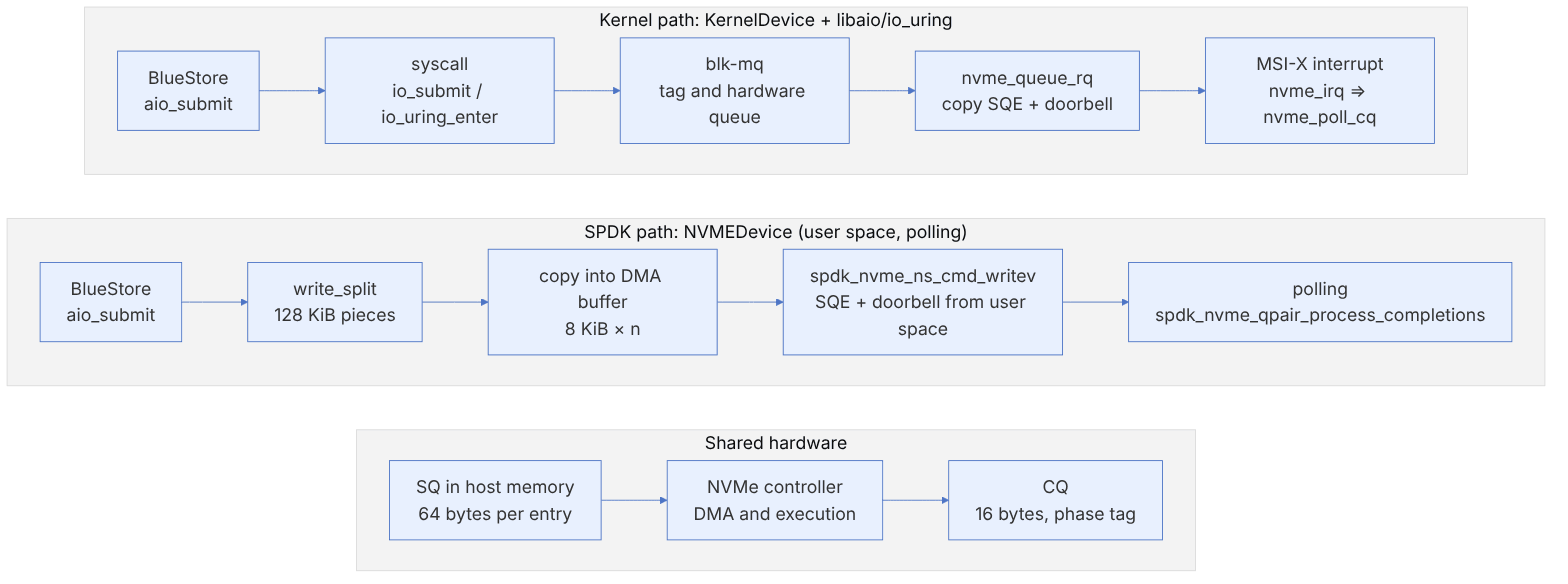
The NVMe controller talks to the host through queue pairs: a Submission Queue (SQ) into which the host writes commands and a Completion Queue (CQ) into which the controller puts the results. Both are ring arrays in host memory. The Linux kernel driver usually creates one queue pair per CPU. That is why two CPU cores do not compete to submit commands on one queue.
31-2-2 The bytes of a command#
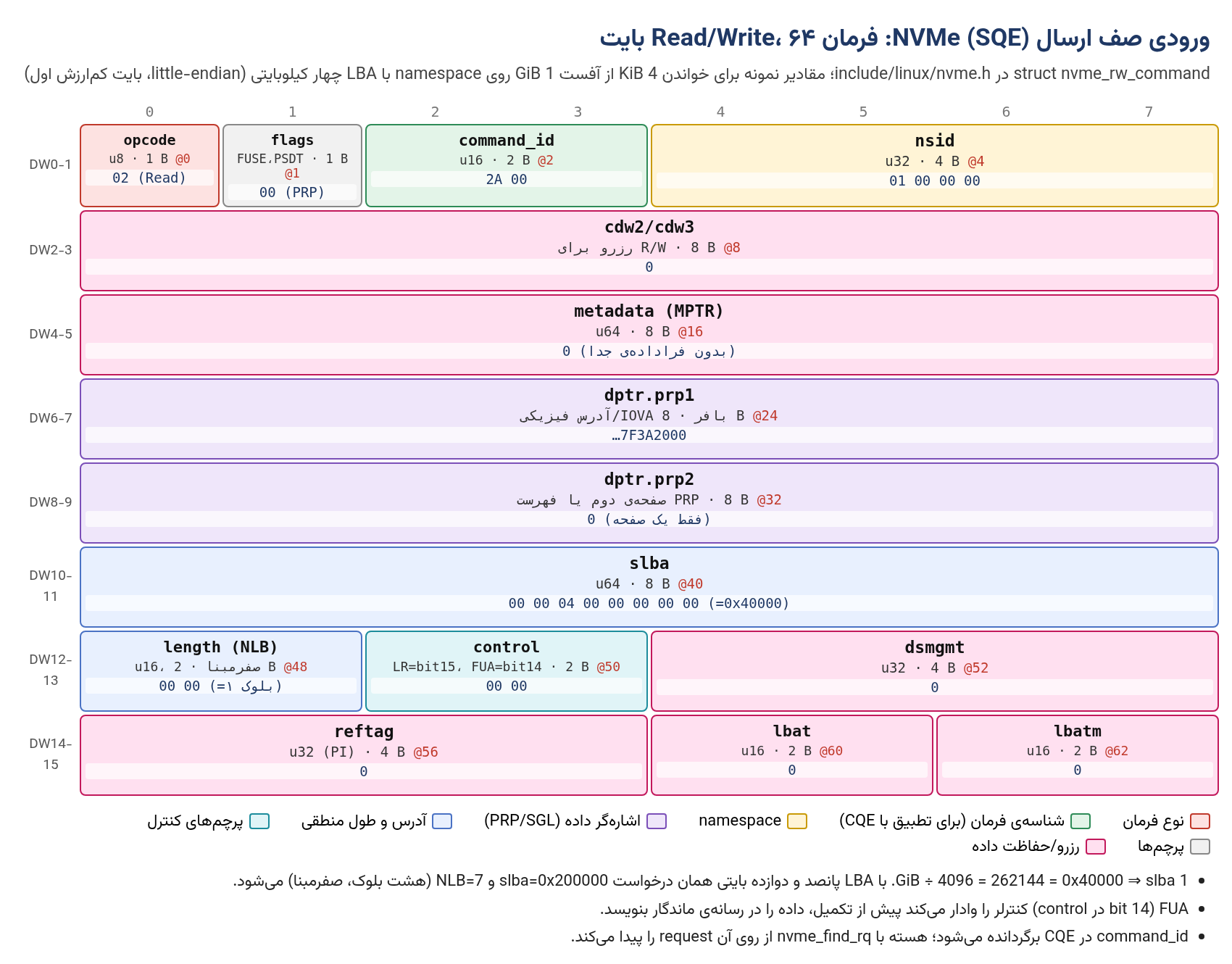
Two low-level points in this structure matter:
- 1. Zero-based length. A value of 0 in
lengthmeans one block. Off-by-one errors are common in experimental drivers. - 2. PRPs and pages. PRP1 points to the first page (it may have an offset within the page). If the data spans more than two pages, PRP2 points to a PRP list. Each entry is 8 bytes, so one 4 KiB page holds a list of 512 pages. For an aligned 8 KB I/O, PRP1 is the first page and PRP2 the second, and no list is needed. For 128 KiB (32 pages), PRP2 points to a list with 31 entries.
31-2-3 The bytes of a completion#
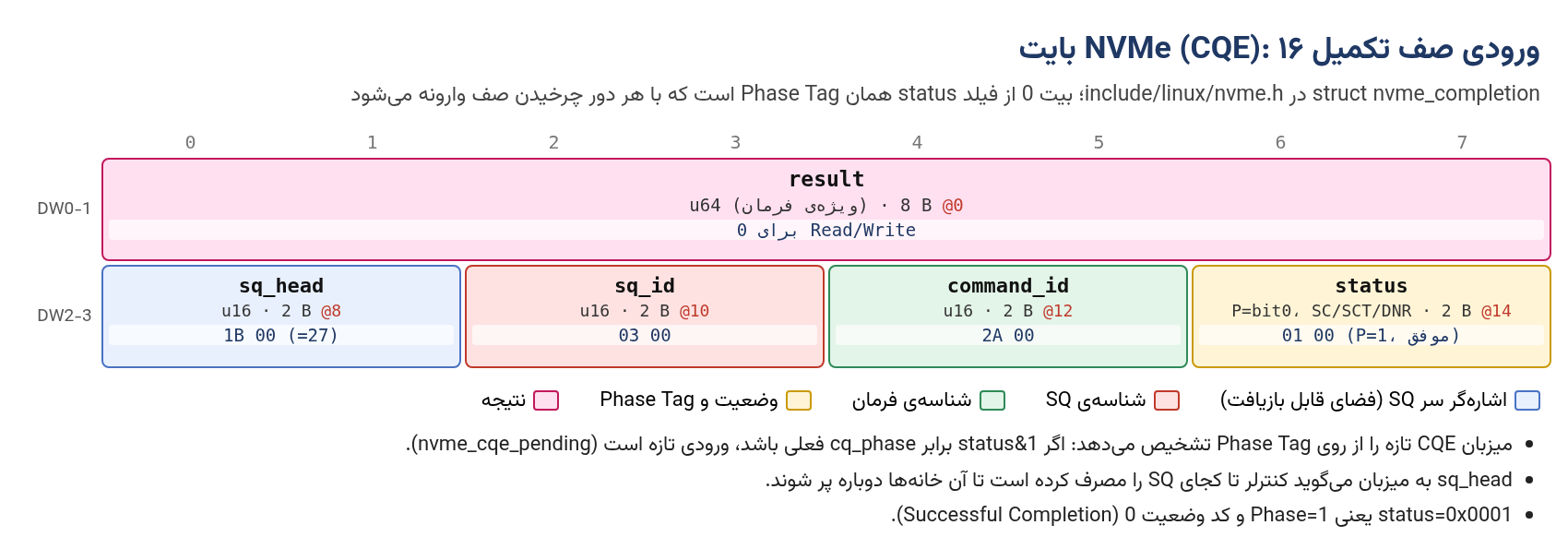
Source in code: linux: drivers/nvme/host/pci.c :: nvme_poll_cq, nvme_cqe_pending, nvme_update_cq_head
Complexity: O(k) for k new completions; one MMIO write at the end
pseudocode (taken from the logic of nvme_poll_cq, rewritten)
found = false
while (cqes[cq_head].status & 1) == cq_phase:     # a new entry?
    found = true
    dma_rmb()                                      # read the rest of the CQE after the phase
    handle(cqes[cq_head])                          # command_id ⇒ request ⇒ completion
    cq_head += 1
    if cq_head == q_depth: cq_head = 0; cq_phase ^= 1
if found: writel(cq_head, CQ_HEAD_DOORBELL)        # once for the whole batch
Why a Phase Tag? The CQ is filled with zeros before starting, and the host's cq_phase starts at 1. On the first pass the controller writes CQEs with P=1, so any slot whose P is 1 is new. When the queue wraps around a full cycle, the old slots have P=1 and this time the controller writes P=0. The host likewise flips cq_phase to change its criterion for "new". So the host knows what has arrived without reading any register from the device, just by reading its own memory. This property is what makes polling cheap: an empty poll is just one read from cache.
Numerical example. q_depth=4, cq_head=2, cq_phase=1. The controller completes three commands and writes them in slots 2 and 3 with P=1 and in slot 0 with P=0 (a new pass). The host processes slot 2 (P=1, new) and slot 3 (new) and reaches the end of the queue: cq_head=0 and cq_phase=0. Slot 0 with P=0 is new and is processed. Slot 1 still has the old P=1, so the loop stops and one doorbell with value 1 is written. Three completions were reported with one MMIO write.
31-2-4 Doorbells and the cost of MMIO#
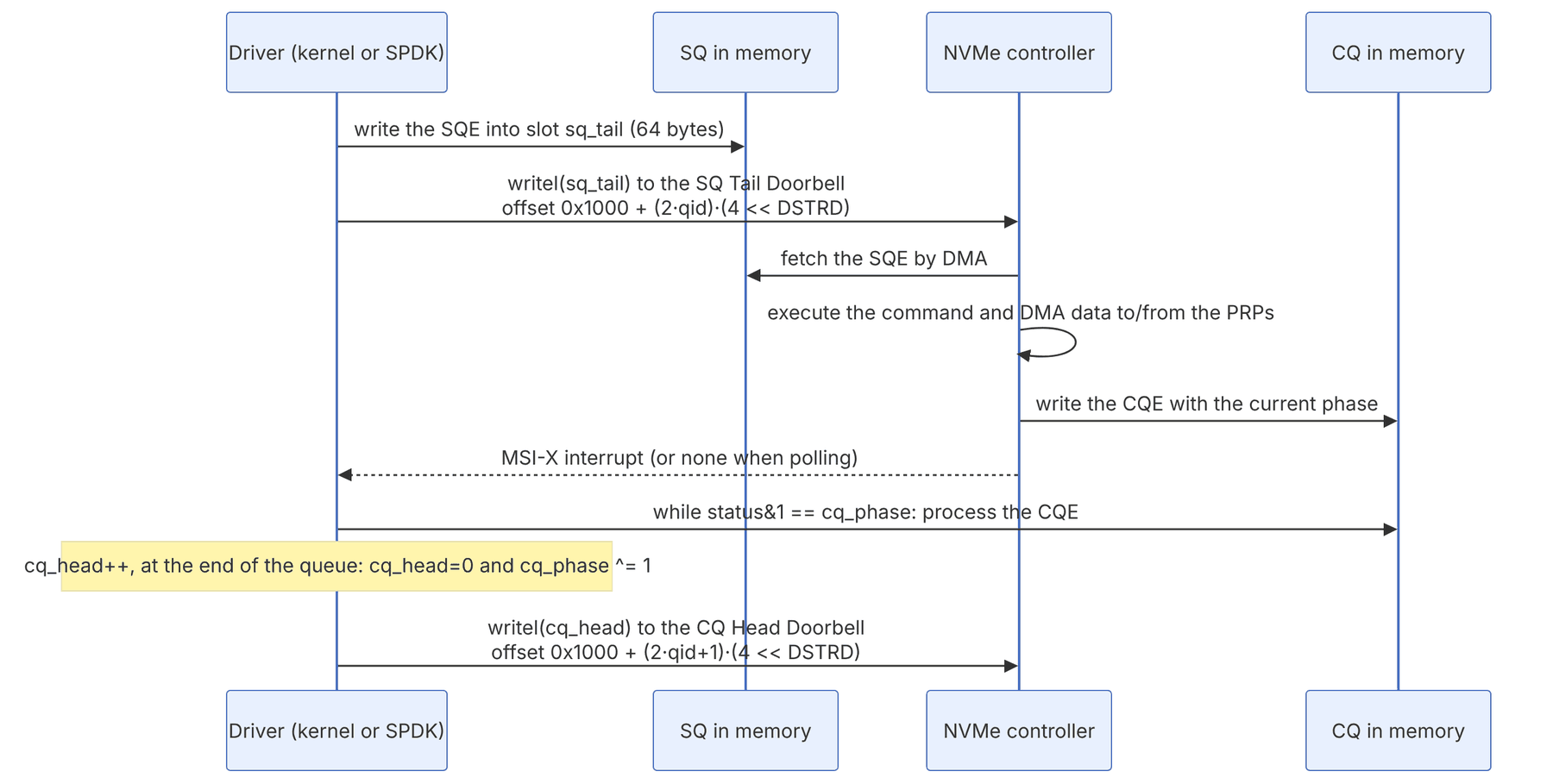
The doorbell offsets in the controller's register space (BAR0) come from the standard NVMe formula: SQyTDBL = 0x1000 + (2y) × (4 << CAP.DSTRD) and CQyHDBL = 0x1000 + (2y+1) × (4 << CAP.DSTRD). For queue 3 with DSTRD=0, the SQ doorbell is at 0x1018 and the CQ doorbell at 0x101C. Each doorbell is an uncacheable MMIO write that crosses PCIe. That is why the kernel, in nvme_write_sq_db, defers the doorbell write until the last request of a batch (the write_sq parameter and last_sq_tail), and nvme_commit_rqs writes it at the end of the batch. The Doorbell Buffer Config feature (in the kernel, nvme_dbbuf_update_and_check_event) eliminates even this write on virtual controllers, if the device declares it unnecessary.
Locks in the kernel path. nvme_sq_copy_cmd and nvme_write_sq_db are annotated with __must_hold(&nvmeq->sq_lock): copying the 64 bytes and advancing sq_tail happen under a spinlock specific to that queue. Because each CPU usually has its own queue, this lock is almost never contended. The completion path also runs in the interrupt context of the same queue and takes no lock on the CQ.
31-3 NVMEDevice: SPDK in BlueStore, function by function#
31-3-1 Configuration and opening#
When the device file name starts with spdk: (SPDK_PREFIX in BlockDevice.h), BlueStore uses NVMEDevice instead of KernelDevice. The BlueStore documentation shows two forms:
bluestore_block_path = "spdk:trtype:PCIe traddr:0000:01:00.0"
bluestore_block_path = "spdk:trtype:TCP adrfam:IPv4 traddr:10.0.0.7 trsvcid:4420 subnqn:nqn.2019-02.io.spdk:cnode1"
# so that DB and WAL also go through SPDK (co-located):
bluestore_block_db_path = ""
bluestore_block_wal_path = ""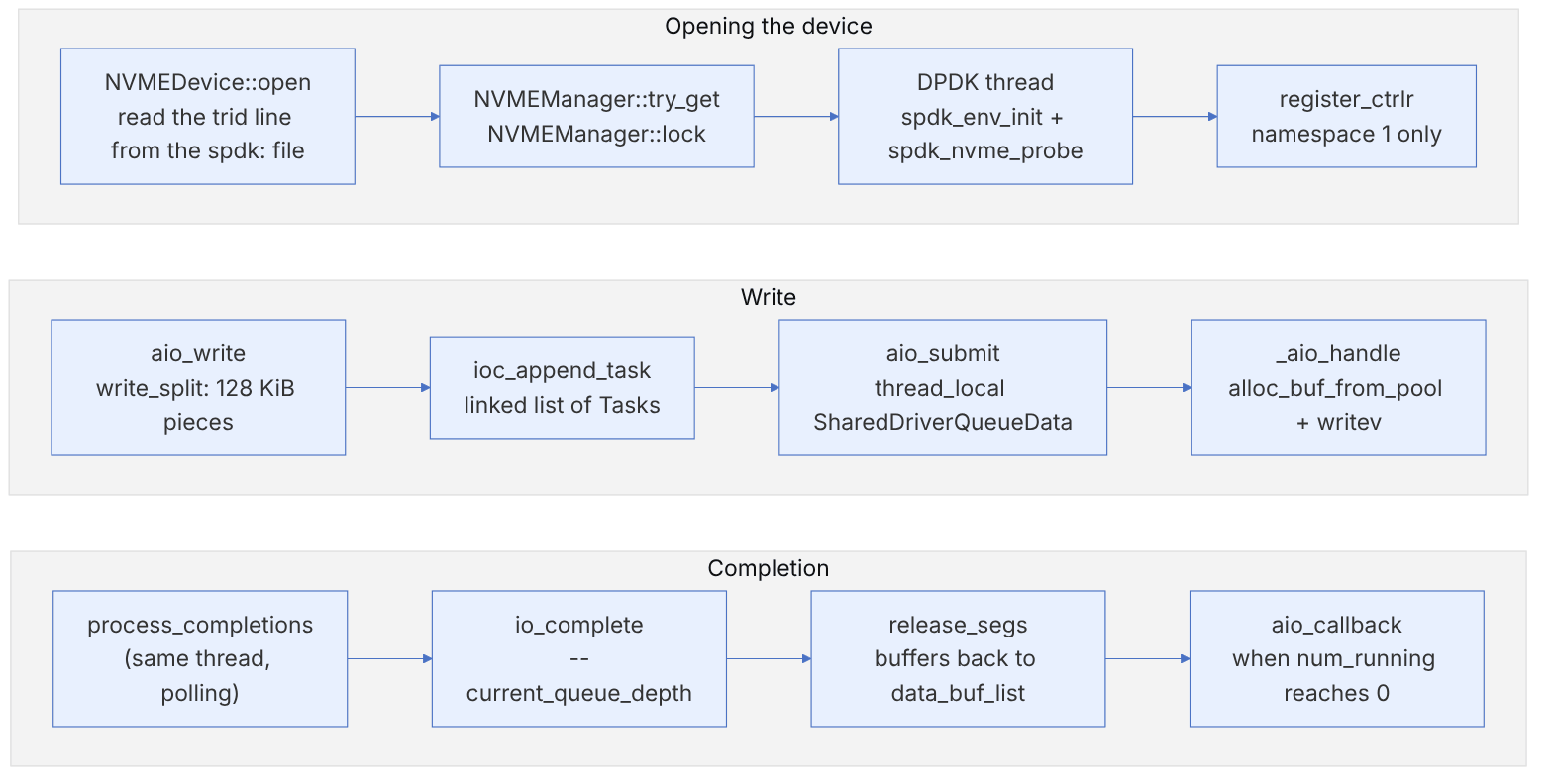
| Function | Work | Thread and lock |
|---|---|---|
| NVMEDevice::open | read the trid line, spdk_nvme_transport_id_parse, manager.try_get | the opening thread; NVMEManager::lock |
| NVMEManager::try_get | first time: create dpdk_thread with spdk_env_init (coremask, mem_size), the probe queue | probe_queue_lock and probe_queue_cond |
| probe_cb / attach_cb | match the trid, register_ctrlr | the DPDK thread |
| register_ctrlr | only namespace number 1; "only one device per OSD for now" (ceph_assert) | under NVMEManager::lock |
| SharedDriverData | for a non-PCIe transport, an admin_thread that processes admin completions every 1 second (keep-alive) | a separate thread |
| aio_write ⇒ write_split | 131072-byte pieces, bl.splice into the Task | the calling thread |
| aio_submit | num_pending ⇒ num_running; thread_local SharedDriverQueueData | lock-free: a qpair dedicated to that thread |
| _aio_handle | submit the Tasks and poll until num_running is zero | the same thread, busy-poll |
| io_complete | decrement the queue depth, release_segs, aio_callback | the same thread (inside process_completions) |
31-3-2 The DMA buffer pool and request splitting#
SPDK cannot use the ordinary memory of a bufferlist directly. For DMA, the controller needs memory that is pinned and whose physical address or IOVA is known (DPDK hugepages). So SharedDriverQueueData creates, in its constructor, 1024 buffers of 8 KB with spdk_dma_zmalloc (data_buffer_default_num and data_buffer_size). The data of each write is copied into these buffers. The code comment (a TODO) itself says this copy could be removed if the upper layer provided memory with a known physical address.
Source in code: src/blk/spdk/NVMEDevice.cc :: write_split, make_read_tasks, SharedDriverQueueData::alloc_buf_from_pool
Complexity: O(len/8K) for copying and allocation; a fixed 8 MiB of space per thread
pseudocode
write_split(off, bl):
    while remaining > 0:
        n = min(remaining, 128 KiB)
        task = Task(WRITE, off+begin, n); bl.splice(0, n, task.bl); append(ioc, task)
alloc_buf_from_pool(task):
    count = ceil(task.len / 8 KiB)
    if count > free_buffers: return -ENOMEM        # _aio_handle polls again (goto again)
    segs = count ≤ 32 ? task.inline_segs : new void*[count]
    pop count buffers; copy task.bl into them (write)
submit: spdk_nvme_ns_cmd_writev(ns, qpair, off/bs, len/bs, io_complete, task,
                                reset_sgl=data_buf_reset_sgl, next_sge=data_buf_next_sge)
Numerical example. A 300 KiB (307200-byte) write with a 4096-byte block:
| Task | Relative offset | Length | lba_count | 8 KiB buffers |
|---|---|---|---|---|
| 1 | 0 | 131072 | 32 | 16 |
| 2 | 131072 | 131072 | 32 | 16 |
| 3 | 262144 | 45056 | 11 | 6 (five full + one with 4096 bytes) |
In total, 3 NVMe commands and 38 of the 1024 buffers. Because each Task is at most 128 KiB, the number of buffers never exceeds 16 and always fits in the 32 slots of inline_segs. The extra_segs branch is effectively unused for this split size. SPDK gets the scatter-gather list from the Task through two callbacks: data_buf_next_sge returns the next buffer with length 8192 (or the final remainder, here 4096), and data_buf_reset_sgl is for replaying from an offset. A pool of 1024 buffers means at most 8 MiB of data in flight per thread. A batch larger than this returns to the polling loop with -ENOMEM until buffers are freed.
31-3-3 Synchronous polling in the calling thread#
The most important behavioural point of this driver is in _aio_handle: the outer loop while (ioc->num_running) continues until all the I/Os of this IOContext have completed. So, unlike KernelDevice, aio_submit in NVMEDevice does not just submit; it holds the thread until completion. If process_completions finds nothing, the thread sleeps with usleep for bluestore_spdk_io_sleep (default 5 microseconds). bluestore_spdk_max_io_completion (default 0, meaning SPDK decides) limits the number of completions per poll.
The consequence for BlueStore. In KernelDevice, a separate aio thread collects the completions, and kv_sync_thread or the op thread only submits. In NVMEDevice, every thread that calls aio_submit waits until its own I/O finishes. With thread_local, each thread has a dedicated qpair, which removes contention, but every new thread that submits I/O consumes 1024 DMA buffers (8 MiB) and one qpair. The total can be calculated: if 16 different threads (op shards, kv_sync, BlueFS) submit I/O, 128 MiB of DPDK memory, which is limited by bluestore_spdk_mem=512 (MB), goes to these buffers alone.
Latency reasoning. Consider a random 4 KiB read on a sample SSD with an internal latency of 80 microseconds. In the kernel path, suppose 2 to 5 microseconds are added for the syscall, blk-mq, the interrupt and waking the thread. SPDK removes a large part of this, but adds 0 to 5 microseconds of usleep when idle and the copy into the DMA buffer (negligible for 4 KiB, a few microseconds for 128 KiB). SPDK's gain is more in CPU per I/O than in latency. When the device latency is in the tens of microseconds, a few microseconds of software in the BlueStore layer are small compared with the cost of the OSD (chapters 22 and 30).
Source in code: a queueing-theory result; in the code: max_queue_depth = io_queue_size − 1 in SharedDriverQueueData
Complexity: O(1)
QD_needed = target_IOPS × latencyFor 500K IOPS with a latency of 80 microseconds: QD = 500000 × 0.00008 = 40 concurrent requests. If I/O comes from only one thread with one IOContext that submits everything in one batch and waits for all of it to complete, the effective QD is just the size of that batch. To reach 40, either the batches must be large or several threads must work concurrently. The same calculation shows why running several OSDs on one fast NVMe, or more shards, sometimes has more effect than changing the driver.
31-4 The NVMe-oF gateway#
31-4-1 Architecture#
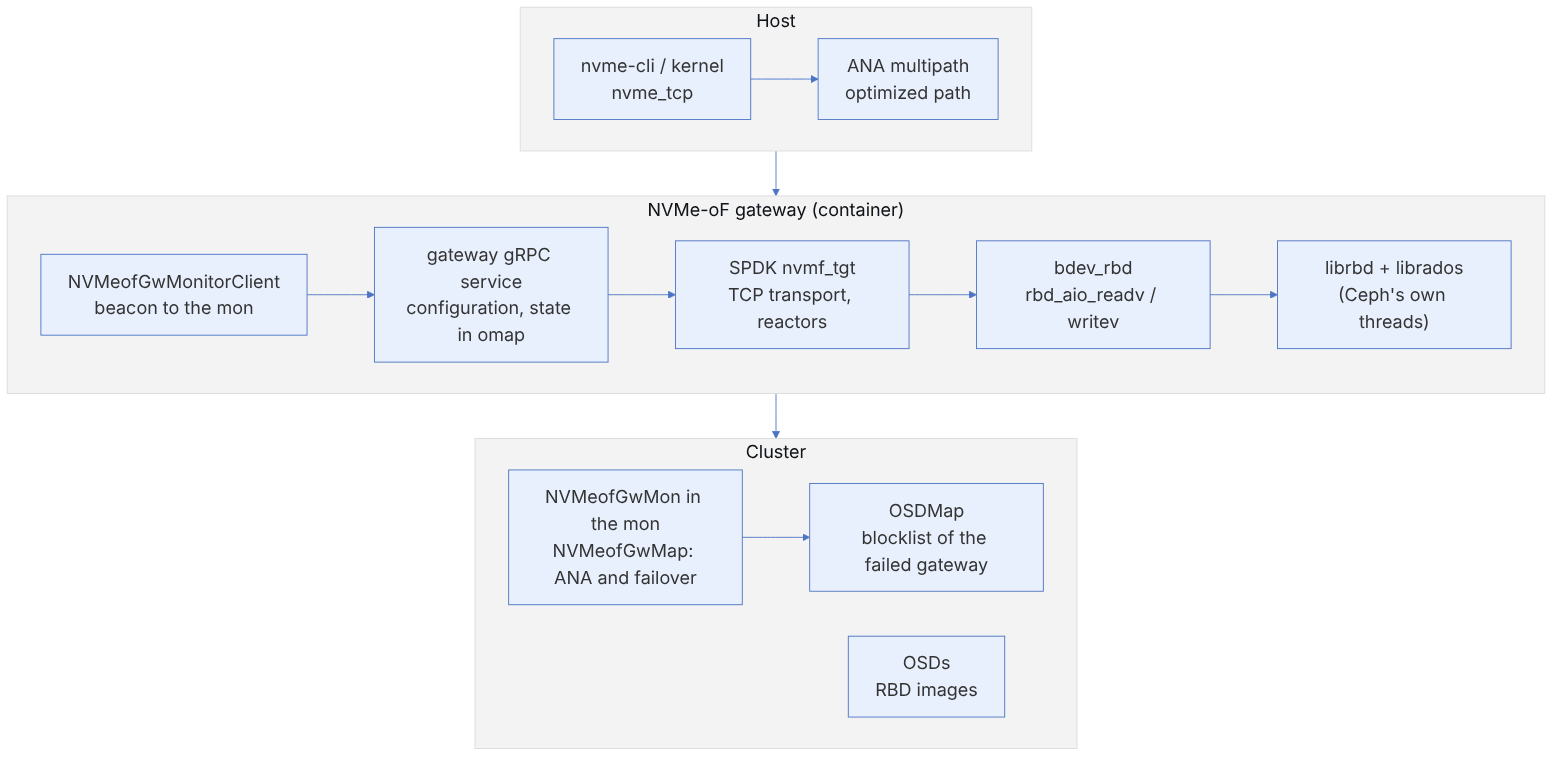
The Ceph documentation describes the gateway as an NVMe/TCP target that exports RBD images. Each gateway also runs a Discovery Controller. The scale figures the main documentation gives are: up to 4 gateway groups, 8 gateways per group, 128 subsystems per group, 32 hosts per subsystem and 1024 namespaces per group. The suggested minimum resources are 8 GB of memory and four processor threads per gateway instance.
Version-dependent. These limits are taken from the main documentation. The sample configuration of the ceph-nvmeof project's devel branch shows options such as max_subsystems = 128, max_namespaces = 4096 and max_gws_in_grp = 16. Before capacity planning, read the documentation of the version you are installing.
31-4-2 The path of a write from the host to the OSD#
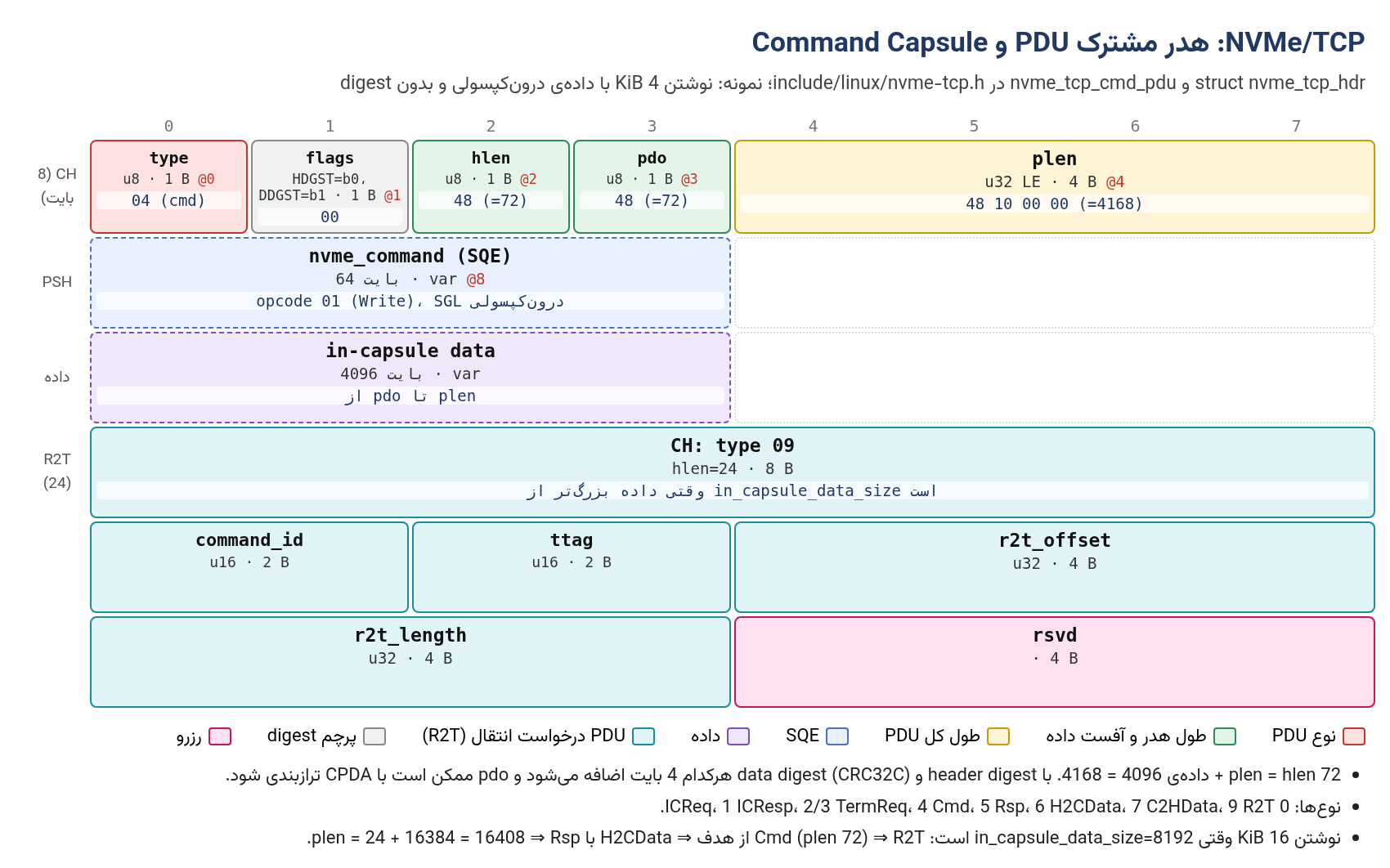
- 1. The host (
nvme_tcpin the kernel) sends a Command Capsule with the Write opcode. The gateway's sample configuration setsin_capsule_data_sizeto 8192, so a 4 KiB write fits in one PDU with plen=4168. - 2. The SPDK reactor polls the socket of that qpair, parses the PDU and hands the command to the bdev.
- 3.
bdev_rbdhands the request to librbd withrbd_aio_create_completionandrbd_aio_writev. From here the path is the librbd path (chapters 2 and 22): ObjectRequest, Objecter and MOSDOp. - 4. The librbd callback runs in librbd's own threads, not in the SPDK reactor.
bdev_rbd_io_completeusesspdk_thread_send_msgto return the completion to the submitting thread (submit_td), so that SPDK's single-threaded model is preserved. - 5. The reactor returns a Response Capsule.
Latency budget (a hypothetical example, 4 KiB, 25-gigabit network). The host-to-gateway round trip is about 20 to 40 microseconds, SPDK processing a few microseconds, two thread-boundary crossings (librbd to the reactor and back) a few microseconds, and the librbd path to the OSD and the replicas (usually 0.5 to 2 milliseconds in NVMe clusters). So the NVMe-oF gateway usually adds one extra network round trip to the direct krbd or librbd path. Its benefit is compatibility with hosts that have no Ceph client (for example VMware) and standard multipath, not lower latency.
31-4-3 ANA and failover in the mon#
For HA, NVMe-oF uses ANA (Asymmetric Namespace Access). Each namespace belongs to an ANA group (a load-balancing group). At any moment only one gateway is "optimized" for that group, and the rest are reported as "inaccessible". The host's multipath sends I/O only to the optimized path. The number of load-balancing groups equals the number of gateways in the group.
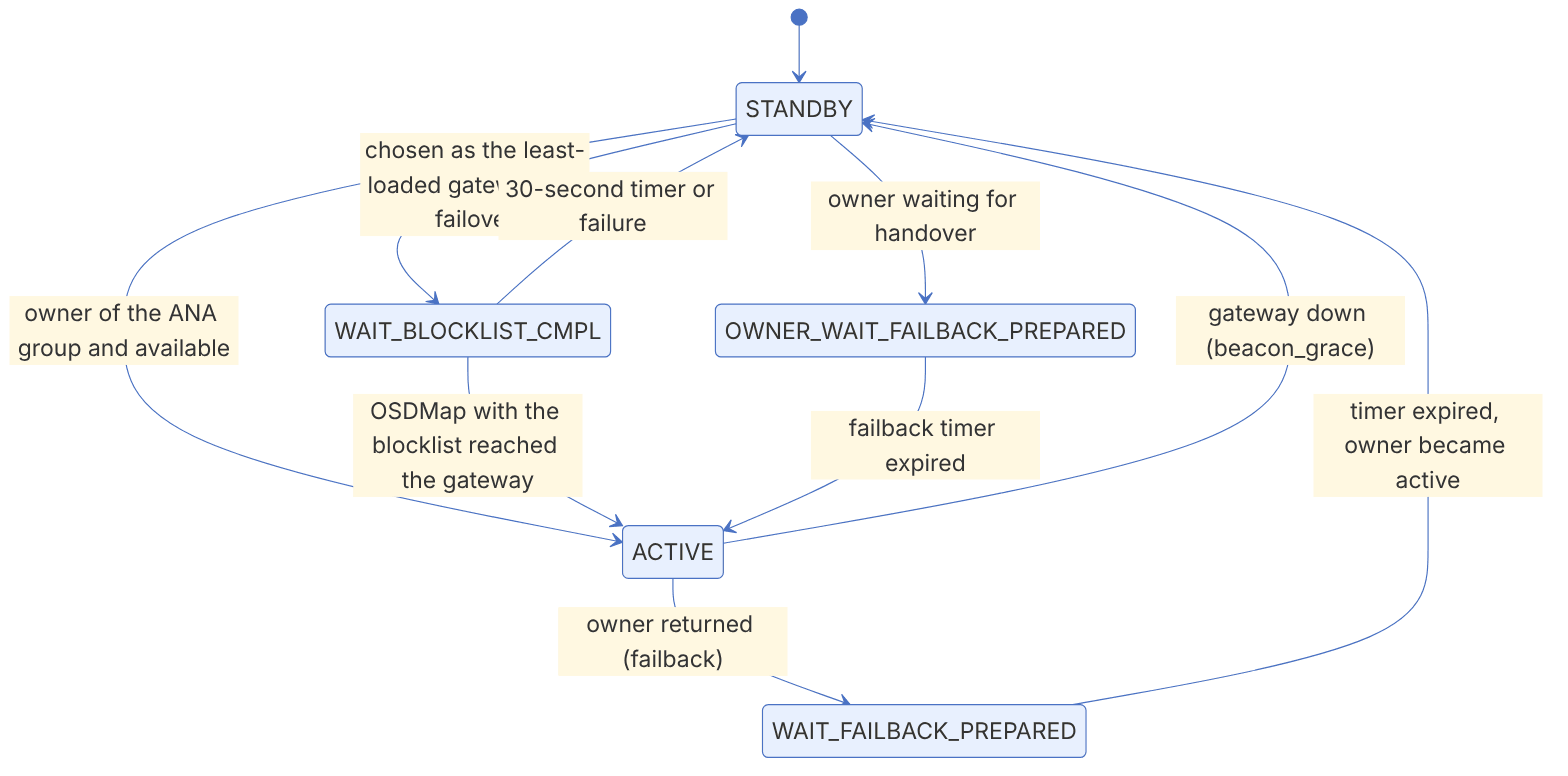
Why WAIT_BLOCKLIST_CMPL? Before gateway B takes over the group of failed gateway A, we must be sure that A (if it is only cut off from the mon and still alive) can no longer write to the RBD images. Otherwise two gateways would write to one namespace at the same time. set_failover_gw_for_ANA_group blocklists A's addresses in the OSDMap with blocklist_gw and keeps its epoch in blocklist_data[grp].osd_epoch. B becomes ACTIVE only when its beacon shows it has seen an OSDMap with an equal or larger epoch (fsm_handle_gw_alive). This is the same blocklist-fencing pattern we saw in RBD's exclusive lock and in rbd-mirror (chapters 2 and 18).
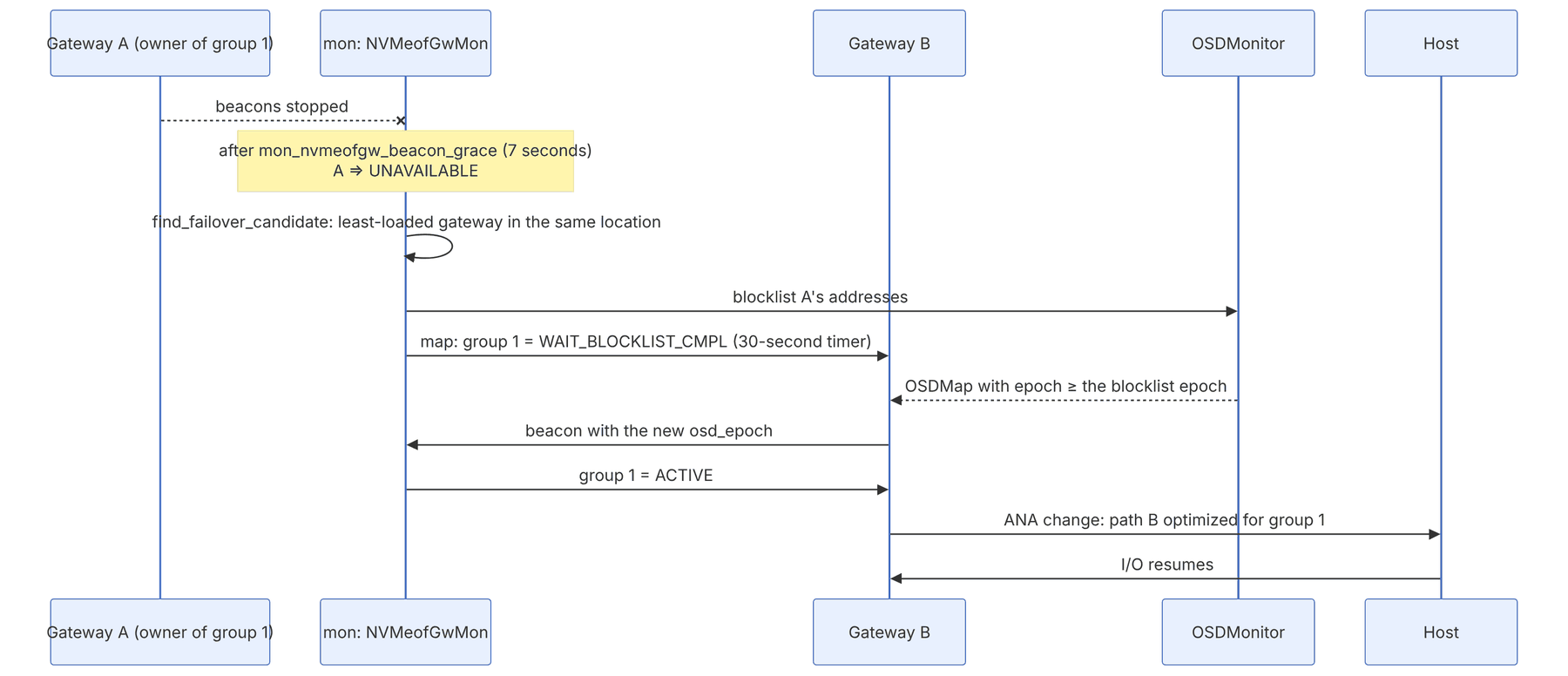
Source in code: src/mon/NVMeofGwMap.cc :: NVMeofGwMap::find_failover_candidate, find_failover_gw_logic
Complexity: O(G × A) for G gateways and A ANA groups
pseudocode
find_failover_gw_logic(gws, location, ignore_locations):
    best = none; best_load = 0xFFF; busy = 0
    for gw in gws (in id order):
        if not AVAILABLE or (not ignore_locations and gw.location ≠ location): continue
        if location(gw) in disaster: continue
        load = 0
        for grp in gw.sm_state:
            if state in {OWNER_WAIT_FAILBACK_PREPARED, WAIT_FAILBACK_PREPARED, WAIT_BLOCKLIST_CMPL}:
                load = 0xFFFF; busy += 1; break           # in transition: excluded
            if state == ACTIVE: load += 1
        if load < best_load: best, best_load = gw, load
    return best ? 0 : (busy ? -EBUSY : -ENOENT)
find_failover_candidate: first with the group's own location; if -ENOENT, with ignore_locations=true
Numerical example. We have a gateway group with four gateways in two locations: A and B in L1, and C and D in L2. The active ANA groups are: A={1}, B={2, 5}, C={3}, D={4}. A is lost, and group 1 is in L1. In the first round only B in L1 is available, with load 2, so B is chosen, even though C and D have less load. This decision is deliberate: the traffic stays in the same location. If B had been in WAIT_FAILBACK_PREPARED for another group at that moment, its load would have been 0xFFFF and the result of the first round -EBUSY. Because -EBUSY is different from -ENOENT, the second round does not run, and the failover is postponed until B's transition ends. If B had also failed (-ENOENT), the second round, between C and D (both with load 1), would choose the first in id order, that is C, because the comparison is strict (>).
| Option (mon.yaml.in, main) | Default | Meaning |
|---|---|---|
| mon_nvmeofgw_beacon_grace | 7 seconds | silence after which the gateway is declared failed |
| mon_nvmeofgw_skip_failovers_interval | 16 seconds | a period during which no failover is done in that pool and group |
| mon_nvmeofgw_beacons_till_ack | 15 | the number of beacons from MonClient before NVMeofGwMon sends an ack map |
| mon_nvmeofgw_max_down_gws | 1 | the ok-to-stop command checks that no more than this many gateways are down (preventing all of them from stopping during an upgrade) |
| mon_nvmeofgw_delete_grace | 15 minutes | after this time, the NVMEOF_GATEWAY_DELETING health warning is raised |
| mon_nvmeofgw_failback_delay | 0 | the failback delay after the owner comes back |
Calculating the I/O interruption during failover. In the worst case: 7 seconds until the failure is declared, plus the time of one Paxos proposal for the blocklist (usually under a second), plus the OSDMap reaching B and its next beacon. So the host must tolerate a few seconds, up to ten-odd seconds, of suspended I/O. The documentation recommends passing -l 1800 (ctrl-loss-tmo of 1800 seconds) to nvme connect-all so that the host does not give up the path in the meantime.
31-5 Practical commands#
# the gateway (main documentation)
ceph orch apply nvmeof POOL GROUP --placement="host01, host02"
ceph nvmeof subsystem add --nqn nqn.2016-06.io.spdk:cnode1
ceph nvmeof listener add --nqn nqn.2016-06.io.spdk:cnode1 --host-name host01 --traddr 10.0.0.11 --trsvcid 4420
ceph nvmeof namespace add --nqn nqn.2016-06.io.spdk:cnode1 --rbd-pool rbd --rbd-image-name vol1
ceph nvme-gw show POOL GROUP          # the ANA state of each gateway as the mon sees it
# the host
nvme discover -t tcp -a 10.0.0.11 -s 8009
nvme connect-all --traddr 10.0.0.11 --transport tcp -l 1800 -s 8009
nvme list-subsys                       # paths and ANA state (optimized/inaccessible)
# seeing NVMe commands in the kernel
bpftrace -e 'tracepoint:nvme:nvme_setup_cmd { @op[args->opcode] = count(); }'If host I/O stays suspended for more than a few tens of seconds after a gateway fails: (1) use ceph nvme-gw show to see whether the ANA group is stuck in WAIT_BLOCKLIST_CMPL; (2) check ceph osd blocklist ls to confirm the old gateway's address has been blocklisted; (3) make sure the OSDMonitor is writeable. CMonRequestProposal waits until the OSDMonitor becomes writeable, so a quorum problem directly stops the failover.
The documentation warns not to run ceph nvme-gw create and delete by hand on a cephadm-managed cluster: deleting a gateway immediately fails over its ANA groups. disable-ing all the gateways of a group cuts off NVMe-oF access to the namespaces.
31-6 Supplementary and up to date#
- The
ceph nvme-gw listenerscommand was added in Tentacle, according to the documentation. - In main, NVMeofGwMap has the concept of a location and a disaster state for a location (
cfg_set_location,cfg_location_disaster_set). The replacement is chosen first within the same location. Check this feature in your own version before using it. NVMeofGwBeaconConstants.hdefines two beacon versions: 1 (old, without diff) and 2 (with diff). The mon optioncfg_enable_disable_beacon_diffcontrols it.- In NVMEDevice,
register_ctrlruses only namespace number 1, andceph_assert(shared_driver_datas.empty())means only one SPDK device per OSD process.
31-7 Hands-on exercise#
- 1. For q_depth=8 and DSTRD=2, compute the offsets of the SQ and CQ doorbells of queue 5. (Answer: 0x1000 + 10×16 = 0x10A0 and 0x10B0)
- 2. Write the SQE of a 64 KiB write at offset 3 GiB with a 512-byte LBA: slba, NLB and the number of PRP list entries.
- 3. A 1 MiB write in NVMEDevice: compute the number of Tasks, commands and DMA buffers.
- 4. With bpftrace on the nvme_setup_cmd and nvme_complete_rq tracepoints, build the device latency distribution for an OSD during
rados bench. - 5. In a three-gateway group, stop one with
ceph orch daemon stopand follow the ANA state change innvme list-subsysandceph nvme-gw show.
31-8 Review questions#
- 1. Where are the SQ and CQ located, and who writes into each?
- 2. How does the Phase Tag identify a new CQE without reading a device register?
- 3. Why does the kernel defer the doorbell write until the end of a batch?
- 4. Why is the length field of a Read command zero-based, and what is its value for 8 blocks?
- 5. Why does NVMEDevice copy data into DMA buffers?
- 6. What are the benefit and the cost of the thread_local SharedDriverQueueData?
- 7. How does aio_submit in NVMEDevice differ from KernelDevice in terms of blocking?
- 8. Describe the path of a write from the host's nvme_tcp to the OSD, using the names of the bdev_rbd functions.
- 9. Why must the replacement gateway wait for the blocklist before becoming ACTIVE?
- 10. When does the replacement-gateway algorithm return -EBUSY, and when -ENOENT?
Answers to these questions are in Appendix E: Answers to Review Questions. Answers to this chapter's questions →
31-9 Sources for this chapter#
- The NVMe-oF gateway in the Ceph documentation
https://docs.ceph.com/en/latest/rbd/nvmeof-overview/ - Configuring the NVMe-oF target
https://docs.ceph.com/en/latest/rbd/nvmeof-target-configure/ - Gateway requirements
https://docs.ceph.com/en/latest/rbd/nvmeof-requirements/ - Using SPDK in BlueStore
https://docs.ceph.com/en/latest/rados/configuration/bluestore-config-ref/ - NVMEDevice code
https://github.com/ceph/ceph/blob/main/src/blk/spdk/NVMEDevice.cc - NVMeofGwMap code
https://github.com/ceph/ceph/blob/main/src/mon/NVMeofGwMap.cc - The ceph-nvmeof project
https://github.com/ceph/ceph-nvmeof - The Linux kernel NVMe driver
https://github.com/torvalds/linux/blob/master/drivers/nvme/host/pci.c - NVMe and NVMe/TCP structures
https://github.com/torvalds/linux/blob/master/include/linux/nvme.h - The bdev_rbd module in SPDK
https://github.com/spdk/spdk/blob/master/module/bdev/rbd/bdev_rbd.c - SPDK documentation
https://spdk.io/doc/ - The NVMe specifications
https://nvmexpress.org/specifications/